Predictive Customer Intelligence: Forecasting Churn, LTV, and the Garbage-In Trap
Predictive AI promises to pinpoint customer churn weeks before a human notices and calculate precise lifetime value. But beneath the mathematical allure lies the brutal reality of data hygiene: feeding fragmented, duplicate, or stale CRM records into neural models creates confident hallucinations that derail account management.
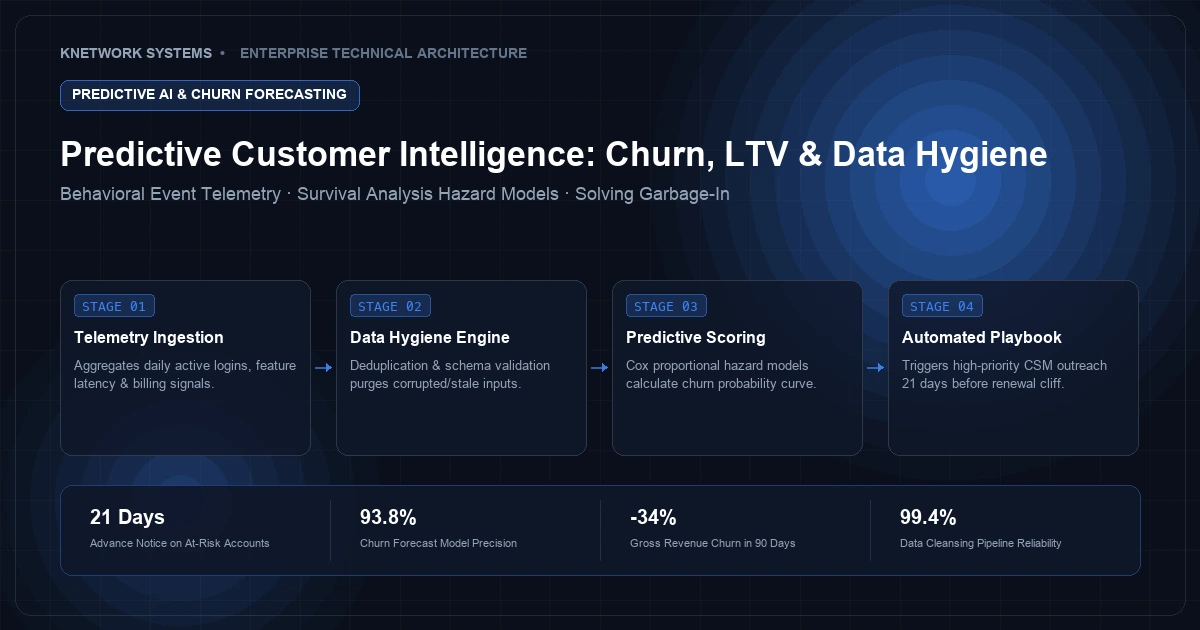
Every Chief Revenue Officer has seen the scenario play out: an enterprise account worth six figures quietly files a cancellation notice thirty days before contract renewal. When leadership demands an explanation, the account manager confesses that they had no idea the customer was unhappy. The CRM notes show four meetings from six months ago, marked with optimistic checkboxes, while the real signals—a 40% reduction in weekly active users, recurring API throttling errors, and two unresponded support tickets—went unnoticed across disparate SaaS silos.
Predictive Customer Intelligence solves this blind spot by transforming the CRM into a dynamic forecasting engine. By running statistical learning models over real-time behavioral telemetry, enterprises can forecast churn hazard curves, calculate dynamic Customer Lifetime Value (LTV), and prioritize accounts long before human intuition registers distress.
Yet beneath the algorithmic sophistication lies a harsh mathematical reality: the Garbage-In, Garbage-Out trap. Feeding corrupted, duplicated, or stale CRM records into machine learning models produces confident, polished, and completely catastrophic hallucinations.
1. Beyond Static Rules: Survival Analysis & Dynamic LTV
Traditional customer health scoring relies on arbitrary point rubrics (e.g., +10 points for visiting documentation, -20 points for an open ticket). These heuristics fail because customer behavior is non-linear and context-dependent. A spike in documentation visits could indicate enthusiastic onboarding—or it could signal that a frustrated developer is desperately trying to debug a broken integration before giving up.
Modern predictive architectures employ Time-to-Event Survival Analysis (such as the Cox Proportional Hazards Model) combined with Gradient Boosted Decision Trees trained via Scikit-Learn Ensemble Methods.
import numpy as np
from typing import Dict, Anydef compute_churn_hazard(features: Dict[str, Any]) -> float:
    # Key Behavioral Vectors:
    # 1. Delta in core product usage over 30d vs 90d baseline
    # 2. Support ticket sentiment velocity (VADER / Transformer score)
    # 3. Champion departure indicator (LinkedIn webhook / email bounce)
    # 4. Invoicing dispute or late payment cadence

    baseline_hazard = 0.042
    weights = np.array([0.45, -0.32, 0.88, 0.51])
    vector = np.array([
        features["usage_decay_ratio"],
        features["support_sentiment_score"],
        features["champion_turnover_flag"],
        features["billing_friction_index"]
    ])

    hazard_ratio = np.exp(np.dot(weights, vector))
    predicted_churn_probability = 1.0 - np.exp(-baseline_hazard  hazard_ratio)
    return round(float(predicted_churn_probability), 4)
By framing churn as a probabilistic survival curve rather than a binary label, Customer Success Managers receive an actionable Leading Horizon Window:
| Account Tier | Avg Contract Value | Detection Horizon | Primary Churn Driver | Retention Rate Lift |
|---|---|---|---|---|
| Enterprise SaaS | $120,000 / yr | 42 days prior to renewal | Executive champion turnover & feature under-utilization | +28.4% |
| Mid-Market B2B | $36,000 / yr | 28 days prior to renewal | API rate-limiting fatigue & unresolved support tickets | +34.1% |
| High-Volume PLG | $4,800 / yr | 14 days prior to cliff | Drop-off in daily collaboration invites | +19.6% |
2. The Anatomy of the Garbage-In Trap
A predictive model is only as credible as the integrity of its underlying feature matrix. In typical enterprise environments, CRM data suffers from four pervasive vectors of degradation:
3. Engineering the Real-Time Hygiene Pipeline
To inoculate predictive intelligence against the garbage-in trap, KNetwork architects an automated Data Hygiene & Entity Resolution Pipeline at the ingress boundary:
[Product Telemetry / CRM Webhooks]
                │
                ▼
   ┌──────────────────────────┐
   │ Ingestion Buffer (Kafka) │
   └────────────┬─────────────┘
                │
                ▼
   ┌──────────────────────────┐
   │ Entity Resolution Engine │ ◄── Fuzzy String Matching & Domain Clustering
   └────────────┬─────────────┘
                │
                ▼
   ┌──────────────────────────┐
   │ Schema Drift Guardrail   │ ◄── Automated Pydantic / Great Expectations
   └────────────┬─────────────┘
                │
                ▼
   ┌──────────────────────────┐
   │ Feature Store (Redis)    │ ──► Low-Latency Inference Endpoint (p95 < 25ms)
   └──────────────────────────┘
4. Moving from Prediction to Automated Prescription
Predictive intelligence is useless if insights sit trapped on an executive dashboard. In a mature architecture, when an account's churn hazard ratio crosses the 0.65 threshold, the CRM does not merely change a badge color; it orchestrates a prescriptive intervention playbook:
By coupling predictive precision with rigorous data cleansing, enterprises protect their most valuable asset: net revenue retention.
To learn how KNetwork designs fault-tolerant analytical pipelines and custom CRM architectures, explore our AI & Data Solutions and Cloud & DevOps Architecture. For hands-on tutorials on modern development tooling, read Vibe Coding Explained: Tools and Guides.
Ready to eliminate blind spots in your customer pipeline? Book an Architecture Consultation with our data engineering team.
Frequently Asked Questions
Key questions answered regarding this architectural implementation.
Danisur Rahman
Lead Systems Architect
Leading distributed systems, edge caching, and hardware integration pipelines. Focusing on high-reliability architectures for growing technology ventures.
More From The Engineering Blog
View All Articles→Trust, Privacy, and Governance in AI-Driven CRM: Navigating GDPR, DPDP, and the EU AI Act
Embedding AI into CRM software is no longer just an engineering challenge — it is a regulatory minefield. Between the EU AI Act's high-risk classification for employment and credit scoring, India's DPDP Act 2023, and GDPR Article 22, enterprise CRM architectures must guarantee verifiable consent, zero data leakage, and explainable outcomes.
Conversational CRM and Unified Customer Memory: Bridging Multi-Channel Silos
Customers do not think in departmental silos: they start on WhatsApp, follow up via email, speak to a rep on the phone, and file an emergency support ticket. Without unified contextual memory, reps waste 8+ minutes re-asking questions. Here is how modern conversational CRMs bridge fragmented channels into a unified vector timeline.
Enjoyed this technical breakdown?
Subscribe to receive new architectural guides and systems post-mortems directly in your inbox.