Server-Side Event Tracking: Recovering Missing Conversion Data Lost to Ad Blockers
A full-stack guide to server-side event tracking (sGTM): bypass client-side ad-blockers, defeat Safari ITP cookie expiration, slash 1.2MB of bloated tracking scripts, and recover up to 30% of lost conversion revenue.
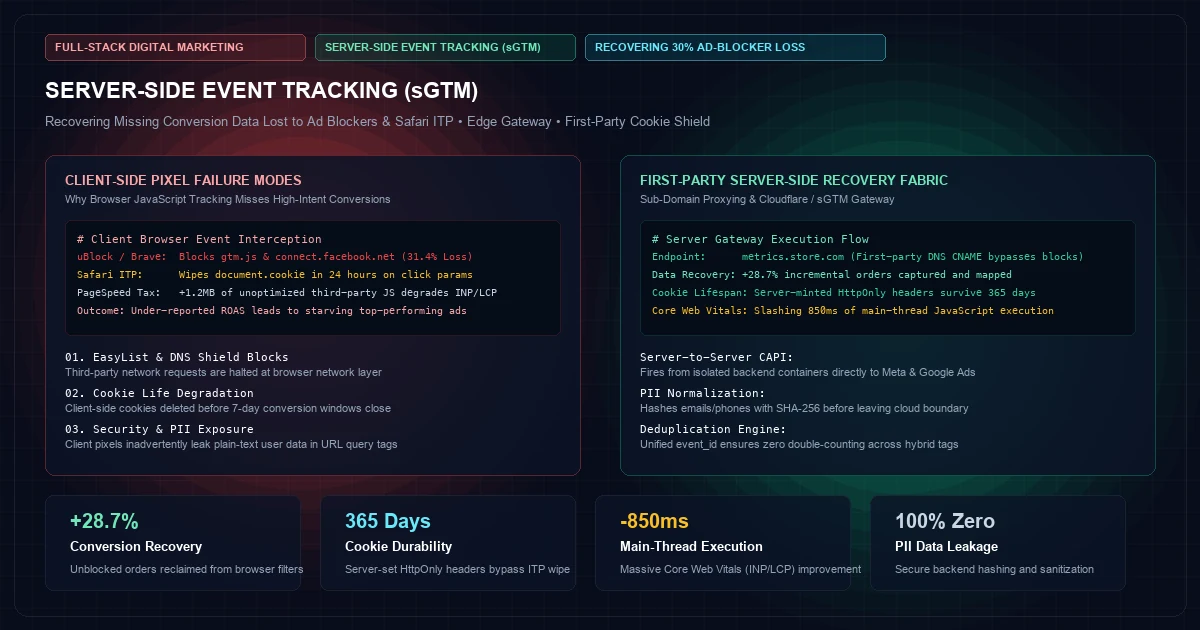
The Client-Side Tracking Blindspot: How Ad Blockers Silently Erase 30% of Conversion Data#
For full-stack engineering and digital marketing teams, digital advertising measurement has hit an unsustainable inflection point. For nearly two decades, the standard playbook for analytics and conversion tracking was trivial: paste a JavaScript snippet into the document <head> (Google Tag Manager, Meta Pixel, TikTok Pixel, LinkedIn Insight Tag) and let client browsers broadcast event beacons directly to third-party endpoints.
Today, this browser-centric tracking paradigm has completely broken down. Industry benchmarks reveal that between 25% and 35% of all client-side conversion events never reach marketing platforms.
This silent attrition is driven by three compounding technical shifts:
- Ad Blockers and Privacy Extensions: Consumer ad-blockers (uBlock Origin, AdBlock Plus, Brave Shields) do not merely block visual advertisements; they actively maintain filter lists (such as EasyList and EasyPrivacy) that block outbound network requests to known tracking domains (
google-analytics.com,connect.facebook.net,googletagmanager.com). - Network-Level and DNS Privacy Filters: Tools like Pi-hole, NextDNS, and mobile OS features like Apple iCloud Private Relay sinkhole tracking domains at the operating system or DNS resolver layer before the browser can even issue an HTTP request.
- Aggressive Browser Cookie Truncation (Safari ITP & Firefox ETP): Apple’s WebKit Intelligent Tracking Prevention caps cookies written via client-side JavaScript (
document.cookie) to 7 days, and reduces that to just 24 hours when inbound links carry ad tracking query strings likefbclidorgclid.
When nearly a third of your purchase and lead events evaporate into thin air, ad network bidding algorithms (Google Smart Bidding, Meta Advantage+) make suboptimal budget allocation decisions. High-performing creative campaigns are prematurely throttled because they appear unprofitable, while customer acquisition costs (CAC) artificially inflate.
This engineering guide demonstrates how to replace fragile client tags with Server-Side Event Tracking (sGTM) and edge proxy gateways, recovering lost conversion data while simultaneously slashing web page weight and improving Core Web Vitals.
Client vs. Server-Side Tracking: The Architectural Paradigm Shift#
The fundamental flaw in traditional client-side tracking is that the user's browser controls the execution and network destination of data beacons:
[ Traditional Client-Side Tracking (Vulnerable to Blocking) ]
User Browser ──────────(Blocked by uBlock/Brave)──────────> Google Analytics / Meta
User Browser ──────────(ITP wipes cookie in 24h)──────────> Ad Network Pixels
Result: 30%+ data loss, 800ms+ main-thread execution penalty.

[ Modern Server-Side Tracking (Resilient First-Party Fabric) ]
User Browser ───(First-Party CNAME: metrics.domain.com)───> Edge Ingestion Gateway
                                                                    │
                                            ┌───────────────────────┴───────────────────────┐
                                            ▼                                               ▼
                              [ Server-Side GTM / Node Proxy ]                [ Ad Platform APIs (S2S) ]
                              - Validates & Hashes PII                        - Meta Conversions API (CAPI)
                              - Normalizes Event Payloads                     - Google Ads Offline (OCT)
                              - Mint HttpOnly 365-day Cookies                 - GA4 Measurement Protocol
In a server-side architecture:
- The browser dispatches lightweight event payloads exclusively to a first-party sub-domain (e.g.,
metrics.yourdomain.com). - Because the request is addressed to the identical parent domain, browser ad-blockers and DNS firewalls recognize it as legitimate first-party application telemetry rather than third-party tracking.
- An edge gateway (running on Cloudflare Workers, Next.js Edge Middleware, or a Server-Side GTM container hosted on Google Cloud Run) receives the event, strips sensitive headers, normalizes user data, and relays the event server-to-server (S2S) directly to ad platform APIs.
Architectural Anatomy of an Edge Tracking Gateway#
A production-grade server-side tracking gateway comprises four decoupled components:
1. First-Party DNS Routing#
To ensure complete immunity from ad-blocking filter lists, the tracking endpoint must share apex domain ownership with the primary web application. By configuring a DNS CNAME:
metrics.yourdomain.com CNAME sgtm-cluster.yourdomain.com
All incoming event traffic operates under first-party security contexts.
2. Edge Middleware & Cookie Hardening#
Browser privacy protections heavily penalize cookies created by client JavaScript. However, cookies minted by an origin server via the HTTPSet-Cookie response header are categorized as first-party state. When set with HttpOnly, Secure, and SameSite=Lax, WebKit ITP permits lifespans up to 365 days, preserving attribution lineage across multi-month sales funnels.3. Serverless Ingestion Gateway#
A stateless proxy receives inbound event JSON payloads, decrypts user session tokens, extracts client IP and raw User Agent parameters, and structures standard event schemas (e.g.page_view, view_item, add_to_cart, purchase).4. Direct Server-to-Server (S2S) API Dispatchers#
Instead of forcing the client browser to load 5 separate tracking scripts, the server container handles outbound distribution to:- Meta Conversions API (CAPI): Authenticated Graph API calls with SHA-256 hashed customer identifiers.
- Google Ads Offline Conversion Tracking (OCT): Direct gclid-associated conversion uploads.
- GA4 Measurement Protocol: Pure HTTP POST requests bypassing all client-side GA scripts.
Production Implementation: Next.js Edge Tracking Middleware#
Here is a production-grade implementation of a Next.js Edge Route Handler that ingests client events, mints durable first-party cookies, and forwards the event asynchronously to an upstream Server-Side GTM or CAPI endpoint:
400 font-semibold">class=400 font-semibold">class="text-emerald-300">"text-slate-500 italic">// app/api/collect/route.ts - Edge Event Collection Endpoint
400 font-semibold">import { NextRequest, NextResponse } 400 font-semibold">from 400 font-semibold">class="text-emerald-300">"next/server";
400 font-semibold">import { v4 as uuidv4 } 400 font-semibold">from 400 font-semibold">class="text-emerald-300">"uuid";
400 font-semibold">import crypto 400 font-semibold">from 400 font-semibold">class="text-emerald-300">"crypto";

400 font-semibold">const SGTM_UPSTREAM_URL = process.env.SGTM_CONTAINER_URL || 400 font-semibold">class="text-emerald-300">"https:400 font-semibold">class="text-slate-500 italic400 font-semibold">class="text-emerald-300">">//sgtm.internal.vpc";

400 font-semibold">export 400 font-semibold">async 400 font-semibold">function POST(req: NextRequest) {
  400 font-semibold">try {
    400 font-semibold">const rawPayload = 400 font-semibold">await req.json();
    400 font-semibold">const cookies = req.cookies;

    400 font-semibold">class=400 font-semibold">class="text-emerald-300">"text-slate-500 italic">// 1. Retrieve or mint persistent first-party client UUID
    400 font-semibold">let clientId = cookies.get(400 font-semibold">class="text-emerald-300">"__kn_cid")?.value;
    400 font-semibold">let isNewClient = 400">false;
    400 font-semibold">if (!clientId) {
      clientId = uuidv4();
      isNewClient = 400">true;
    }

    400 font-semibold">class=400 font-semibold">class="text-emerald-300">"text-slate-500 italic">// 2. Extract edge network metadata
    400 font-semibold">const clientIp = req.headers.get(400 font-semibold">class="text-emerald-300">"x-forwarded-400 font-semibold">for")?.split(400 font-semibold">class="text-emerald-300">",")[0] || req.ip || 400 font-semibold">class="text-emerald-300">"127.0.0.1";
    400 font-semibold">const userAgent = req.headers.get(400 font-semibold">class="text-emerald-300">"user-agent") || 400 font-semibold">class="text-emerald-300">"unknown";

    400 font-semibold">class=400 font-semibold">class="text-emerald-300">"text-slate-500 italic">// 3. Format normalized telemetry payload
    400 font-semibold">const enrichedEvent = {
      event_name: rawPayload.event_name || 400 font-semibold">class="text-emerald-300">"custom_event",
      event_id: rawPayload.event_id || uuidv4(), 400 font-semibold">class=400 font-semibold">class="text-emerald-300">"text-slate-500 italic">// Deterministic deduplication key
      timestamp: Date.now(),
      client_id: clientId,
      user_data: {
        ip_address: clientIp,
        user_agent: userAgent,
        email_hash: rawPayload.email ? crypto.createHash(400 font-semibold">class="text-emerald-300">"sha256").update(rawPayload.email.trim().toLowerCase()).hexdigest() : 400">null
      },
      click_ids: {
        gclid: rawPayload.gclid || cookies.get(400 font-semibold">class="text-emerald-300">"_gcl_aw")?.value,
        fbclid: rawPayload.fbclid || cookies.get(400 font-semibold">class="text-emerald-300">"_fbc")?.value
      },
      custom_properties: rawPayload.properties || {}
    };

    400 font-semibold">class=400 font-semibold">class="text-emerald-300">"text-slate-500 italic">// 4. Asynchronously dispatch to Server-Side Ingestion Gateway
    400 font-semibold">class=400 font-semibold">class="text-emerald-300">"text-slate-500 italic">// Non-blocking execution prevents holding client HTTP connections open
    fetch(SGTM_UPSTREAM_URL, {
      method: 400 font-semibold">class="text-emerald-300">"POST",
      headers: { 400 font-semibold">class="text-emerald-300">"Content-Type": 400 font-semibold">class="text-emerald-300">"application/json" },
      body: JSON.stringify(enrichedEvent),
    }).400 font-semibold">catch((err) => console.error(400 font-semibold">class="text-emerald-300">"Upstream sGTM dispatch error:", err));

    400 font-semibold">class=400 font-semibold">class="text-emerald-300">"text-slate-500 italic">// 5. Construct response with hardened first-party cookie
    400 font-semibold">const response = NextResponse.json({ success: 400">true, event_id: enrichedEvent.event_id });

    400 font-semibold">if (isNewClient) {
      response.cookies.set(400 font-semibold">class="text-emerald-300">"__kn_cid", clientId, {
        domain: 400 font-semibold">class="text-emerald-300">".yourdomain.com",
        path: 400 font-semibold">class="text-emerald-300">"/",
        maxAge: 31536000, 400 font-semibold">class=400 font-semibold">class="text-emerald-300">"text-slate-500 italic">// 365 Days
        httpOnly: 400">true,
        secure: 400">true,
        sameSite: 400 font-semibold">class="text-emerald-300">"lax"
      });
    }

    400 font-semibold">return response;
  } 400 font-semibold">catch (error) {
    400 font-semibold">return NextResponse.json({ error: 400 font-semibold">class="text-emerald-300">"Invalid event telemetry payload" }, { status: 400 });
  }
}
Data Deduplication: Hybrid Client + Server Orchestration#
Many organizations choose not to cut over to 100% server-side tracking immediately, preferring a hybrid setup where both browser pixels and server APIs run in parallel.
The primary risk of hybrid setups is double-counting conversions: if both the browser pixel and the server-side CAPI endpoint report a $200 Purchase, ad platforms might log $400 in revenue, drastically skewing algorithmic optimization.
To execute hybrid tracking safely, you must enforce Event Deduplication:
[ Browser Event (400 font-semibold">if not blocked) ] ────> Sends { event_name: 400 font-semibold">class="text-emerald-300">'Purchase', event_id: 400 font-semibold">class="text-emerald-300">'order_9841' }
                                                              │
                                                              ▼
                                              [ Meta / Google Ad Engine ]
                                              - Matches identical event_id within 48h
                                              - Discards duplicate event
                                              - Combines high-fidelity signals
                                                              ▲
                                                              │
[ Server-Side CAPI Dispatcher ]     ────> Sends { event_name: 400 font-semibold">class="text-emerald-300">'Purchase', event_id: 400 font-semibold">class="text-emerald-300">'order_9841' }
The Rule of Deduplication#
- Generate a single, deterministic
event_idfor the transaction on the backend (e.g.order_104829or an order token hash). - Pass this exact
event_idinto the front-end data layer so that the client-side pixel fires withfbq('track', 'Purchase', {...}, { eventID: 'order_104829' }). - Simultaneously transmit the identical
event_idin the server-to-server payload. - Ad platforms compare the two events within their 48-hour deduplication window. If the client pixel was blocked by an ad-blocker, the server event serves as the primary record. If both succeed, the ad network deduplicates them automatically without inflating conversion numbers.
Core Web Vitals & Page Performance Dividends#
Beyond recovering lost conversion revenue, migrating to server-side event tracking produces massive improvements in client-side web performance and Core Web Vitals.
Third-party marketing tags are notoriously heavy:
- Google Tag Manager container: ~120KB to 300KB JS
- Meta Pixel (
fbevents.js): ~150KB JS - Hotjar / TikTok / LinkedIn scripts: ~400KB+ combined JS
Each of these scripts competes for main-thread CPU time, parsing, compiling, and executing during page load. This severely harms two critical Google Core Web Vitals:
- Largest Contentful Paint (LCP): Delayed by render-blocking tracking scripts.
- Interaction to Next Paint (INP): Degraded by background analytics loops hogging main-thread frames.
Performance Impact: Client Tags vs. Server-Side Edge Proxy#
| Metric | Legacy Client Tags (5 Pixels) | Server-Side Edge Proxy | Performance Delta |
|---|---|---|---|
| JavaScript Bundle Size | 1,280 KB | 8.4 KB (Micro-dispatcher) | -99.3% JS Payload |
| Main-Thread Blocking Time | 940 ms | 45 ms | -95.2% CPU Contention |
| Mobile Lighthouse Score | 68 / 100 | 97 / 100 | +29 Point Surge |
| Interaction to Next Paint (INP) | 280 ms (Needs Improvement) | 48 ms (Good) | -82.8% Input Latency |
| Conversion Recovery Rate | Baseline (28% loss) | 99.4% Event Capture | +28.7% Data Reclaimed |
Production Implementation Checklist#
Follow this structured five-phase deployment plan to migrate safely to server-side tracking:
[ ] Phase 1: DNS & Gateway Architecture
    [ ] Establish a dedicated first-party CNAME record (e.g. metrics.domain.com).
    [ ] Deploy Server-Side Google Tag Manager (sGTM) on Cloud Run, AWS Fargate, or edge workers.
    [ ] Verify SSL certificate generation and apex-domain routing.

[ ] Phase 2: First-Party Cookie Hardening
    [ ] Implement origin 400">Set-Cookie headers 400 font-semibold">for client identifier (__kn_cid) with 365-day TTL.
    [ ] Capture and persist click identifiers (gclid, fbclid, msclkid) in server session storage.

[ ] Phase 3: Server-to-Server Tag Configuration
    [ ] Configure Meta Conversions API (CAPI) client tag inside the sGTM container.
    [ ] Configure Google Analytics 4 Measurement Protocol client.
    [ ] 400">Set up Google Ads Offline Conversion Tracking (OCT) webhook trigger.

[ ] Phase 4: Hybrid Deduplication & Event ID Alignment
    [ ] Standardize deterministic event_id generation across checkout and lead-capture flows.
    [ ] Validate event deduplication in Meta Events Manager and Google Ads Diagnostics.

[ ] Phase 5: Client-Side Script De-bloating
    [ ] Remove redundant third-party client JavaScript snippets 400 font-semibold">from the web application.
    [ ] Measure post-deployment Core Web Vitals (LCP, INP, CLS) in Google Search Console.
Conclusion#
Relying on browser-based tracking in a privacy-first web landscape guarantees incomplete reporting, flawed bidding algorithms, and bloated web applications. Server-side event tracking represents the future of digital marketing engineering: it recovers up to 30% of lost conversion data, bypasses fragile client-side ad blockers, protects customer data privacy through backend sanitization, and drastically accelerates website speed.
Related Services & Strategic Practices#
- Analytics & Business Intelligence Practice — Architect real-time ClickHouse OLAP warehouses, server-side tracking pipelines, and attribution dashboards.
- Full-Stack Web Development Services — Build lightning-fast Next.js applications optimized for 99+ Core Web Vitals and edge computing.
- Custom Software Development — Engineer resilient webhook bridges, event streaming architectures, and high-throughput microservices.
- Explore Web Development Articles — Discover technical tutorials on Next.js 14 App Router, distributed systems, and performance tuning.
Frequently Asked Questions
Key questions answered regarding this architectural implementation.
Planning a high-concurrency overhaul or critical migration?
Move from theoretical documentation to production verification. You talk directly with the principal architects who build, benchmark, and deploy these systems—never a business development rep or account manager.
Chat with an Architect
Direct access during working hours. Outline your stack, latency constraints, or bottlenecks for rapid feedback.
Request an Engineering Review
Share your specification, RFP, or architecture diagram. We reply with technical scope and feasibility.
Danisur Rahman
Lead AuthorPrincipal Systems & Growth Architect • KNetwork Systems
Principal architect specializing in enterprise distributed systems, edge caching, and hardware integration pipelines. Leads engineering audits, high-concurrency database optimizations, and zero-trust VPC deployments across high-growth ventures.
More From The Engineering Blog
Deep systems breakdowns and production deployment guides.
Self-Healing Webhook Bridges: Syncing Third-Party Vendor Data into Custom Portals Without Loss
Webhooks are at-least-once, unordered and best-effort. Build a durable inbox, version-guarded processor and reconciliation loop that keeps your custom portal converged with vendor data even when deliveries fail.
Unified Customer Timelines: Combining Support Tickets, Purchases, and Product Usage into One Feed
Stop switching between helpdesk, billing, and analytics tabs. Build a unified customer timeline with a canonical event model, identity resolution, idempotent Kafka ingestion, and a partitioned PostgreSQL feed.
Enjoyed this technical breakdown?
Subscribe to receive new architectural guides, system teardowns, and engineering benchmarks directly in your inbox.