The Transactional Outbox Pattern: Reliable Event Publishing via Debezium CDC
Eliminate the dual-write problem in distributed microservices: Atomic database commits, PostgreSQL WAL change data capture, Debezium Outbox Event Router SMT, and idempotent consumers.
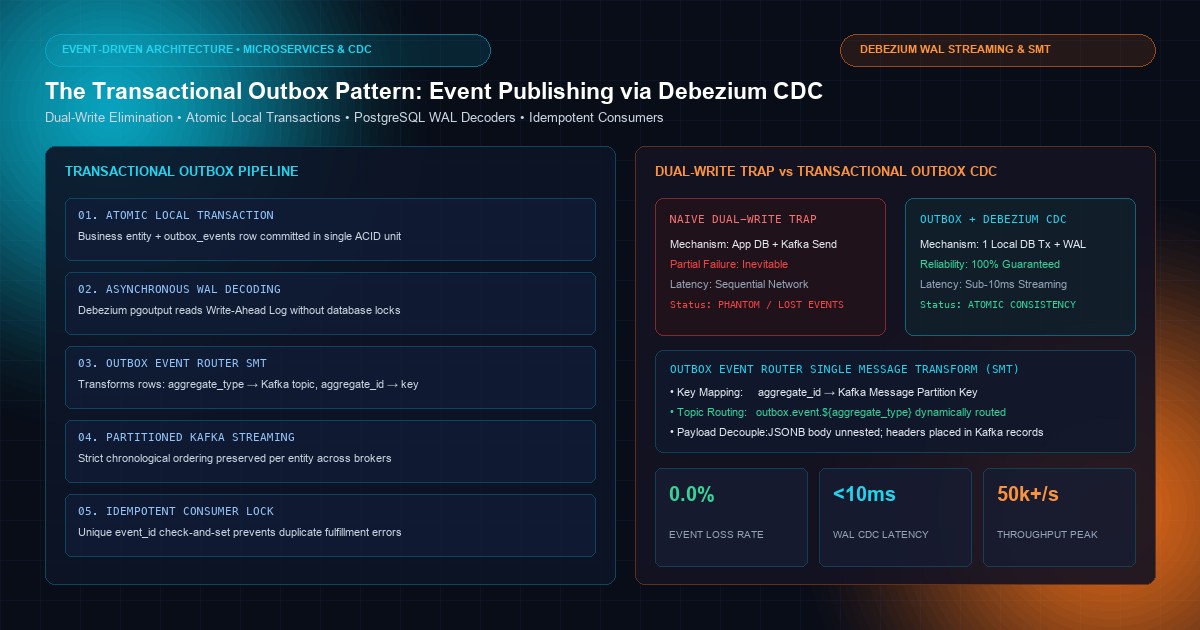
In distributed microservice architectures, one of the most persistent and insidious failure modes is the Dual-Write Problem.
Consider an enterprise e-commerce platform processing a customer checkout. The OrderService must accomplish two discrete tasks:
- Insert the new order record into its local PostgreSQL database (
INSERT INTO orders ...). - Publish an
OrderCreatedevent to an Apache Kafka topic to trigger downstream inventory reservation, fraud scoring, and payment gateway capture.
In naive implementations, developers write application code that executes both operations sequentially:
400 font-semibold">class=400 font-semibold">class="text-emerald-300">"text-slate-500 italic"># The Naive Dual-Write Trap
400 font-semibold">def process_order(order_data):
    db.session.add(Order(order_data))
    db.session.commit() 400 font-semibold">class=400 font-semibold">class="text-emerald-300">"text-slate-500 italic"># Step 1: Database Commit

    kafka_producer.send(400 font-semibold">class="text-emerald-300">"orders.events", order_data) 400 font-semibold">class=400 font-semibold">class="text-emerald-300">"text-slate-500 italic"># Step 2: Message Publish
Under low traffic, this code appears functional. But under real-world cloud conditions, distributed failure is inevitable:
- If the database commit succeeds but the network to the Kafka broker glitches or the container crashes before
kafka_producer.send()executes, the order exists in the database, but downstream fulfillment never occurs (Data Desynchronization). - If the engineer inverts the order—publishing to Kafka first, then committing to the database—the message broker receives the event, but if a subsequent database constraint or deadlock rolls back the SQL transaction, downstream services charge the customer for an order that does not exist (Phantom Processing).
Distributed two-phase commits (XA transactions) across heterogenous datastores are widely recognized as an anti-pattern: they impose blocking row locks, lack native broker support, and destroy horizontal throughput.
The definitive architectural solution for reliable event publishing is the Transactional Outbox Pattern, powered by Change Data Capture (CDC) using Debezium.
At KNetwork's Custom Software Development practice, we engineer fault-tolerant event-driven backends for high-velocity fintech, supply chain, and commerce platforms. In this deep-dive guide, we dissect the failure physics of dual writes, formulate the Transactional Outbox architecture, configure Debezium's WAL log reader with the Outbox Event Router SMT, implement consumer idempotency, and benchmark performance under heavy transactional volume.
1. Anatomy of the Dual-Write Failure#
To understand why dual writes fail, we must analyze the transactional boundary of relational databases versus asynchronous message brokers:
┌────────────────────────────────────────────────────────────────────────┐
│ THE DUAL-WRITE DILEMMA: PARTIAL FAILURE WINDOWS                       │
└────────────────────────────────────────────────────────────────────────┘

 SCENARIO A: COMMIT SUCCEEDS, PUBLISH FAILS
 [Application Service] ──► (1) BEGIN TRANSACTION
          │            ──► (2) 400 font-semibold">INSERT INTO orders
          │            ──► (3) COMMIT (Success!)
          │
          └── (Crash / Network Timeout) ──► ❌ Kafka Broker (Never received)
          Result: Order exists in DB; downstream fulfillment never runs.

 SCENARIO B: PUBLISH SUCCEEDS, COMMIT FAILS
 [Application Service] ──► (1) kafka_producer.send(400 font-semibold">class="text-emerald-300">"OrderCreated") (Success!)
          │
          ├── (Database Deadlock / Unique Constraint Violation)
          └──► (2) ROLLBACK (Database reverts)
          Result: Downstream services charge customer 400 font-semibold">for a non-existent order.
In any system where mutations must cross two distinct network boundaries without a distributed transaction coordinator, partial failure is mathematically inevitable.
Network packets drop, TCP connections reset, JVM garbage collector pauses exceed socket timeouts, and cloud availability zones experience momentary partitions. Relying on application-level try/catch blocks with retries cannot solve the dilemma; a retry after a network timeout risks publishing duplicate messages or exhausting local memory buffers.
2. The Transactional Outbox Pattern: Mechanics & Architecture#
The Transactional Outbox Pattern resolves the dual-write problem by leveraging the database's native, ACID-compliant local transaction engine:
┌────────────────────────────────────────────────────────────────────────┐
│ THE TRANSACTIONAL OUTBOX ARCHITECTURE                                  │
└────────────────────────────────────────────────────────────────────────┘

 [Application Service]
          │
          │ (Single Local ACID Transaction)
          ▼
 ┌─────────────────────────────────────────────────┐
 │ PostgreSQL Database                             │
 │  ┌─────────────────┐       ┌──────────────────┐ │
 │  │ Business Table  │  AND  │  outbox_events   │ │
 │  │ (e.g. orders)   │       │  (Event Payload) │ │
 │  └─────────────────┘       └─────────┬────────┘ │
 └──────────────────────────────────────┼──────────┘
                                        │
                         Write-Ahead Log (WAL)
                                        │
                                        ▼
                         ┌─────────────────────────────┐
                         │ Debezium Kafka Connector    │
                         │ (Logical Replication Stream)│
                         └──────────────┬──────────────┘
                                        │
                                        ▼ (Asynchronous Publish)
                         ┌─────────────────────────────┐
                         │ Apache Kafka Cluster        │
                         │ Topic: 400 font-semibold">class="text-emerald-300">`orders.events`      │
                         └─────────────────────────────┘
2.1 The Core Protocol#
Instead of attempting to communicate directly with Kafka, the application performs both actions within a single local database transaction:- It inserts or updates the business domain entity (e.g.,
orders). - In the exact same transaction, it inserts a serialized event message into a dedicated table:
outbox_events. - If the transaction succeeds, both the order and the outbox event commit atomically. If the transaction fails, both roll back completely.
Once persisted, an independent relay mechanism extracts records from outbox_events and publishes them to Kafka.
3. Polling Publisher vs. Change Data Capture (CDC): The Architectural Trade-Off#
How does the outbox record move from the outbox_events table into the Kafka broker? There are two primary paradigms:
OUTBOX RELAY STRATEGY COMPARISON:

┌──────────────────────┬─────────────────────────┬─────────────────────────┐
│ Metric / Dimension   │ Polling Publisher       │ Log-Based CDC (Debezium)│
├──────────────────────┼─────────────────────────┼─────────────────────────┤
│ Ingestion Mechanism  │ Periodic 400 font-semibold">SELECT queries │ Tail PostgreSQL WAL     │
│ Database Overhead    │ High CPU & lock churn   │ Near-zero (asynchronous)│
│ Event Latency        │ Polling Interval (1-5s) │ Sub-10ms (Real-time)    │
│ Table Contention     │ Row locks via 400 font-semibold">UPDATE    │ Zero table locks        │
│ Scale Limit          │ ~1,000 writes/sec       │ 100,000+ writes/sec     │
│ Infrastructure       │ Custom background daemon│ Kafka Connect Cluster   │
└──────────────────────┴─────────────────────────┴─────────────────────────┘
3.1 The Failure of the Polling Publisher#
A naive approach is to deploy a background worker that executes:
400 font-semibold">SELECT * 400 font-semibold">FROM outbox_events 400 font-semibold">WHERE status = 400 font-semibold">class="text-emerald-300">'PENDING' FOR 400 font-semibold">UPDATE SKIP LOCKED LIMIT 100;
Under heavy production throughput, polling breaks down:
- Lock Contention: Constantly querying and updating
status = 'PROCESSED'induces heavy index churn, table bloat (MVCC dead tuples in PostgreSQL), and vacuum thrashing. - Latency Lag: Events are buffered until the next polling cycle, introducing seconds of artificial latency into real-time pipelines.
- CPU Waste: Polling empty tables consumes database compute and connection pool capacity unnecessarily.
3.2 The Superiority of Log-Based CDC (Debezium)#
Change Data Capture operates directly on the storage engine's Write-Ahead Log (WAL).When PostgreSQL commits a transaction, it writes the raw binary changes sequentially to the WAL before touching table data pages. Debezium connects as a logical replication client (using PostgreSQL’s native pgoutput plugin), reads committed mutations directly from the WAL stream, and publishes them to Kafka with sub-millisecond latency.
The database executes zero additional queries, acquires zero application table locks, and suffers zero read-after-write overhead.
4. Production Database Schema: The Outbox Table#
To support high-throughput CDC streaming and dynamic topic routing, the outbox_events table must be carefully structured.
4.1 PostgreSQL Schema Definition (outbox.sql)#
400 font-semibold">CREATE EXTENSION IF NOT EXISTS 400 font-semibold">class="text-emerald-300">"uuid-ossp";

400 font-semibold">CREATE 400 font-semibold">TABLE outbox_events (
    id UUID PRIMARY KEY DEFAULT gen_random_uuid(),
    aggregate_type VARCHAR(64) NOT NULL,
    aggregate_id VARCHAR(128) NOT NULL,
    event_type VARCHAR(128) NOT NULL,
    payload JSONB NOT NULL,
    headers JSONB DEFAULT 400 font-semibold">class="text-emerald-300">'{}'::jsonb,
    created_at TIMESTAMP WITH TIME ZONE DEFAULT clock_timestamp() NOT NULL
);

-- Optimize WAL extraction and partition cleanup
400 font-semibold">CREATE 400 font-semibold">INDEX idx_outbox_created_at ON outbox_events (created_at);
4.2 Why JSONB and Strict Partitioning#
payload: Stored as binary JSON (JSONB), allowing the application to persist arbitrary schema payloads while enabling database-level validation.aggregate_type: Identifies the domain root (e.g.,Order,Payment,CustomerAccount).aggregate_id: Represents the domain entity ID. Debezium uses this value as the Kafka message key, guaranteeing that all sequential events for the same order route to the exact same Kafka partition (preserving strict chronological ordering).
5. Debezium Configuration: The Outbox Event Router SMT#
By default, Debezium streams every raw column change from the table into a Kafka topic named <server>.<schema>.outbox_events. This exposes internal database metadata to consumers.
To transform outbox rows into clean, idiomatic cloud events, we use Debezium's built-in Outbox Event Router Single Message Transformation (SMT).
┌────────────────────────────────────────────────────────────────────────┐
│ OUTBOX EVENT ROUTER SINGLE MESSAGE TRANSFORMATION (SMT)               │
└────────────────────────────────────────────────────────────────────────┘

 [outbox_events row]
   id:             uuid-8899
   aggregate_type: 400 font-semibold">class="text-emerald-300">"Order"
   aggregate_id:   400 font-semibold">class="text-emerald-300">"ORD-9821"
   event_type:     400 font-semibold">class="text-emerald-300">"OrderCreated"
   payload:        {400 font-semibold">class="text-emerald-300">"total": 450.00, 400 font-semibold">class="text-emerald-300">"currency": 400 font-semibold">class="text-emerald-300">"USD"}
            │
            ▼ (Debezium Kafka Connect Engine)
   Outbox Event Router SMT
            │
            ├─► Extracts 400 font-semibold">class="text-emerald-300">`aggregate_id`   ──► Becomes Kafka Message Key
            ├─► Extracts 400 font-semibold">class="text-emerald-300">`payload`        ──► Becomes Kafka Message Value
            ├─► Extracts 400 font-semibold">class="text-emerald-300">`event_type`     ──► Added to Kafka Message Header
            │
            ▼
 [Target Kafka Topic: 400 font-semibold">class="text-emerald-300">`outbox.event.Order`]
5.1 Kafka Connect Connector Configuration (debezium-postgres-connector.json)#
{
  400 font-semibold">class="text-emerald-300">"name": 400 font-semibold">class="text-emerald-300">"knetwork-outbox-connector",
  400 font-semibold">class="text-emerald-300">"config": {
    400 font-semibold">class="text-emerald-300">"connector.400 font-semibold">class": 400 font-semibold">class="text-emerald-300">"io.debezium.connector.postgresql.PostgresConnector",
    400 font-semibold">class="text-emerald-300">"tasks.max": 400 font-semibold">class="text-emerald-300">"1",
    400 font-semibold">class="text-emerald-300">"plugin.name": 400 font-semibold">class="text-emerald-300">"pgoutput",
    400 font-semibold">class="text-emerald-300">"database.hostname": 400 font-semibold">class="text-emerald-300">"pg-primary.internal",
    400 font-semibold">class="text-emerald-300">"database.port": 400 font-semibold">class="text-emerald-300">"5432",
    400 font-semibold">class="text-emerald-300">"database.user": 400 font-semibold">class="text-emerald-300">"debezium_replicator",
    400 font-semibold">class="text-emerald-300">"database.password": 400 font-semibold">class="text-emerald-300">"VaultSecurePassword2026!",
    400 font-semibold">class="text-emerald-300">"database.dbname": 400 font-semibold">class="text-emerald-300">"production_commerce",
    400 font-semibold">class="text-emerald-300">"database.server.name": 400 font-semibold">class="text-emerald-300">"commerce_cluster",

    400 font-semibold">class="text-emerald-300">"table.include.list": 400 font-semibold">class="text-emerald-300">"400 font-semibold">public.outbox_events",
    400 font-semibold">class="text-emerald-300">"tombstones.on.delete": 400 font-semibold">class="text-emerald-300">"400">false",

    400 font-semibold">class="text-emerald-300">"transforms": 400 font-semibold">class="text-emerald-300">"outbox",
    400 font-semibold">class="text-emerald-300">"transforms.outbox.400 font-semibold">type": 400 font-semibold">class="text-emerald-300">"io.debezium.transforms.outbox.EventRouter",
    400 font-semibold">class="text-emerald-300">"transforms.outbox.route.by.field": 400 font-semibold">class="text-emerald-300">"aggregate_type",
    400 font-semibold">class="text-emerald-300">"transforms.outbox.route.topic.replacement": 400 font-semibold">class="text-emerald-300">"outbox.event.${routedByValue}",
    400 font-semibold">class="text-emerald-300">"transforms.outbox.table.fields.additional.placement": 400 font-semibold">class="text-emerald-300">"event_type:header:eventType,id:header:eventId",
    400 font-semibold">class="text-emerald-300">"transforms.outbox.table.op.invalid.behavior": 400 font-semibold">class="text-emerald-300">"error"
  }
}
5.2 Key Configuration Parameters Explained#
plugin.name: "pgoutput": Uses PostgreSQL's standard built-in logical decoding plugin, eliminating the need to compile third-party native libraries likedecoderbufs.route.by.field: "aggregate_type": Dynamically partitions output topics based on the aggregate type. An aggregate ofOrderautomatically routes to topicoutbox.event.Order.table.fields.additional.placement: Automatically maps the database event ID and event type into native Kafka Record Headers, keeping the message body pure and unpolluted by transport metadata.
6. End-to-End Code: Transactional Producer & Idempotent Consumer#
To guarantee end-to-end reliability, the system requires two software components: a transactional producer that writes to the outbox, and an idempotent consumer that processes events without duplicate side-effects.
6.1 Transactional Producer Implementation (TypeScript / Node.js)#
400 font-semibold">import { PoolClient } 400 font-semibold">from 400 font-semibold">class="text-emerald-300">"pg";

400 font-semibold">export 400 font-semibold">interface OrderPayload {
  orderId: 400">string;
  customerId: 400">string;
  amount: 400">number;
  currency: 400">string;
  items: 400">Array<{ sku: 400">string; quantity: 400">number }>;
}

400 font-semibold">export 400 font-semibold">async 400 font-semibold">function createOrderTransaction(
  client: PoolClient,
  order: OrderPayload
): 400">Promise<400">void> {
  400 font-semibold">try {
    400 font-semibold">class=400 font-semibold">class="text-emerald-300">"text-slate-500 italic">// 1. Begin atomic database transaction
    400 font-semibold">await client.query(400 font-semibold">class="text-emerald-300">"BEGIN TRANSACTION ISOLATION LEVEL READ COMMITTED");

    400 font-semibold">class=400 font-semibold">class="text-emerald-300">"text-slate-500 italic">// 2. Insert into primary domain table
    400 font-semibold">const insertOrderQuery = 400 font-semibold">class="text-emerald-300">`
      400 font-semibold">INSERT INTO orders (id, customer_id, total_amount, currency, status)
      VALUES ($1, $2, $3, $4, 'CREATED')
    `;
    400 font-semibold">await client.query(insertOrderQuery, [
      order.orderId,
      order.customerId,
      order.amount,
      order.currency,
    ]);

    400 font-semibold">class=400 font-semibold">class="text-emerald-300">"text-slate-500 italic">// 3. Atomically write to Outbox table
    400 font-semibold">const insertOutboxQuery = 400 font-semibold">class="text-emerald-300">`
      400 font-semibold">INSERT INTO outbox_events (
        aggregate_type,
        aggregate_id,
        event_type,
        payload
      ) VALUES ($1, $2, $3, $4)
    `;

    400 font-semibold">const eventPayload = JSON.stringify({
      orderId: order.orderId,
      customerId: order.customerId,
      amount: order.amount,
      currency: order.currency,
      items: order.items,
      timestamp: 400 font-semibold">new Date().toISOString(),
    });

    400 font-semibold">await client.query(insertOutboxQuery, [
      400 font-semibold">class="text-emerald-300">"Order",
      order.orderId,
      400 font-semibold">class="text-emerald-300">"OrderCreated",
      eventPayload,
    ]);

    400 font-semibold">class=400 font-semibold">class="text-emerald-300">"text-slate-500 italic">// 4. Commit atomic unit of work
    400 font-semibold">await client.query(400 font-semibold">class="text-emerald-300">"COMMIT");
    400 font-semibold">class=400 font-semibold">class="text-emerald-300">"text-slate-500 italic">// Both Order and Event are guaranteed to exist on disk in WAL!
  } 400 font-semibold">catch (error) {
    400 font-semibold">await client.query(400 font-semibold">class="text-emerald-300">"ROLLBACK");
    400 font-semibold">throw 400 font-semibold">new Error(400 font-semibold">class="text-emerald-300">`Order creation failed: ${(error as Error).message}`);
  }
}
6.2 The Consumer Problem: At-Least-Once Delivery#
Debezium guarantees At-Least-Once delivery. If a Kafka Connect task crashes or rebalances after publishing a message to Kafka but before committing its replication offset, it may replay the last few WAL events.Therefore, downstream microservices must implement Idempotent Consumption.
6.3 Idempotent Consumer Implementation (Python)#
400 font-semibold">import json
400 font-semibold">import psycopg2
400 font-semibold">from kafka 400 font-semibold">import KafkaConsumer

400 font-semibold">class IdempotentOrderConsumer:
    400 font-semibold">def __init__(self, db_conn, bootstrap_servers):
        self.db = db_conn
        self.consumer = KafkaConsumer(
            400 font-semibold">class="text-emerald-300">"outbox.event.Order",
            bootstrap_servers=bootstrap_servers,
            group_id=400 font-semibold">class="text-emerald-300">"inventory-service-group",
            enable_auto_commit=False, 400 font-semibold">class=400 font-semibold">class="text-emerald-300">"text-slate-500 italic"># Manual offset commit
            auto_offset_reset=400 font-semibold">class="text-emerald-300">"earliest"
        )

    400 font-semibold">def process_events(self):
        400 font-semibold">for message in self.consumer:
            headers = dict(message.headers)
            event_id = headers.get(b400 font-semibold">class="text-emerald-300">"eventId", b400 font-semibold">class="text-emerald-300">"").decode(400 font-semibold">class="text-emerald-300">"utf-8")
            event_type = headers.get(b400 font-semibold">class="text-emerald-300">"eventType", b400 font-semibold">class="text-emerald-300">"").decode(400 font-semibold">class="text-emerald-300">"utf-8")
            payload = json.loads(message.value.decode(400 font-semibold">class="text-emerald-300">"utf-8"))

            400 font-semibold">if not self._acquire_idempotency_lock(event_id):
                400 font-semibold">class=400 font-semibold">class="text-emerald-300">"text-slate-500 italic"># Duplicate event detected; acknowledge and skip
                self.consumer.commit()
                continue

            400 font-semibold">try:
                400 font-semibold">class=400 font-semibold">class="text-emerald-300">"text-slate-500 italic"># Execute business logic (e.g. reserve inventory)
                self._handle_business_logic(event_type, payload)

                400 font-semibold">class=400 font-semibold">class="text-emerald-300">"text-slate-500 italic"># Mark event as permanently processed
                self._mark_processed(event_id)
                self.consumer.commit()
            except Exception as e:
                self.db.rollback()
                400 font-semibold">class=400 font-semibold">class="text-emerald-300">"text-slate-500 italic"># Do not commit Kafka offset; message will be retried
                raise e

    400 font-semibold">def _acquire_idempotency_lock(self, event_id: str) -> bool:
        cursor = self.db.cursor()
        400 font-semibold">class=400 font-semibold">class="text-emerald-300">"text-slate-500 italic"># Atomic test-and-set using unique primary key constraint
        query = 400 font-semibold">class="text-emerald-300">""400 font-semibold">class="text-emerald-300">"
            400 font-semibold">INSERT INTO processed_events (event_id, processed_at)
            VALUES (%s, clock_timestamp())
            ON CONFLICT (event_id) DO NOTHING
            RETURNING event_id;
        "400 font-semibold">class="text-emerald-300">""
        cursor.execute(query, (event_id,))
        result = cursor.fetchone()
        400 font-semibold">return result is not None
7. Outbox Table Maintenance: Preventing Infinite Table Bloat#
In a system processing 20 million orders a month, the outbox_events table accumulates 20 million rows per month. Left unmanaged, the table will consume hundreds of gigabytes of disk space and degrade performance.
Because Debezium streams events from the WAL—and does not care whether rows remain in the physical table once read—the outbox table must be pruned continuously.
7.1 Automated Rolling Partitioning#
Implement native PostgreSQL range partitioning by day:
400 font-semibold">CREATE 400 font-semibold">TABLE outbox_events_partitioned (
    id UUID DEFAULT gen_random_uuid(),
    aggregate_type VARCHAR(64) NOT NULL,
    aggregate_id VARCHAR(128) NOT NULL,
    event_type VARCHAR(128) NOT NULL,
    payload JSONB NOT NULL,
    created_at DATE NOT NULL,
    PRIMARY KEY (created_at, id)
) PARTITION BY RANGE (created_at);

-- Detach and drop partitions older than 3 days
400 font-semibold">DROP 400 font-semibold">TABLE outbox_events_y2026_m10_d01;
Dropping an entire partitioned table executes instantly in metadata without generating transaction log bloat or triggering heavy vacuum operations.
8. Failure Mode Matrix: What Happens When Components Crash#
FAILURE MODE RESILIENCE MATRIX:

┌────────────────────────────┬─────────────────────────────┬───────────────────────────┐
│ Failure Event              │ Immediate Impact            │ Recovery Behavior         │
├────────────────────────────┼─────────────────────────────┼───────────────────────────┤
│ App crashes before commit  │ Transaction rolls back      │ Zero phantom messages     │
│ App crashes after commit   │ DB & WAL committed safely   │ Debezium reads WAL later  │
│ Kafka brokers unreachable  │ Debezium buffers in WAL     │ Replays upon reconnect    │
│ Debezium connector crashes │ Replication slot retains WAL│ Resumes 400 font-semibold">from last LSN     │
│ Consumer worker crashes    │ Offset uncommitted in Kafka │ Re-delivered & de-duped   │
└────────────────────────────┴─────────────────────────────┴───────────────────────────┘
9. Architectural Comparison: Outbox vs. Event Sourcing vs. Dual Writes#
EVENT-DRIVEN DATA ARCHITECTURE COMPARISON:

┌───────────────────────────┬─────────────────────┬───────────────────┬──────────────────┐
│ Dimension                 │ Naive Dual-Write    │ Transactional     │ Full Event       │
│                           │ (App-level send)    │ Outbox + CDC      │ Sourcing         │
├───────────────────────────┼─────────────────────┼───────────────────┼──────────────────┤
│ Data Consistency          │ Eventual (Brittle)  │ Guaranteed        │ Guaranteed       │
│ Throughput Capacity       │ High until timeout  │ 50,000+ msg/sec   │ 100,000+ msg/sec │
│ Schema Flexibility        │ Low                 │ High (JSONB)      │ High (Append-only│
│ Implementation Effort     │ Minimal (2 lines)   │ Moderate (Connect)│ High (Rewrites)  │
│ Operational Overhead      │ High (Manual fixes) │ Low (Debezium HA) │ Extreme          │
│ Query Ergonomics          │ Standard SQL CRUD   │ Standard SQL CRUD │ CQRS / Projections
└───────────────────────────┴─────────────────────┴───────────────────┴──────────────────┘
10. Production Runbook: Monitoring Debezium Replication Lag#
In production, monitoring Debezium requires tracking two vital metrics:
- Replication Slot Lag: Measures the distance between PostgreSQL's current active WAL position and Debezium's confirmed flush position:
   400 font-semibold">SELECT
       slot_name,
       active,
       pg_size_pretty(pg_wal_lsn_diff(pg_current_wal_lsn(), confirmed_flush_lsn)) AS lag_bytes
   400 font-semibold">FROM pg_replication_slots
   400 font-semibold">WHERE slot_name = 400 font-semibold">class="text-emerald-300">'debezium';
Action: If lag_bytes exceeds 10 GB, trigger alerts for Kafka Connect worker starvation or network throttling.
- Consumer Group Lag: Tracks unread messages inside target Kafka topics:
   kafka-consumer-groups.sh \
     --bootstrap-server kafka-broker:9092 \
     --describe \
     --group inventory-service-group
Frequently Asked Questions#
1. What is the fundamental problem with the naive Dual-Write approach?#
The dual-write problem occurs when an application writes to a database and publishes to a message broker sequentially. Because these are two distinct systems without a distributed transaction coordinator, any failure between the two operations (crashes, timeouts, deadlocks) leaves the system permanently desynchronized: either data exists in the database without an event, or an event is published for an aborted transaction.2. Why is Debezium CDC superior to a database polling query for Outbox tables?#
A polling worker executes repeatedSELECT ... FOR UPDATE SKIP LOCKED queries against the outbox table. Under high volume, this introduces significant CPU overhead, index bloat, table locks, and seconds of latency. Debezium reads changes asynchronously from PostgreSQL's Write-Ahead Log (WAL) without executing SQL queries or locking application tables, delivering sub-10ms event latency.3. Does the Transactional Outbox Pattern guarantee Exactly-Once delivery?#
No. Debezium guarantees At-Least-Once delivery. If a network blip occurs after a message is published to Kafka but before the replication offset is acknowledged, Debezium will re-read and re-publish the event upon reconnection. Downstream consumers must implement idempotency (such as checking an event ID against an idempotency table) to prevent duplicate processing.4. What is the Debezium Outbox Event Router SMT?#
The Outbox Event Router is a Single Message Transformation (SMT) for Kafka Connect. It inspects records emitted from the outbox table, uses the aggregate type to dynamically determine the destination Kafka topic, sets the aggregate ID as the Kafka partition key, and moves the event payload and headers into a clean, standard Kafka message.5. How should outbox table bloat be managed over time?#
Because events are permanently preserved in Apache Kafka once Debezium streams them from the WAL, outbox table rows can be safely deleted. High-throughput architectures use PostgreSQL daily range partitioning, dropping entire daily partition tables older than 48 hours instantly via metadata operations without generating disk vacuum thrashing.Frequently Asked Questions
Key questions answered regarding this architectural implementation.
Danisur Rahman
Lead AuthorPrincipal Distributed Systems Architect • KNetwork Systems
Principal architect specializing in enterprise distributed systems, edge caching, and hardware integration pipelines. Leads engineering audits, high-concurrency database optimizations, and zero-trust VPC deployments across high-growth ventures.
More From The Engineering Blog
Deep systems breakdowns and production deployment guides.
First-Party Attribution Engines: Reconciling Offline CRM Sales with Web CAPI
Bypass pixel loss and iOS privacy barriers: Architect server-side first-party attribution, stitch deterministic identity graphs, and sync offline CRM deals to Meta CAPI.
Zero-Copy Parquet Lakehouses: Ingesting IoT Telemetry with Apache Iceberg
Eliminate Hive directory bottlenecks and small-file chaos: ACID snapshot trees, automated asynchronous compaction, hidden partitioning, and zero-copy multi-engine analytics.
Enjoyed this technical breakdown?
Subscribe to receive new architectural guides, system teardowns, and engineering benchmarks directly in your inbox.