First-Party Attribution Engines: Reconciling Offline CRM Sales with Web CAPI
Bypass pixel loss and iOS privacy barriers: Architect server-side first-party attribution, stitch deterministic identity graphs, and sync offline CRM deals to Meta CAPI.
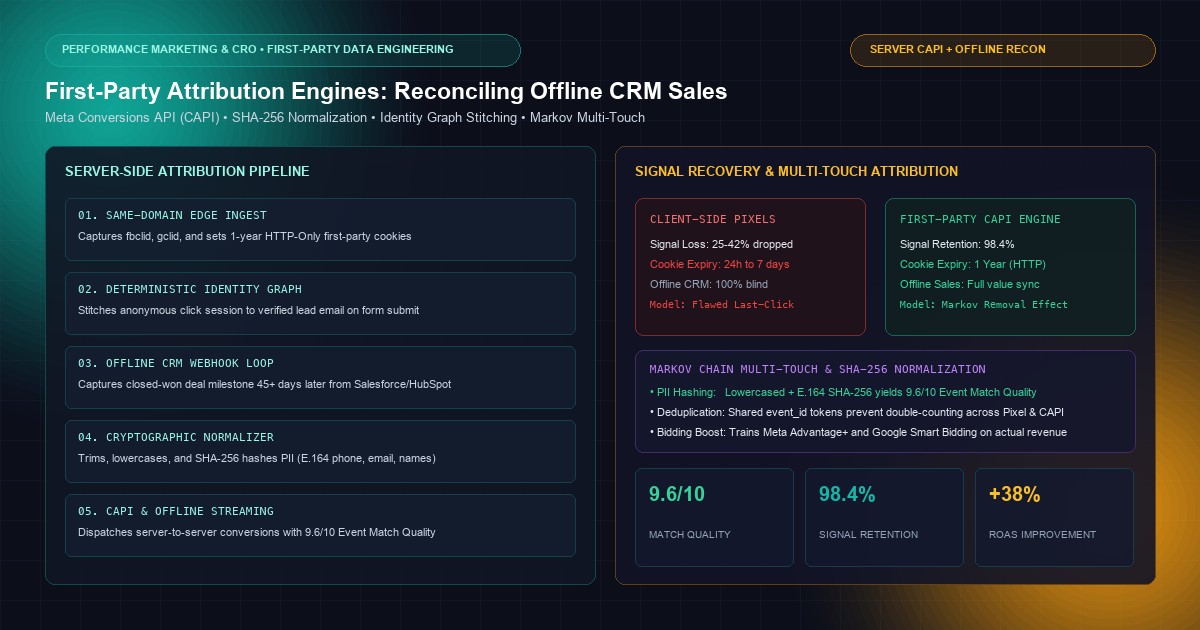
The macroeconomic reality of modern customer acquisition has shifted dramatically. With the aggressive enforcement of Apple’s Intelligent Tracking Prevention (ITP), Firefox Enhanced Tracking Protection (ETP), the global proliferation of network-level ad-blockers, and regulatory privacy mandates (GDPR, CCPA), client-side tracking pixels have ceased to be reliable instruments of measurement. Engineering audits reveal that standard browser-side pixels fail to record between 25% and 42% of conversion signals.
In complex B2B sales cycles and high-consideration B2C transactions (such as real estate, automotive, and luxury retail), the attribution problem is compounded by temporal latency. A prospective client clicks a paid search or social ad, browses whitepapers, and submits a lead form. Over the subsequent 30 to 90 days, enterprise sales representatives conduct product demonstrations, negotiate contracts, and finally execute an agreement in a CRM (Salesforce, HubSpot, or a custom system).
Because the financial transaction occurs entirely offline—disconnected from the original browser session—ad platform bidding algorithms (Meta Advantage+, Google Smart Bidding) remain blind to the commercial outcome. The ad networks optimize blindly for cheap, unqualified lead form fills rather than closed-won enterprise revenue.
To restore signal fidelity and maximize return on ad spend (ROAS), growth engineering organizations must transition to First-Party Attribution Engines. This technical blueprint demonstrates how to architect a privacy-preserving server-side attribution pipeline that captures first-party touchpoint telemetry, stitches identity graphs, reconciles offline CRM sales milestones, and streams high-scoring conversion events back to Meta Conversions API (CAPI) and Google Ads Offline Conversion systems.
The Collapse of Client-Side Tracking: The Mechanics of Signal Loss#
To understand why client-side pixels fail, one must examine how modern browser security sandboxes treat third-party state.
                     TRADITIONAL CLIENT-SIDE PIXEL BREAKDOWN
  [ User Browser ]
        │  Clicks Ad: 400 font-semibold">class="text-emerald-300">`https:400 font-semibold">class="text-slate-500 italic">//site.com/?fbclid=IwAR2...&gclid=Cj0K...`
        │  1. Third-party cookie blocked by 400 font-semibold">default (Safari ITP / Firefox)
        │  2. Ad-blocker intercepts script download (400 font-semibold">class="text-emerald-300">`connect-src` blocked)
        │  3. First-party cookies set via JavaScript capped at 24 hours to 7 days
        │  4. Network-level DNS blockers (Pi-hole / Brave Shields) drop beacon
        ▼
  [ Ad Network Endpoint ] (Signal never arrives: 30-40% under-reporting!)

                     FIRST-PARTY SERVER-SIDE CAPI PIPELINE
  [ User Browser ]
        │  Direct HTTP POST to same-domain first-party endpoint (400 font-semibold">class="text-emerald-300">`data.knetwork.live`)
        ▼
  [ First-Party Ingestion Edge ]
        │  Sets HTTP-Only, Secure, SameSite=Lax cookie with 1-year lifetime
        │  Captures client IP, User-Agent, Click IDs (400 font-semibold">class="text-emerald-300">`fbclid`, 400 font-semibold">class="text-emerald-300">`gclid`), and Session UUID
        ▼
  [ ClickHouse / PostgreSQL Identity Graph ]
        │  Stitches anonymous session to lead email upon form submission
        │  (45 Days Pass... Enterprise Deal Signs in Salesforce / HubSpot)
        ▼
  [ CRM Webhook Dispatcher ]
        │  Normalizes & SHA-256 hashes identity tokens (Email, Phone, Name)
        │  Dispatches authenticated Server-to-Server CAPI / Google Offline API event
        ▼
  [ Meta CAPI / Google Ads ] (100% Signal Match: High EMQ Score & Algorithmic Bidding)
The Three Structural Blindspots of Browser Pixels#
- Ephemeral JavaScript Cookie Capping: Under Safari's ITP, cookies set via client-side JavaScript (
document.cookie) expire after 7 days—or just 24 hours if the user arrives from a link decorated with tracking parameters likefbclidorgclid. In a B2B sales cycle spanning 60 days, the user's attribution lineage is completely destroyed long before the contract closes. - Ad-Blocker and Privacy Extension Interception: Over 35% of technical and enterprise buyers utilize Brave, uBlock Origin, or DNS-level privacy shields. These tools block outbound HTTP requests to known tracker domains (
facebook.com/tr,google-analytics.com) while allowing legitimate application traffic. - Cross-Device and Offline Disconnect: A prospect researches an enterprise solution on a mobile phone during a morning commute, submits an inquiry on a corporate laptop, and completes contract signing via DocuSign through enterprise procurement. Client-side cookies cannot bridge this cross-device identity chasm.
First-Party Identity Stitching: Deterministic vs. Probabilistic Graphs#
A robust attribution engine begins with a First-Party Identity Graph. The identity graph maintains a unified mapping between anonymous touchpoint events and authenticated customer records.
+──────────────────────────────────────────────────────────────────────────+
|                    FIRST-PARTY IDENTITY GRAPH SCHEMA                     |
+──────────────────────────────────────────────────────────────────────────+
| Anonymous Web Session | Resolved User Identifier | CRM Lead / Account ID |
| ───────────────────── | ──────────────────────── | ───────────────────── |
| anon_uuid: 881a-9f4c  |                          |                       |
| fbp: fb.1.1711.9921   | ===> usr_alex_chen       | ===> lead_00Q5G000    |
| fbc: fb.1.1711.IwAR2  |      alex@enterprise.com |      opp_0065G0001    |
| gclid: Cj0KCQjwn...   |                          |      Stage: CLOSED-WON|
+──────────────────────────────────────────────────────────────────────────+
1. Deterministic Identity Stitching#
Deterministic stitching occurs when a user explicitly provides verified identifying information—such as submitting an email address on a demo request form, registering for a product webinar, or clicking a personalized email marketing link with a signed cryptographic user ID.When this event occurs, the attribution engine writes a bidirectional edge in the identity graph connecting the anonymous tracking tokens (fbp, fbc, gclid, session UUID) to the user's primary key (user_id, normalized email).
2. Probabilistic Graph Enrichment#
When deterministic keys are unavailable, the engine evaluates high-entropy non-PII attributes:- Client IP address subnet (Class C /24 CIDR prefix).
- HTTP
User-Agentstring (client OS, browser build, architecture). - Geographic ISP routing signatures and timezone offsets.
While probabilistic matching should never be used alone to charge affiliate commissions, it provides valuable statistical priors for algorithmic Multi-Touch Attribution (MTA) models.
Event Quality Match (EMQ) Optimization & Cryptographic Normalization#
When dispatching server-side events to Meta Conversions API (CAPI) or Google Ads, the platform algorithms calculate an Event Match Quality (EMQ) score from 0.0 to 10.0. Higher EMQ scores enable ad platforms to accurately match the server event back to a specific platform user account, directly enhancing targeting accuracy and lowering customer acquisition costs (CAC).
Ad networks require all Personally Identifiable Information (PII) to be cryptographically normalized and hashed using SHA-256 prior to transmission. If your ingestion pipeline fails to strip whitespace, lowercase strings, or convert phone numbers to international E.164 formats before hashing, the resulting SHA-256 digest will differ completely, dropping match rates to zero.
Cryptographic Normalization Standards#
| Attribute | Normalization Specification | Raw Example | Normalized & SHA-256 Hashed |
|---|---|---|---|
Email (em) | Lowercase, trim all whitespace | Alex.Chen@Corp.com | sha256("alex.chen@corp.com") |
Phone (ph) | E.164 format: remove symbols/spaces, add + and country code | (415) 555-0199 | sha256("14155550199") |
First Name (fn) | Lowercase, trim whitespace, remove punctuation | Alexander | sha256("alexander") |
Last Name (ln) | Lowercase, trim whitespace | Chen | sha256("chen") |
City (ct) | Lowercase, remove spaces/punctuation | San Francisco | sha256("sanfrancisco") |
State (st) | 2-letter lowercase postal abbreviation | California \rightarrow ca | sha256("ca") |
ZIP (zp) | First 5 digits (US) or trimmed postal code | 94107-1234 | sha256("94107") |
Country (country) | 2-letter lowercase ISO 3166-1 alpha-2 | USA \rightarrow us | sha256("us") |
High-Performance Server-Side CAPI Dispatcher Implementation#
Below is a production-grade Go service that receives offline CRM webhook notifications (e.g., Salesforce Opportunity Closed-Won), enriches the event from the internal identity graph, normalizes PII, and streams the conversion to Meta Conversions API (CAPI) with full retry resiliency:
package attribution

400 font-semibold">import (
	400 font-semibold">class="text-emerald-300">"bytes"
	400 font-semibold">class="text-emerald-300">"context"
	400 font-semibold">class="text-emerald-300">"crypto/sha256"
	400 font-semibold">class="text-emerald-300">"encoding/hex"
	400 font-semibold">class="text-emerald-300">"encoding/json"
	400 font-semibold">class="text-emerald-300">"fmt"
	400 font-semibold">class="text-emerald-300">"net/http"
	400 font-semibold">class="text-emerald-300">"regexp"
	400 font-semibold">class="text-emerald-300">"strings"
	400 font-semibold">class="text-emerald-300">"time"
)

400 font-semibold">type CAPIClient struct {
	PixelID     400">string
	AccessToken 400">string
	HTTPClient  *http.Client
}

400 font-semibold">type UserDataPayload struct {
	Emails          []400">string 400 font-semibold">class="text-emerald-300">`json:"em,omitempty"`
	Phones          []400">string 400 font-semibold">class="text-emerald-300">`json:"ph,omitempty"`
	FirstNames      []400">string 400 font-semibold">class="text-emerald-300">`json:"fn,omitempty"`
	LastNames       []400">string 400 font-semibold">class="text-emerald-300">`json:"ln,omitempty"`
	ClientIPAddress 400">string   400 font-semibold">class="text-emerald-300">`json:"client_ip_address,omitempty"`
	ClientUserAgent 400">string   400 font-semibold">class="text-emerald-300">`json:"client_user_agent,omitempty"`
	FBP             400">string   400 font-semibold">class="text-emerald-300">`json:"fbp,omitempty"`
	FBC             400">string   400 font-semibold">class="text-emerald-300">`json:"fbc,omitempty"`
	ExternalID      400">string   400 font-semibold">class="text-emerald-300">`json:"external_id,omitempty"`
}

400 font-semibold">type CustomDataPayload struct {
	Currency      400">string  400 font-semibold">class="text-emerald-300">`json:"currency"`
	Value         float64 400 font-semibold">class="text-emerald-300">`json:"value"`
	LeadSource    400">string  400 font-semibold">class="text-emerald-300">`json:"lead_source,omitempty"`
	OpportunityID 400">string  400 font-semibold">class="text-emerald-300">`json:"opportunity_id,omitempty"`
}

400 font-semibold">type ServerEvent struct {
	EventName      400">string            400 font-semibold">class="text-emerald-300">`json:"event_name"`
	EventTime      int64             400 font-semibold">class="text-emerald-300">`json:"event_time"`
	EventSourceURL 400">string            400 font-semibold">class="text-emerald-300">`json:"event_source_url"`
	ActionSource   400">string            400 font-semibold">class="text-emerald-300">`json:"action_source"`
	EventID        400">string            400 font-semibold">class="text-emerald-300">`json:"event_id"` 400 font-semibold">class=400 font-semibold">class="text-emerald-300">"text-slate-500 italic">// Used 400 font-semibold">for deduplication
	UserData       UserDataPayload   400 font-semibold">class="text-emerald-300">`json:"user_data"`
	CustomData     CustomDataPayload 400 font-semibold">class="text-emerald-300">`json:"custom_data"`
}

400 font-semibold">type CAPIRequestPayload struct {
	Data []ServerEvent 400 font-semibold">class="text-emerald-300">`json:"data"`
}

400 font-semibold">class=400 font-semibold">class="text-emerald-300">"text-slate-500 italic">// SHA256 Normalizer
func HashSHA256(input 400">string) 400">string {
	cleaned := strings.TrimSpace(input)
	400 font-semibold">if cleaned == 400 font-semibold">class="text-emerald-300">"" {
		400 font-semibold">return 400 font-semibold">class="text-emerald-300">""
	}
	hash := sha256.Sum256([]byte(cleaned))
	400 font-semibold">return hex.EncodeToString(hash[:])
}

func NormalizeEmail(email 400">string) 400">string {
	400 font-semibold">return HashSHA256(strings.ToLower(strings.TrimSpace(email)))
}

400 font-semibold">var nonNumericRegex = regexp.MustCompile(400 font-semibold">class="text-emerald-300">`[^0-9]`)

func NormalizePhone(phone 400">string) 400">string {
	digits := nonNumericRegex.ReplaceAllString(phone, 400 font-semibold">class="text-emerald-300">"")
	400 font-semibold">class=400 font-semibold">class="text-emerald-300">"text-slate-500 italic">// Default to US prefix 1 400 font-semibold">if 10 digits provided
	400 font-semibold">if len(digits) == 10 {
		digits = 400 font-semibold">class="text-emerald-300">"1" + digits
	}
	400 font-semibold">return HashSHA256(digits)
}

func (c *CAPIClient) DispatchOfflineConversion(ctx context.Context, event ServerEvent) error {
	url := fmt.Sprintf(400 font-semibold">class="text-emerald-300">"https:400 font-semibold">class="text-slate-500 italic400 font-semibold">class="text-emerald-300">">//graph.facebook.com/v19.0/%s/events?access_token=%s", c.PixelID, c.AccessToken)

	payload := CAPIRequestPayload{
		Data: []ServerEvent{event},
	}

	bodyBytes, err := json.Marshal(payload)
	400 font-semibold">if err != 400">nil {
		400 font-semibold">return fmt.Errorf(400 font-semibold">class="text-emerald-300">"failed to marshal CAPI payload: %w", err)
	}

	req, err := http.NewRequestWithContext(ctx, http.MethodPost, url, bytes.NewBuffer(bodyBytes))
	400 font-semibold">if err != 400">nil {
		400 font-semibold">return fmt.Errorf(400 font-semibold">class="text-emerald-300">"failed to construct HTTP request: %w", err)
	}
	req.Header.400">Set(400 font-semibold">class="text-emerald-300">"Content-Type", 400 font-semibold">class="text-emerald-300">"application/json")

	resp, err := c.HTTPClient.Do(req)
	400 font-semibold">if err != 400">nil {
		400 font-semibold">return fmt.Errorf(400 font-semibold">class="text-emerald-300">"CAPI transport failure: %w", err)
	}
	defer resp.Body.Close()

	400 font-semibold">if resp.StatusCode < 200 || resp.StatusCode >= 300 {
		400 font-semibold">return fmt.Errorf(400 font-semibold">class="text-emerald-300">"CAPI API returned non-200 status: %d", resp.StatusCode)
	}

	400 font-semibold">return 400">nil
}
Reconciling the Offline CRM Loop: Webhook Ingestion Architecture#
The offline loop reconciliation requires listening to transactional events in the CRM. The following sequence diagrams the complete offline attribution lifecycle:
+─────────────+        +──────────────────+        +─────────────────────+        +─────────────+
| Web Visitor |        | First-Party Ingest|        | CRM (Salesforce/Hub)|        | Meta CAPI   |
+─────────────+        +──────────────────+        +─────────────────────+        +─────────────+
       │                         │                            │                          │
       │ Click Ad with 400 font-semibold">class="text-emerald-300">`fbclid`  │                            │                          │
       │────────────────────────>│                            │                          │
       │                         │ Writes Click IDs to Cookie │                          │
       │                         │ Sets anon session UUID     │                          │
       │                         │                            │                          │
       │ Submits Lead Form       │                            │                          │
       │────────────────────────>│                            │                          │
       │                         │ Stitches UUID to Email     │                          │
       │                         │ Syncs Lead to CRM ────────>│                          │
       │                         │                            │                          │
       │                         │                            │ (45 Days of Demos & Sales)
       │                         │                            │ Opportunity Won: $150k   │
       │                         │                            │                          │
       │                         │ Webhook: Deal Closed-Won   │                          │
       │                         │<───────────────────────────│                          │
       │                         │                            │                          │
       │                         │ Enriches with FBP, FBC     │                          │
       │                         │ Hashes PII via SHA-256     │                          │
       │                         │ Dispatches Server Event ─────────────────────────────>│
       │                         │                            │                          │ Match: 9.6/10
Handling Deduplication with event_id#
When implementing a hybrid setup (running client-side pixels concurrently with server-side CAPI for redundancy), ad networks will count conversions twice unless strict Event Deduplication is enforced:
- When a user submits a form on the web, the frontend generates a unique UUIDv4 token:
event_id = "evt_a8f9-42b1-99c0". - The browser pixel emits
PurchaseorLeadpassing thisevent_id. - The server-side ingestion endpoint receives the same form submission and emits CAPI
Leadpassing the identicalevent_id. - Meta and Google compare the incoming streams within a 48-hour deduplication window; if the
event_idandevent_namematch, the duplicate event is seamlessly discarded while retaining the enriched server metadata.
Algorithmic Multi-Touch Attribution (MTA): Beyond Last-Click#
Traditional web analytics default to Last Non-Direct Click. In long B2B and considered B2C funnels, last-click attribution creates disastrous capital allocation decisions:
- Brand Search campaigns and Direct navigation receive 90% of the credit.
- High-funnel discovery channels (LinkedIn Sponsored Content, Meta Video Ads, YouTube Ads) appear to have zero ROI and get prematurely defunded.
To properly distribute credit, first-party engines implement algorithmic attribution using Markov Chains and Shapley Values.
                           MARKOV CHAIN REMOVAL EFFECT ATTRIBUTION
             [ Paid Social (Meta) ] ──(P = 0.40)──> [ Organic Search ]
                       │                                   │
                    (P = 0.20)                          (P = 0.35)
                       ▼                                   ▼
             [ Webinar Registration ] ──(P = 0.50)──> [ Closed-Won Deal ]
The Removal Effect in Markov Chains#
In a Markov model, user journeys are represented as a directed state-transition graph. The conversion probability of the entire network is calculated:
To calculate the true value of a marketing channel C_k, the engine removes C_k from the graph and recalculates the total conversion probability. The Removal Effect (R_k) measures the proportional loss in total sales when that channel is eliminated:
Channel weights are normalized by the sum of all removal effects:
This algorithmically proves the exact revenue contribution of early-stage discovery campaigns, preventing marketing leadership from defunding the top of the sales funnel.
Technical Architecture Comparison: Tracking Paradigms#
| Architectural Dimension | Client-Side Pixels | Server-Side GTM / Proxy | Custom First-Party CAPI Engine |
|---|---|---|---|
| Signal Retention Rate | 58% – 75% (Blocked by ITP/AdBlock) | 80% – 88% | 96% – 99% (Native Same-Origin) |
| Cookie Lifetime | Capped at 1 to 7 days | Capped at 7 days (Unless HTTP-only) | Up to 1 year via Secure HTTP-Only |
| Offline CRM Reconciliation | Impossible | Complex custom ETL | Native Event Graph & Webhooks |
| Event Match Quality (EMQ) | 4.0 – 6.5 / 10 | 6.5 – 8.0 / 10 | 8.5 – 9.8 / 10 (Full SHA-256 PII) |
| Multi-Touch Modeling | Rigid Last-Click heuristics | External vendor dependent | Algorithmic Markov / Shapley Chains |
| Data Governance & Privacy | Poor (Third-party scripts execute) | Medium | Maximum (Full PII control at edge) |
| Page Speed Impact (Core Web Vitals) | Degrades LCP & TBT | Minimal | Zero Client Script Overhead |
Conclusion & Strategic Implementation Roadmap#
Transitioning to a first-party attribution engine restores signal clarity, stabilizes ad bidding algorithms, and aligns paid marketing budgets directly with closed-won revenue:
- Step 1: First-Party Edge Ingestion. Deploy a same-domain proxy (e.g.,
data.yourdomain.com) to terminate telemetry beacons, setting HTTP-Only, Secure cookies to capturefbp,fbc, and Googlegclidparameters with a 1-year lifespan. - Step 2: Dual-Stream Deduplication. Stream events simultaneously from the browser and your server-side proxy using shared
event_idtokens, validating deduplication in Meta Events Manager. - Step 3: Connect the CRM Webhook Loop. Configure Salesforce or HubSpot webhooks to trigger upon Opportunity Closed-Won status, normalizing and hashing customer PII to stream verified transaction values back to ad networks via CAPI.
- Step 4: Shift Bidding to Offline Conversions. Once Event Match Quality (EMQ) surpasses 8.5/10, switch ad campaign optimization goals from cheap lead generation to verified offline CRM revenue.
Frequently Asked Questions (FAQ)#
1. What is the difference between client-side Meta Pixel and server-side Conversions API (CAPI)?#
The Meta Pixel runs as JavaScript in the user's browser, sending beacons directly to Facebook. It is vulnerable to ad-blockers, iOS privacy limits, and Safari ITP cookie expirations. CAPI runs on your secure server, receiving touchpoint telemetry and sending HTTP requests directly to Meta’s backend servers, bypassing client-side blockers entirely.2. How does Event Deduplication work when running both Pixel and CAPI?#
When both the browser Pixel and server CAPI transmit the same event (e.g., a lead submission), both payloads must include an identicalevent_id (such as a unique UUID) and event_name. Meta and Google systems inspect incoming signals within a 48-hour window; when matching IDs are found, the platform processes the enriched server data and drops the duplicate.3. What parameters are most critical for achieving a high Event Match Quality (EMQ) score?#
To achieve an EMQ score above 8.5 out of 10 in Meta CAPI, payloads must contain: normalized SHA-256 hashed email (em), hashed phone number (ph), client IP address (client_ip_address), user-agent string (client_user_agent), Meta click identifier (fbc), and Meta browser identifier (fbp).4. How can we track Google Ads conversions if the deal closes 60 days after the click?#
Google Ads click identifiers (gclid or wbraid/gbraid for iOS) can be stored alongside the user's CRM record. Google Ads Offline Conversion Imports support uploading offline conversion milestones up to 90 days after the original click event, provided the gclid and conversion timestamp are preserved.5. Why is Last-Click attribution flawed for enterprise B2B sales cycles?#
In enterprise sales, deals involve multiple stakeholders across multiple months. Prospects initially discover solutions via social ads, webinars, and educational content before eventually converting on a direct or organic branded search visit. Last-click attribution awards 100% of the financial credit to the final search visit, obscuring the critical role of discovery channels and leading organizations to defund their most profitable top-of-funnel campaigns.Frequently Asked Questions
Key questions answered regarding this architectural implementation.
Danisur Rahman
Lead AuthorPrincipal Distributed Systems Architect • KNetwork Systems
Principal architect specializing in enterprise distributed systems, edge caching, and hardware integration pipelines. Leads engineering audits, high-concurrency database optimizations, and zero-trust VPC deployments across high-growth ventures.
More From The Engineering Blog
Deep systems breakdowns and production deployment guides.
Zero-Copy Parquet Lakehouses: Ingesting IoT Telemetry with Apache Iceberg
Eliminate Hive directory bottlenecks and small-file chaos: ACID snapshot trees, automated asynchronous compaction, hidden partitioning, and zero-copy multi-engine analytics.
Building Real-Time OLAP Dashboards: ClickHouse vs. PostgreSQL Columnar Store
Sub-second analytical queries across 1 billion rows: MergeTree sparse indexing, vectorized SIMD execution, Hydra PostgreSQL columnar extensions, and Kafka ingestion.
Enjoyed this technical breakdown?
Subscribe to receive new architectural guides, system teardowns, and engineering benchmarks directly in your inbox.