Dynamic Attribute-Based Access Control (ABAC) in Regulated B2B CRMs
Eliminate role explosion in enterprise CRMs: Decouple authorization with Open Policy Agent (OPA), sub-millisecond Rego evaluation, and PostgreSQL Row-Level Security.
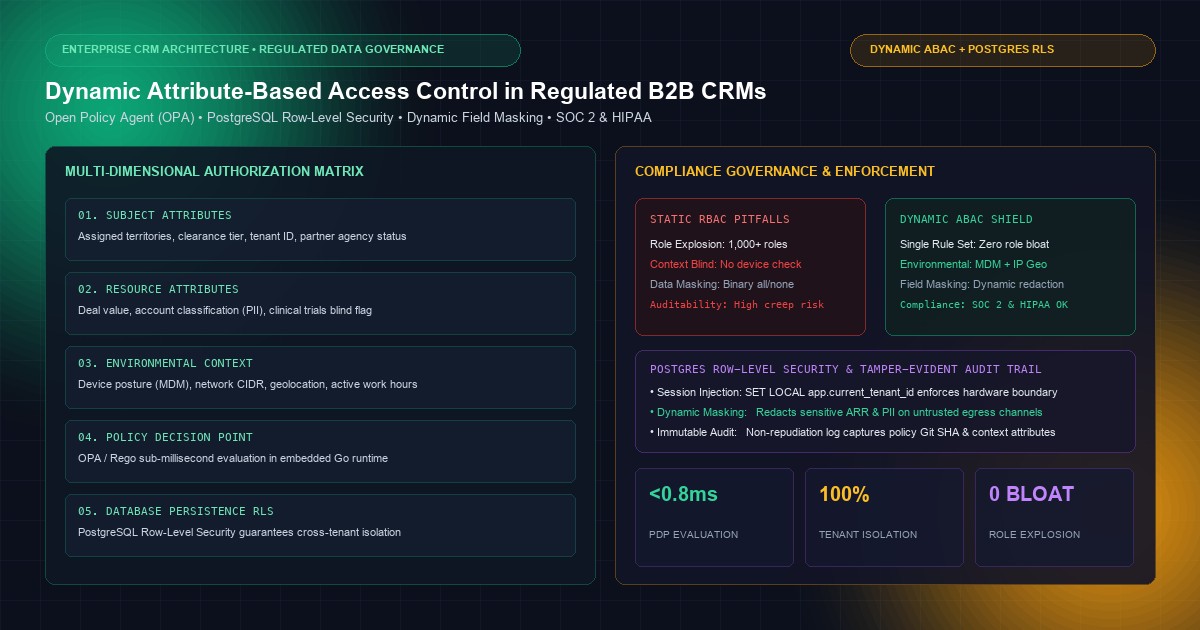
In modern enterprise B2B Customer Relationship Management (CRM) platforms, access control is frequently treated as a simple matrix of roles and permissions. Standard Role-Based Access Control (RBAC)—where users are assigned static roles such as Sales_Rep, Territory_Manager, or Compliance_Auditor—operates adequately in flat corporate structures. However, in highly regulated industries (healthcare life sciences under HIPAA, wealth management under FINRA/SEC, and global SaaS under GDPR and SOC 2 Type II), static RBAC rapidly disintegrates.
Enterprise sales organizations do not operate in static hierarchies. Deal teams form dynamically across territories; outsourced sales development agencies require ephemeral access to lead segments without viewing deal values; clinical trials require blinding patient-identifying CRM data from pharmaceutical reps; and regional sovereignty laws demand strict geographic fencing of customer records.
Attempting to model these granular constraints within RBAC triggers an unmanageable explosion of roles (e.g., Sales_Rep_EMEA_Healthcare_Enterprise_Tier1_ReadOnly), creating severe operational gridlock and compliance vulnerabilities.
To solve this, modern enterprise architectures transition to Dynamic Attribute-Based Access Control (ABAC). This guide provides an end-to-end architectural blueprint for implementing low-latency ABAC within custom B2B CRMs. We examine the core decoupling of Policy Decision Points (PDP) from Policy Enforcement Points (PEP), implement declarative policies via Open Policy Agent (OPA) and Rego, and push enforcement deep into the persistence layer using PostgreSQL Row-Level Security (RLS).
The Architectural Limits of Static RBAC in Enterprise CRMs#
To understand why RBAC fails in regulated B2B environments, consider an enterprise sales organization operating across North America, Europe, and Asia-Pacific.
                                  RBAC ROLE EXPLOSION PROBLEM
           ┌──────────────┐      ┌──────────────┐      ┌──────────────┐
           │  Role Count  │ ===> │ Combinations │ ===> │ Audit Chaos  │
           │  Explodes to │      │  (Territory  │      │ Ghost Perms  │
           │  1,000+      │      │ x Vertical x │      │ Privilege    │
           │  Roles       │      │ Compliance)  │      │ Creep        │
           └──────────────┘      └──────────────┘      └──────────────┘
                                         vs.
                                DYNAMIC ABAC PARADIGM
    User Attributes        Resource Attributes       Context / Environment
    - Department           - Customer Tier           - Device Posture (MDM)
    - Region / Territory   - Data Classification     - Network CIDR / IP
    - Clearance Level      - Tenant Ownership        - Geolocation / Time
          │                        │                         │
          └────────────────────────┼─────────────────────────┘
                                   ▼
                [ Policy Decision Point (OPA / Rego) ]
                                   │
                                   ▼  Decision: ALLOW / DENY + Field Mask
                         [ Enforcement Point ]
The Three Structural Failure Modes of RBAC#
- Role Explosion & Privilege Creep: As business rules multiply, administrators generate custom roles for individual edge cases. Over time, employees change projects, retaining historical roles. Auditing who has access to a specific Fortune 500 account becomes an exponential graph search problem.
- Context Blindness: RBAC makes authorization decisions based strictly on who the user is, completely ignoring environmental context. An executive logging in from an unmanaged public Wi-Fi hotspot in an embargoed country possesses identical data extraction rights as when operating from a corporate-managed laptop inside headquarters.
- Coarse-Grained Authorization: RBAC typically grants binary access at the entity level: a user can either view the
Opportunityrecord or cannot. It cannot natively enforce conditional masking—such as allowing a regional rep to view account contact info while redacting financial pipeline projections unless deal value is under $250,000 and the user belongs to the assigned account team.
Theoretical Foundations: The ABAC Standard Framework (NIST SP 800-162)#
The National Institute of Standards and Technology (NIST) formalizes ABAC through four distinct architectural components:
- Policy Decision Point (PDP): The centralized engine that evaluates authorization requests against formal policies and returns an authoritative
ALLOWorDENYdecision. - Policy Enforcement Point (PEP): The interceptor embedded within API gateways, application middleware, or database proxies that intercepts user requests, requests a decision from the PDP, and enforces the outcome.
- Policy Information Point (PIP): The attribute retrieval layer that enriches the authorization context by querying user identity providers (Okta/Entra ID), CRM databases, or endpoint security agents.
- Policy Administration Point (PAP): The management interface and version-controlled Git repository where security architects author, test, and deploy authorization policies.
In our high-performance architecture, policies evaluate four attribute dimensions:
- Subject Attributes (
A_{Subject}): Department, business unit, assigned geographic territories, clearance tier, active tenant ID, contractor status. - Resource Attributes (
A_{Resource}): Account classification (Public, Confidential, Restricted/PII), deal value, owner territory, customer residency country, sensitivity flags. - Action Attributes (
A_{Action}):read,create,update,delete,export_csv,reassign_owner. - Environment Attributes (
A_{Environment}): Request timestamp, IP subnet, client TLS certificate fingerprint, MDM device posture state (encrypted disk, compliant OS), geographic origin derived from MaxMind GeoIP2.
High-Performance Policy Evaluation with Open Policy Agent (OPA)#
To avoid latency degradation across thousands of API endpoints, policy evaluation must execute in sub-millisecond timeframes. Embedding an Open Policy Agent (OPA) instance as an in-process library (via Go WebAssembly/Go SDK) or a low-latency localhost sidecar guarantees sub-millisecond PDP execution.
Defining Regulated CRM Rules in Rego#
The following production Rego policy defines multi-layered access rules for viewing and modifying CRM Deal records under strict regulatory constraints:
package crm.authz

400 font-semibold">import future.keywords.in
400 font-semibold">import future.keywords.400 font-semibold">if

400 font-semibold">default allow = 400">false
400 font-semibold">default mask_financials = 400">false

400 font-semibold">class=400 font-semibold">class="text-emerald-300">"text-slate-500 italic"># Rule 1: Super Administrators retain full access within their home tenant
allow 400 font-semibold">if {
    input.subject.is_super_admin == 400">true
    input.subject.tenant_id == input.resource.tenant_id
}

400 font-semibold">class=400 font-semibold">class="text-emerald-300">"text-slate-500 italic"># Rule 2: Sales Representatives viewing Deal records
allow 400 font-semibold">if {
    input.action == 400 font-semibold">class="text-emerald-300">"read"
    input.resource.400 font-semibold">type == 400 font-semibold">class="text-emerald-300">"deal"
    input.subject.tenant_id == input.resource.tenant_id

    400 font-semibold">class=400 font-semibold">class="text-emerald-300">"text-slate-500 italic"># Must meet territory alignment or explicit team membership
    user_is_territory_aligned

    400 font-semibold">class=400 font-semibold">class="text-emerald-300">"text-slate-500 italic"># Environment security compliance gate
    environment_is_secure
}

400 font-semibold">class=400 font-semibold">class="text-emerald-300">"text-slate-500 italic"># Rule 3: Sales Reps updating Deal records
allow 400 font-semibold">if {
    input.action in [400 font-semibold">class="text-emerald-300">"update", 400 font-semibold">class="text-emerald-300">"patch"]
    input.resource.400 font-semibold">type == 400 font-semibold">class="text-emerald-300">"deal"
    input.subject.tenant_id == input.resource.tenant_id

    400 font-semibold">class=400 font-semibold">class="text-emerald-300">"text-slate-500 italic"># Rep must be the primary owner or an assigned collaborator
    user_is_deal_collaborator

    400 font-semibold">class=400 font-semibold">class="text-emerald-300">"text-slate-500 italic"># Deals in 400 font-semibold">class="text-emerald-300">'Closed-Won' or 400 font-semibold">class="text-emerald-300">'Archived' cannot be modified without VP approval
    not deal_is_locked

    environment_is_secure
}

400 font-semibold">class=400 font-semibold">class="text-emerald-300">"text-slate-500 italic"># Helper: Territory Alignment
user_is_territory_aligned 400 font-semibold">if {
    input.resource.territory in input.subject.assigned_territories
}

user_is_deal_collaborator 400 font-semibold">if {
    input.subject.user_id == input.resource.owner_id
}

user_is_deal_collaborator 400 font-semibold">if {
    input.subject.user_id in input.resource.collaborator_ids
}

400 font-semibold">class=400 font-semibold">class="text-emerald-300">"text-slate-500 italic"># Helper: Locked State
deal_is_locked 400 font-semibold">if {
    input.resource.stage in [400 font-semibold">class="text-emerald-300">"closed_won", 400 font-semibold">class="text-emerald-300">"closed_lost", 400 font-semibold">class="text-emerald-300">"audit_lock"]
}

400 font-semibold">class=400 font-semibold">class="text-emerald-300">"text-slate-500 italic"># Helper: Strict Environmental Posture
environment_is_secure 400 font-semibold">if {
    400 font-semibold">class=400 font-semibold">class="text-emerald-300">"text-slate-500 italic"># Enforce corporate network or verified WireGuard VPN
    input.environment.network_trusted == 400">true

    400 font-semibold">class=400 font-semibold">class="text-emerald-300">"text-slate-500 italic"># Device must pass enterprise MDM validation
    input.environment.device_posture.disk_encrypted == 400">true
    input.environment.device_posture.edr_active == 400">true

    400 font-semibold">class=400 font-semibold">class="text-emerald-300">"text-slate-500 italic"># Restrict high-risk geolocations
    not input.environment.geo_country in [400 font-semibold">class="text-emerald-300">"CU", 400 font-semibold">class="text-emerald-300">"IR", 400 font-semibold">class="text-emerald-300">"KP", 400 font-semibold">class="text-emerald-300">"SY", 400 font-semibold">class="text-emerald-300">"RU"]
}

400 font-semibold">class=400 font-semibold">class="text-emerald-300">"text-slate-500 italic"># Conditional Field Masking: Mask ARR / Financials 400 font-semibold">if outside sales leadership
mask_financials 400 font-semibold">if {
    input.action == 400 font-semibold">class="text-emerald-300">"read"
    input.resource.deal_value > 500000
    not 400 font-semibold">class="text-emerald-300">"Sales_Leadership" in input.subject.roles
}
Policy Enforcement Point (PEP): Intercepting API Requests in Go#
Below is the implementation of a high-concurrency Go HTTP middleware acting as the Policy Enforcement Point (PEP). It enriches the authorization payload with environmental signals and queries the local OPA decision engine:
package middleware

400 font-semibold">import (
	400 font-semibold">class="text-emerald-300">"bytes"
	400 font-semibold">class="text-emerald-300">"context"
	400 font-semibold">class="text-emerald-300">"encoding/json"
	400 font-semibold">class="text-emerald-300">"net/http"
	400 font-semibold">class="text-emerald-300">"strings"
	400 font-semibold">class="text-emerald-300">"time"

	400 font-semibold">class="text-emerald-300">"github.com/open-policy-agent/opa/rego"
)

400 font-semibold">type Authorizer struct {
	preparedQuery rego.PreparedEvalQuery
}

func NewAuthorizer(ctx context.Context, policyCode 400">string) (*Authorizer, error) {
	query, err := rego.New(
		rego.Query(400 font-semibold">class="text-emerald-300">"result = {allow: data.crm.authz.allow, mask: data.crm.authz.mask_financials}"),
		rego.Module(400 font-semibold">class="text-emerald-300">"crm_policy.rego", policyCode),
	).PrepareForEval(ctx)

	400 font-semibold">if err != 400">nil {
		400 font-semibold">return 400">nil, err
	}
	400 font-semibold">return &Authorizer{preparedQuery: query}, 400">nil
}

400 font-semibold">type AuthzInput struct {
	Subject     SubjectContext     400 font-semibold">class="text-emerald-300">`json:"subject"`
	Resource    ResourceContext    400 font-semibold">class="text-emerald-300">`json:"resource"`
	Action      400">string             400 font-semibold">class="text-emerald-300">`json:"action"`
	Environment EnvironmentContext 400 font-semibold">class="text-emerald-300">`json:"environment"`
}

400 font-semibold">type SubjectContext struct {
	UserID              400">string   400 font-semibold">class="text-emerald-300">`json:"user_id"`
	TenantID            400">string   400 font-semibold">class="text-emerald-300">`json:"tenant_id"`
	Roles               []400">string 400 font-semibold">class="text-emerald-300">`json:"roles"`
	AssignedTerritories []400">string 400 font-semibold">class="text-emerald-300">`json:"assigned_territories"`
	IsSuperAdmin        bool     400 font-semibold">class="text-emerald-300">`json:"is_super_admin"`
}

400 font-semibold">type ResourceContext struct {
	Type            400">string   400 font-semibold">class="text-emerald-300">`json:"400 font-semibold">type"`
	TenantID        400">string   400 font-semibold">class="text-emerald-300">`json:"tenant_id"`
	OwnerID         400">string   400 font-semibold">class="text-emerald-300">`json:"owner_id"`
	Territory       400">string   400 font-semibold">class="text-emerald-300">`json:"territory"`
	Stage           400">string   400 font-semibold">class="text-emerald-300">`json:"stage"`
	DealValue       float64  400 font-semibold">class="text-emerald-300">`json:"deal_value"`
	CollaboratorIDs []400">string 400 font-semibold">class="text-emerald-300">`json:"collaborator_ids"`
}

400 font-semibold">type EnvironmentContext struct {
	NetworkTrusted bool          400 font-semibold">class="text-emerald-300">`json:"network_trusted"`
	GeoCountry     400">string        400 font-semibold">class="text-emerald-300">`json:"geo_country"`
	DevicePosture  DevicePosture 400 font-semibold">class="text-emerald-300">`json:"device_posture"`
	RequestTime    400">string        400 font-semibold">class="text-emerald-300">`json:"request_time"`
}

400 font-semibold">type DevicePosture struct {
	DiskEncrypted bool 400 font-semibold">class="text-emerald-300">`json:"disk_encrypted"`
	EDRActive     bool 400 font-semibold">class="text-emerald-300">`json:"edr_active"`
}

func (a *Authorizer) Authorize(input AuthzInput) (bool, bool, error) {
	rs, err := a.preparedQuery.Eval(context.Background(), rego.EvalInput(input))
	400 font-semibold">if err != 400">nil || len(rs) == 0 {
		400 font-semibold">return 400">false, 400">false, err
	}

	resultMap, ok := rs[0].Bindings[400 font-semibold">class="text-emerald-300">"result"].(map[400">string]400 font-semibold">interface{})
	400 font-semibold">if !ok {
		400 font-semibold">return 400">false, 400">false, 400">nil
	}

	allow, _ := resultMap[400 font-semibold">class="text-emerald-300">"allow"].(bool)
	mask, _ := resultMap[400 font-semibold">class="text-emerald-300">"mask"].(bool)

	400 font-semibold">return allow, mask, 400">nil
}
Pushing ABAC to the Database: PostgreSQL Row-Level Security (RLS)#
While application-level middleware (PEP) guards REST and GraphQL endpoints, relying exclusively on application code creates dangerous vulnerabilities: background jobs, reporting tools, or direct database connections can accidentally bypass business logic.
To guarantee infallible multi-tenant boundary isolation and attribute filtering, we push ABAC rules directly into PostgreSQL Row-Level Security (RLS).
+-------------------------------------------------------------------------+
|                  APPLICATION POOL / TRANSACTION CONTEXT                 |
|  SET LOCAL app.current_tenant_id = 400 font-semibold">class="text-emerald-300">'tenant_corp_alpha';                 |
|  SET LOCAL app.current_user_id   = 400 font-semibold">class="text-emerald-300">'usr_882194';                        |
|  SET LOCAL app.current_clearance = 400 font-semibold">class="text-emerald-300">'Confidential';                      |
+-------------------------------------------------------------------------+
                                     │
                                     ▼
+-------------------------------------------------------------------------+
|                  POSTGRESQL KERNEL ROW FILTER ENGINE                    |
|                                                                         |
|  400 font-semibold">TABLE: crm_deals                                                       |
|  - Checks tenant_id = current_setting(400 font-semibold">class="text-emerald-300">'app.current_tenant_id')          |
|  - Evaluates territory against user's assigned attribute array          |
|  - Blocks rows exceeding clearance tier automatically                   |
+-------------------------------------------------------------------------+
PostgreSQL Schema & RLS Policy Implementation#
-- Enable Row Level Security on the Deals Table
400 font-semibold">CREATE 400 font-semibold">TABLE crm_deals (
    deal_id UUID PRIMARY KEY DEFAULT gen_random_uuid(),
    tenant_id VARCHAR(64) NOT NULL,
    owner_id VARCHAR(64) NOT NULL,
    territory VARCHAR(32) NOT NULL,
    deal_name VARCHAR(255) NOT NULL,
    deal_value NUMERIC(15, 2) NOT NULL,
    classification VARCHAR(32) DEFAULT 400 font-semibold">class="text-emerald-300">'Confidential',
    stage VARCHAR(32) NOT NULL,
    collaborator_ids TEXT[] DEFAULT ARRAY[]::TEXT[],
    created_at TIMESTAMPTZ DEFAULT NOW(),
    updated_at TIMESTAMPTZ DEFAULT NOW()
);

-- Enable RLS
400 font-semibold">ALTER 400 font-semibold">TABLE crm_deals ENABLE ROW LEVEL SECURITY;
400 font-semibold">ALTER 400 font-semibold">TABLE crm_deals FORCE ROW LEVEL SECURITY;

-- Index 400 font-semibold">for RLS attribute performance
400 font-semibold">CREATE 400 font-semibold">INDEX idx_crm_deals_rls ON crm_deals (tenant_id, territory, owner_id);

-- Policy 1: Tenant Boundary Isolation (Non-negotiable)
400 font-semibold">CREATE POLICY tenant_isolation_policy ON crm_deals
    AS RESTRICTIVE
    USING (
        tenant_id = NULLIF(current_setting(400 font-semibold">class="text-emerald-300">'app.current_tenant_id', 400">true), 400 font-semibold">class="text-emerald-300">'')
    );

-- Policy 2: Attribute-Based Row Visibility
400 font-semibold">CREATE POLICY abac_deal_visibility_policy ON crm_deals
    FOR 400 font-semibold">SELECT
    USING (
        -- User is the deal owner
        owner_id = NULLIF(current_setting(400 font-semibold">class="text-emerald-300">'app.current_user_id', 400">true), 400 font-semibold">class="text-emerald-300">'')
        OR
        -- User is an active collaborator
        NULLIF(current_setting(400 font-semibold">class="text-emerald-300">'app.current_user_id', 400">true), 400 font-semibold">class="text-emerald-300">'') = ANY(collaborator_ids)
        OR
        -- User400 font-semibold">class="text-emerald-300">'s authorized territories include the deal territory
        territory = ANY(
            string_to_array(
                NULLIF(current_setting('app.authorized_territories400 font-semibold">class="text-emerald-300">', 400">true), '400 font-semibold">class="text-emerald-300">'),
                ',400 font-semibold">class="text-emerald-300">'
            )
        )
        OR
        -- Executive override role
        current_setting('app.user_role400 font-semibold">class="text-emerald-300">', 400">true) = 'Executive_Sales400 font-semibold">class="text-emerald-300">'
    );

-- Policy 3: Update Guardrail (Ownership + Unlocked Stage)
400 font-semibold">CREATE POLICY abac_deal_update_policy ON crm_deals
    FOR 400 font-semibold">UPDATE
    USING (
        (owner_id = NULLIF(current_setting('app.current_user_id400 font-semibold">class="text-emerald-300">', 400">true), '400 font-semibold">class="text-emerald-300">')
         OR NULLIF(current_setting('app.current_user_id400 font-semibold">class="text-emerald-300">', 400">true), '400 font-semibold">class="text-emerald-300">') = ANY(collaborator_ids))
        AND
        stage NOT IN ('closed_won400 font-semibold">class="text-emerald-300">', 'closed_lost400 font-semibold">class="text-emerald-300">', 'audit_lock')
    );
Executing Queries within Scoped Database Transactions#
Whenever the CRM backend opens a pooled connection to execute a user query, it sets session configuration variables within an atomic transaction. This guarantees that even if a SQL injection vulnerability exists in user input, the database engine physically rejects queries spanning across unauthorized rows:
BEGIN;
-- 400">Set session-scoped user attributes
SET LOCAL app.current_tenant_id = 400 font-semibold">class="text-emerald-300">'tenant_enterprise_77';
SET LOCAL app.current_user_id = 400 font-semibold">class="text-emerald-300">'usr_alex_chen';
SET LOCAL app.authorized_territories = 400 font-semibold">class="text-emerald-300">'US_WEST,US_NORTHWEST';
SET LOCAL app.user_role = 400 font-semibold">class="text-emerald-300">'Sales_Rep';

-- Run standard CRM query
400 font-semibold">SELECT deal_id, deal_name, deal_value, territory, stage
400 font-semibold">FROM crm_deals
400 font-semibold">WHERE stage = 400 font-semibold">class="text-emerald-300">'pipeline';

COMMIT;
Dynamic Field-Level Masking & Cryptographic Redaction#
Beyond hiding entire database records, enterprise compliance often requires Field-Level Data Masking. For example, under GDPR Article 32 and HIPAA Privacy Rules:
- An outsourced BDR (Business Development Representative) can view a lead's corporate domain and pipeline stage, but personal email addresses and direct dial mobile numbers must be hashed or masked.
- An account manager can inspect an opportunity's status, but customer bank account numbers or proprietary deal margin percentages must remain redacted unless the user possesses explicit financial clearance.
400 font-semibold">class=400 font-semibold">class="text-emerald-300">"text-slate-500 italic">// Example: Raw CRM Lead Object in Database
{
  400 font-semibold">class="text-emerald-300">"lead_id": 400 font-semibold">class="text-emerald-300">"lead_9921",
  400 font-semibold">class="text-emerald-300">"name": 400 font-semibold">class="text-emerald-300">"Jane Doe",
  400 font-semibold">class="text-emerald-300">"direct_phone": 400 font-semibold">class="text-emerald-300">"+1-415-555-0199",
  400 font-semibold">class="text-emerald-300">"email": 400 font-semibold">class="text-emerald-300">"jdoe@targetenterprise.com",
  400 font-semibold">class="text-emerald-300">"estimated_budget": 750000.00
}

400 font-semibold">class=400 font-semibold">class="text-emerald-300">"text-slate-500 italic">// Dynamically Masked Representation 400 font-semibold">for Unauthorized Context
{
  400 font-semibold">class="text-emerald-300">"lead_id": 400 font-semibold">class="text-emerald-300">"lead_9921",
  400 font-semibold">class="text-emerald-300">"name": 400 font-semibold">class="text-emerald-300">"Jane Doe",
  400 font-semibold">class="text-emerald-300">"direct_phone": 400 font-semibold">class="text-emerald-300">"+1-415-***-**99",
  400 font-semibold">class="text-emerald-300">"email": 400 font-semibold">class="text-emerald-300">"j***e@targetenterprise.com",
  400 font-semibold">class="text-emerald-300">"estimated_budget": 400">null
}
Implementing Dynamic Attribute Transformation in Go#
package transform
400 font-semibold">import (
400 font-semibold">class="text-emerald-300">"regexp"
400 font-semibold">class="text-emerald-300">"strings"
)
400 font-semibold">var emailRegex = regexp.MustCompile(400 font-semibold">class="text-emerald-300">`^(.)(.*)(.@.*)In modern enterprise B2B Customer Relationship Management (CRM) platforms, access control is frequently treated as a simple matrix of roles and permissions. Standard Role-Based Access Control (RBAC)—where users are assigned static roles such as Sales_Rep, Territory_Manager, or Compliance_Auditor—operates adequately in flat corporate structures. However, in highly regulated industries (healthcare life sciences under HIPAA, wealth management under FINRA/SEC, and global SaaS under GDPR and SOC 2 Type II), static RBAC rapidly disintegrates.
Enterprise sales organizations do not operate in static hierarchies. Deal teams form dynamically across territories; outsourced sales development agencies require ephemeral access to lead segments without viewing deal values; clinical trials require blinding patient-identifying CRM data from pharmaceutical reps; and regional sovereignty laws demand strict geographic fencing of customer records.
Attempting to model these granular constraints within RBAC triggers an unmanageable explosion of roles (e.g., Sales_Rep_EMEA_Healthcare_Enterprise_Tier1_ReadOnly), creating severe operational gridlock and compliance vulnerabilities.
To solve this, modern enterprise architectures transition to Dynamic Attribute-Based Access Control (ABAC). This guide provides an end-to-end architectural blueprint for implementing low-latency ABAC within custom B2B CRMs. We examine the core decoupling of Policy Decision Points (PDP) from Policy Enforcement Points (PEP), implement declarative policies via Open Policy Agent (OPA) and Rego, and push enforcement deep into the persistence layer using PostgreSQL Row-Level Security (RLS).
The Architectural Limits of Static RBAC in Enterprise CRMs#
To understand why RBAC fails in regulated B2B environments, consider an enterprise sales organization operating across North America, Europe, and Asia-Pacific.
sh
RBAC ROLE EXPLOSION PROBLEM
┌──────────────┐ ┌──────────────┐ ┌──────────────┐
│ Role Count │ ===> │ Combinations │ ===> │ Audit Chaos │
│ Explodes to │ │ (Territory │ │ Ghost Perms │
│ 1,000+ │ │ x Vertical x │ │ Privilege │
│ Roles │ │ Compliance) │ │ Creep │
└──────────────┘ └──────────────┘ └──────────────┘
vs.
DYNAMIC ABAC PARADIGM
User Attributes Resource Attributes Context / Environment
- Department - Customer Tier - Device Posture (MDM)
- Region / Territory - Data Classification - Network CIDR / IP
- Clearance Level - Tenant Ownership - Geolocation / Time
│ │ │
└────────────────────────┼─────────────────────────┘
▼
[ Policy Decision Point (OPA / Rego) ]
│
▼ Decision: ALLOW / DENY + Field Mask
[ Enforcement Point ]
The Three Structural Failure Modes of RBAC#
- Role Explosion & Privilege Creep: As business rules multiply, administrators generate custom roles for individual edge cases. Over time, employees change projects, retaining historical roles. Auditing who has access to a specific Fortune 500 account becomes an exponential graph search problem.
- Context Blindness: RBAC makes authorization decisions based strictly on who the user is, completely ignoring environmental context. An executive logging in from an unmanaged public Wi-Fi hotspot in an embargoed country possesses identical data extraction rights as when operating from a corporate-managed laptop inside headquarters.
- Coarse-Grained Authorization: RBAC typically grants binary access at the entity level: a user can either view the
Opportunity record or cannot. It cannot natively enforce conditional masking—such as allowing a regional rep to view account contact info while redacting financial pipeline projections unless deal value is under $250,000 and the user belongs to the assigned account team.
Theoretical Foundations: The ABAC Standard Framework (NIST SP 800-162)#
The National Institute of Standards and Technology (NIST) formalizes ABAC through four distinct architectural components:
- Policy Decision Point (PDP): The centralized engine that evaluates authorization requests against formal policies and returns an authoritative
ALLOW or DENY decision. - Policy Enforcement Point (PEP): The interceptor embedded within API gateways, application middleware, or database proxies that intercepts user requests, requests a decision from the PDP, and enforces the outcome.
- Policy Information Point (PIP): The attribute retrieval layer that enriches the authorization context by querying user identity providers (Okta/Entra ID), CRM databases, or endpoint security agents.
- Policy Administration Point (PAP): The management interface and version-controlled Git repository where security architects author, test, and deploy authorization policies.
In our high-performance architecture, policies evaluate four attribute dimensions:
Mathematical FormulationDecision = f(A_{Subject}, \; A_{Resource}, \; A_{Action}, \; A_{Environment})- Subject Attributes (
A_{Subject}): Department, business unit, assigned geographic territories, clearance tier, active tenant ID, contractor status. - Resource Attributes (
A_{Resource}): Account classification (Public, Confidential, Restricted/PII), deal value, owner territory, customer residency country, sensitivity flags. - Action Attributes (
A_{Action}): read, create, update, delete, export_csv, reassign_owner. - Environment Attributes (
A_{Environment}): Request timestamp, IP subnet, client TLS certificate fingerprint, MDM device posture state (encrypted disk, compliant OS), geographic origin derived from MaxMind GeoIP2.
High-Performance Policy Evaluation with Open Policy Agent (OPA)#
To avoid latency degradation across thousands of API endpoints, policy evaluation must execute in sub-millisecond timeframes. Embedding an Open Policy Agent (OPA) instance as an in-process library (via Go WebAssembly/Go SDK) or a low-latency localhost sidecar guarantees sub-millisecond PDP execution.
Defining Regulated CRM Rules in Rego#
The following production Rego policy defines multi-layered access rules for viewing and modifying CRM Deal records under strict regulatory constraints:
rego
package crm.authz
400 font-semibold">import future.keywords.in
400 font-semibold">import future.keywords.400 font-semibold">if
400 font-semibold">default allow = 400">false
400 font-semibold">default mask_financials = 400">false
400 font-semibold">class=400 font-semibold">class="text-emerald-300">"text-slate-500 italic"># Rule 1: Super Administrators retain full access within their home tenant
allow 400 font-semibold">if {
input.subject.is_super_admin == 400">true
input.subject.tenant_id == input.resource.tenant_id
}
400 font-semibold">class=400 font-semibold">class="text-emerald-300">"text-slate-500 italic"># Rule 2: Sales Representatives viewing Deal records
allow 400 font-semibold">if {
input.action == 400 font-semibold">class="text-emerald-300">"read"
input.resource.400 font-semibold">type == 400 font-semibold">class="text-emerald-300">"deal"
input.subject.tenant_id == input.resource.tenant_id
400 font-semibold">class=400 font-semibold">class="text-emerald-300">"text-slate-500 italic"># Must meet territory alignment or explicit team membership
user_is_territory_aligned
400 font-semibold">class=400 font-semibold">class="text-emerald-300">"text-slate-500 italic"># Environment security compliance gate
environment_is_secure
}
400 font-semibold">class=400 font-semibold">class="text-emerald-300">"text-slate-500 italic"># Rule 3: Sales Reps updating Deal records
allow 400 font-semibold">if {
input.action in [400 font-semibold">class="text-emerald-300">"update", 400 font-semibold">class="text-emerald-300">"patch"]
input.resource.400 font-semibold">type == 400 font-semibold">class="text-emerald-300">"deal"
input.subject.tenant_id == input.resource.tenant_id
400 font-semibold">class=400 font-semibold">class="text-emerald-300">"text-slate-500 italic"># Rep must be the primary owner or an assigned collaborator
user_is_deal_collaborator
400 font-semibold">class=400 font-semibold">class="text-emerald-300">"text-slate-500 italic"># Deals in 400 font-semibold">class="text-emerald-300">'Closed-Won' or 400 font-semibold">class="text-emerald-300">'Archived' cannot be modified without VP approval
not deal_is_locked
environment_is_secure
}
400 font-semibold">class=400 font-semibold">class="text-emerald-300">"text-slate-500 italic"># Helper: Territory Alignment
user_is_territory_aligned 400 font-semibold">if {
input.resource.territory in input.subject.assigned_territories
}
user_is_deal_collaborator 400 font-semibold">if {
input.subject.user_id == input.resource.owner_id
}
user_is_deal_collaborator 400 font-semibold">if {
input.subject.user_id in input.resource.collaborator_ids
}
400 font-semibold">class=400 font-semibold">class="text-emerald-300">"text-slate-500 italic"># Helper: Locked State
deal_is_locked 400 font-semibold">if {
input.resource.stage in [400 font-semibold">class="text-emerald-300">"closed_won", 400 font-semibold">class="text-emerald-300">"closed_lost", 400 font-semibold">class="text-emerald-300">"audit_lock"]
}
400 font-semibold">class=400 font-semibold">class="text-emerald-300">"text-slate-500 italic"># Helper: Strict Environmental Posture
environment_is_secure 400 font-semibold">if {
400 font-semibold">class=400 font-semibold">class="text-emerald-300">"text-slate-500 italic"># Enforce corporate network or verified WireGuard VPN
input.environment.network_trusted == 400">true
400 font-semibold">class=400 font-semibold">class="text-emerald-300">"text-slate-500 italic"># Device must pass enterprise MDM validation
input.environment.device_posture.disk_encrypted == 400">true
input.environment.device_posture.edr_active == 400">true
400 font-semibold">class=400 font-semibold">class="text-emerald-300">"text-slate-500 italic"># Restrict high-risk geolocations
not input.environment.geo_country in [400 font-semibold">class="text-emerald-300">"CU", 400 font-semibold">class="text-emerald-300">"IR", 400 font-semibold">class="text-emerald-300">"KP", 400 font-semibold">class="text-emerald-300">"SY", 400 font-semibold">class="text-emerald-300">"RU"]
}
400 font-semibold">class=400 font-semibold">class="text-emerald-300">"text-slate-500 italic"># Conditional Field Masking: Mask ARR / Financials 400 font-semibold">if outside sales leadership
mask_financials 400 font-semibold">if {
input.action == 400 font-semibold">class="text-emerald-300">"read"
input.resource.deal_value > 500000
not 400 font-semibold">class="text-emerald-300">"Sales_Leadership" in input.subject.roles
}
Policy Enforcement Point (PEP): Intercepting API Requests in Go#
Below is the implementation of a high-concurrency Go HTTP middleware acting as the Policy Enforcement Point (PEP). It enriches the authorization payload with environmental signals and queries the local OPA decision engine:
go
package middleware
400 font-semibold">import (
400 font-semibold">class="text-emerald-300">"bytes"
400 font-semibold">class="text-emerald-300">"context"
400 font-semibold">class="text-emerald-300">"encoding/json"
400 font-semibold">class="text-emerald-300">"net/http"
400 font-semibold">class="text-emerald-300">"strings"
400 font-semibold">class="text-emerald-300">"time"
400 font-semibold">class="text-emerald-300">"github.com/open-policy-agent/opa/rego"
)
400 font-semibold">type Authorizer struct {
preparedQuery rego.PreparedEvalQuery
}
func NewAuthorizer(ctx context.Context, policyCode 400">string) (*Authorizer, error) {
query, err := rego.New(
rego.Query(400 font-semibold">class="text-emerald-300">"result = {allow: data.crm.authz.allow, mask: data.crm.authz.mask_financials}"),
rego.Module(400 font-semibold">class="text-emerald-300">"crm_policy.rego", policyCode),
).PrepareForEval(ctx)
400 font-semibold">if err != 400">nil {
400 font-semibold">return 400">nil, err
}
400 font-semibold">return &Authorizer{preparedQuery: query}, 400">nil
}
400 font-semibold">type AuthzInput struct {
Subject SubjectContext 400 font-semibold">class="text-emerald-300">`json:"subject"`
Resource ResourceContext 400 font-semibold">class="text-emerald-300">`json:"resource"`
Action 400">string 400 font-semibold">class="text-emerald-300">`json:"action"`
Environment EnvironmentContext 400 font-semibold">class="text-emerald-300">`json:"environment"`
}
400 font-semibold">type SubjectContext struct {
UserID 400">string 400 font-semibold">class="text-emerald-300">`json:"user_id"`
TenantID 400">string 400 font-semibold">class="text-emerald-300">`json:"tenant_id"`
Roles []400">string 400 font-semibold">class="text-emerald-300">`json:"roles"`
AssignedTerritories []400">string 400 font-semibold">class="text-emerald-300">`json:"assigned_territories"`
IsSuperAdmin bool 400 font-semibold">class="text-emerald-300">`json:"is_super_admin"`
}
400 font-semibold">type ResourceContext struct {
Type 400">string 400 font-semibold">class="text-emerald-300">`json:"400 font-semibold">type"`
TenantID 400">string 400 font-semibold">class="text-emerald-300">`json:"tenant_id"`
OwnerID 400">string 400 font-semibold">class="text-emerald-300">`json:"owner_id"`
Territory 400">string 400 font-semibold">class="text-emerald-300">`json:"territory"`
Stage 400">string 400 font-semibold">class="text-emerald-300">`json:"stage"`
DealValue float64 400 font-semibold">class="text-emerald-300">`json:"deal_value"`
CollaboratorIDs []400">string 400 font-semibold">class="text-emerald-300">`json:"collaborator_ids"`
}
400 font-semibold">type EnvironmentContext struct {
NetworkTrusted bool 400 font-semibold">class="text-emerald-300">`json:"network_trusted"`
GeoCountry 400">string 400 font-semibold">class="text-emerald-300">`json:"geo_country"`
DevicePosture DevicePosture 400 font-semibold">class="text-emerald-300">`json:"device_posture"`
RequestTime 400">string 400 font-semibold">class="text-emerald-300">`json:"request_time"`
}
400 font-semibold">type DevicePosture struct {
DiskEncrypted bool 400 font-semibold">class="text-emerald-300">`json:"disk_encrypted"`
EDRActive bool 400 font-semibold">class="text-emerald-300">`json:"edr_active"`
}
func (a *Authorizer) Authorize(input AuthzInput) (bool, bool, error) {
rs, err := a.preparedQuery.Eval(context.Background(), rego.EvalInput(input))
400 font-semibold">if err != 400">nil || len(rs) == 0 {
400 font-semibold">return 400">false, 400">false, err
}
resultMap, ok := rs[0].Bindings[400 font-semibold">class="text-emerald-300">"result"].(map[400">string]400 font-semibold">interface{})
400 font-semibold">if !ok {
400 font-semibold">return 400">false, 400">false, 400">nil
}
allow, _ := resultMap[400 font-semibold">class="text-emerald-300">"allow"].(bool)
mask, _ := resultMap[400 font-semibold">class="text-emerald-300">"mask"].(bool)
400 font-semibold">return allow, mask, 400">nil
}
Pushing ABAC to the Database: PostgreSQL Row-Level Security (RLS)#
While application-level middleware (PEP) guards REST and GraphQL endpoints, relying exclusively on application code creates dangerous vulnerabilities: background jobs, reporting tools, or direct database connections can accidentally bypass business logic.
To guarantee infallible multi-tenant boundary isolation and attribute filtering, we push ABAC rules directly into PostgreSQL Row-Level Security (RLS).
sh
+-------------------------------------------------------------------------+
| APPLICATION POOL / TRANSACTION CONTEXT |
| SET LOCAL app.current_tenant_id = 400 font-semibold">class="text-emerald-300">'tenant_corp_alpha'; |
| SET LOCAL app.current_user_id = 400 font-semibold">class="text-emerald-300">'usr_882194'; |
| SET LOCAL app.current_clearance = 400 font-semibold">class="text-emerald-300">'Confidential'; |
+-------------------------------------------------------------------------+
│
▼
+-------------------------------------------------------------------------+
| POSTGRESQL KERNEL ROW FILTER ENGINE |
| |
| 400 font-semibold">TABLE: crm_deals |
| - Checks tenant_id = current_setting(400 font-semibold">class="text-emerald-300">'app.current_tenant_id') |
| - Evaluates territory against user's assigned attribute array |
| - Blocks rows exceeding clearance tier automatically |
+-------------------------------------------------------------------------+
PostgreSQL Schema & RLS Policy Implementation#
sql
-- Enable Row Level Security on the Deals Table
400 font-semibold">CREATE 400 font-semibold">TABLE crm_deals (
deal_id UUID PRIMARY KEY DEFAULT gen_random_uuid(),
tenant_id VARCHAR(64) NOT NULL,
owner_id VARCHAR(64) NOT NULL,
territory VARCHAR(32) NOT NULL,
deal_name VARCHAR(255) NOT NULL,
deal_value NUMERIC(15, 2) NOT NULL,
classification VARCHAR(32) DEFAULT 400 font-semibold">class="text-emerald-300">'Confidential',
stage VARCHAR(32) NOT NULL,
collaborator_ids TEXT[] DEFAULT ARRAY[]::TEXT[],
created_at TIMESTAMPTZ DEFAULT NOW(),
updated_at TIMESTAMPTZ DEFAULT NOW()
);
-- Enable RLS
400 font-semibold">ALTER 400 font-semibold">TABLE crm_deals ENABLE ROW LEVEL SECURITY;
400 font-semibold">ALTER 400 font-semibold">TABLE crm_deals FORCE ROW LEVEL SECURITY;
-- Index 400 font-semibold">for RLS attribute performance
400 font-semibold">CREATE 400 font-semibold">INDEX idx_crm_deals_rls ON crm_deals (tenant_id, territory, owner_id);
-- Policy 1: Tenant Boundary Isolation (Non-negotiable)
400 font-semibold">CREATE POLICY tenant_isolation_policy ON crm_deals
AS RESTRICTIVE
USING (
tenant_id = NULLIF(current_setting(400 font-semibold">class="text-emerald-300">'app.current_tenant_id', 400">true), 400 font-semibold">class="text-emerald-300">'')
);
-- Policy 2: Attribute-Based Row Visibility
400 font-semibold">CREATE POLICY abac_deal_visibility_policy ON crm_deals
FOR 400 font-semibold">SELECT
USING (
-- User is the deal owner
owner_id = NULLIF(current_setting(400 font-semibold">class="text-emerald-300">'app.current_user_id', 400">true), 400 font-semibold">class="text-emerald-300">'')
OR
-- User is an active collaborator
NULLIF(current_setting(400 font-semibold">class="text-emerald-300">'app.current_user_id', 400">true), 400 font-semibold">class="text-emerald-300">'') = ANY(collaborator_ids)
OR
-- User400 font-semibold">class="text-emerald-300">'s authorized territories include the deal territory
territory = ANY(
string_to_array(
NULLIF(current_setting('app.authorized_territories400 font-semibold">class="text-emerald-300">', 400">true), '400 font-semibold">class="text-emerald-300">'),
',400 font-semibold">class="text-emerald-300">'
)
)
OR
-- Executive override role
current_setting('app.user_role400 font-semibold">class="text-emerald-300">', 400">true) = 'Executive_Sales400 font-semibold">class="text-emerald-300">'
);
-- Policy 3: Update Guardrail (Ownership + Unlocked Stage)
400 font-semibold">CREATE POLICY abac_deal_update_policy ON crm_deals
FOR 400 font-semibold">UPDATE
USING (
(owner_id = NULLIF(current_setting('app.current_user_id400 font-semibold">class="text-emerald-300">', 400">true), '400 font-semibold">class="text-emerald-300">')
OR NULLIF(current_setting('app.current_user_id400 font-semibold">class="text-emerald-300">', 400">true), '400 font-semibold">class="text-emerald-300">') = ANY(collaborator_ids))
AND
stage NOT IN ('closed_won400 font-semibold">class="text-emerald-300">', 'closed_lost400 font-semibold">class="text-emerald-300">', 'audit_lock')
);
Executing Queries within Scoped Database Transactions#
Whenever the CRM backend opens a pooled connection to execute a user query, it sets session configuration variables within an atomic transaction. This guarantees that even if a SQL injection vulnerability exists in user input, the database engine physically rejects queries spanning across unauthorized rows:
sql
BEGIN;
-- 400">Set session-scoped user attributes
SET LOCAL app.current_tenant_id = 400 font-semibold">class="text-emerald-300">'tenant_enterprise_77';
SET LOCAL app.current_user_id = 400 font-semibold">class="text-emerald-300">'usr_alex_chen';
SET LOCAL app.authorized_territories = 400 font-semibold">class="text-emerald-300">'US_WEST,US_NORTHWEST';
SET LOCAL app.user_role = 400 font-semibold">class="text-emerald-300">'Sales_Rep';
-- Run standard CRM query
400 font-semibold">SELECT deal_id, deal_name, deal_value, territory, stage
400 font-semibold">FROM crm_deals
400 font-semibold">WHERE stage = 400 font-semibold">class="text-emerald-300">'pipeline';
COMMIT;
Dynamic Field-Level Masking & Cryptographic Redaction#
Beyond hiding entire database records, enterprise compliance often requires Field-Level Data Masking. For example, under GDPR Article 32 and HIPAA Privacy Rules:
- An outsourced BDR (Business Development Representative) can view a lead's corporate domain and pipeline stage, but personal email addresses and direct dial mobile numbers must be hashed or masked.
- An account manager can inspect an opportunity's status, but customer bank account numbers or proprietary deal margin percentages must remain redacted unless the user possesses explicit financial clearance.
json
400 font-semibold">class=400 font-semibold">class="text-emerald-300">"text-slate-500 italic">// Example: Raw CRM Lead Object in Database
{
400 font-semibold">class="text-emerald-300">"lead_id": 400 font-semibold">class="text-emerald-300">"lead_9921",
400 font-semibold">class="text-emerald-300">"name": 400 font-semibold">class="text-emerald-300">"Jane Doe",
400 font-semibold">class="text-emerald-300">"direct_phone": 400 font-semibold">class="text-emerald-300">"+1-415-555-0199",
400 font-semibold">class="text-emerald-300">"email": 400 font-semibold">class="text-emerald-300">"jdoe@targetenterprise.com",
400 font-semibold">class="text-emerald-300">"estimated_budget": 750000.00
}
400 font-semibold">class=400 font-semibold">class="text-emerald-300">"text-slate-500 italic">// Dynamically Masked Representation 400 font-semibold">for Unauthorized Context
{
400 font-semibold">class="text-emerald-300">"lead_id": 400 font-semibold">class="text-emerald-300">"lead_9921",
400 font-semibold">class="text-emerald-300">"name": 400 font-semibold">class="text-emerald-300">"Jane Doe",
400 font-semibold">class="text-emerald-300">"direct_phone": 400 font-semibold">class="text-emerald-300">"+1-415-***-**99",
400 font-semibold">class="text-emerald-300">"email": 400 font-semibold">class="text-emerald-300">"j***e@targetenterprise.com",
400 font-semibold">class="text-emerald-300">"estimated_budget": 400">null
}
Implementing Dynamic Attribute Transformation in Go#
)
func MaskEmail(email 400">string) 400">string {
parts := strings.Split(email, 400 font-semibold">class="text-emerald-300">"@")
400 font-semibold">if len(parts) != 2 || len(parts[0]) <= 2 {
400 font-semibold">return 400 font-semibold">class="text-emerald-300">"***@***.com"
}
user := parts[0]
domain := parts[1]
maskedUser := 400">string(user[0]) + strings.Repeat(400 font-semibold">class="text-emerald-300">"*", len(user)-2) + 400">string(user[len(user)-1])
400 font-semibold">return maskedUser + 400 font-semibold">class="text-emerald-300">"@" + domain
}
func MaskPhoneNumber(phone 400">string) 400">string {
400 font-semibold">if len(phone) < 7 {
400 font-semibold">return 400 font-semibold">class="text-emerald-300">"******"
}
400 font-semibold">return phone[:6] + strings.Repeat(400 font-semibold">class="text-emerald-300">"*", len(phone)-8) + phone[len(phone)-2:]
}
Auditability, Non-Repudiation, and Regulatory Compliance#
In regulated enterprise environments, demonstrating that unauthorized access was blocked is just as important as granting legitimate access. Auditing must provide cryptographic proof of policy enforcement.
+──────────────────────────────────────────────────────────────────────────+
|                    IMMUTABLE APPEND-ONLY AUDIT STREAM                    |
+──────────────────────────────────────────────────────────────────────────+
| - Timestamp:       2026-10-03T14:42:01.819Z                              |
| - Request ID:      req_c918f4a1-098b-4b89                                |
| - Subject:         usr_alex_chen (Tenant: tenant_enterprise_77)          |
| - Action:          read                                                  |
| - Target Resource: crm_deals/deal_991823                                 |
| - Resource Attrs:  { territory: 400 font-semibold">class="text-emerald-300">"EU_CENTRAL", classification: 400 font-semibold">class="text-emerald-300">"Restricted" } |
| - Context Attrs:   { ip: 400 font-semibold">class="text-emerald-300">"198.51.100.4", mdm: 400">true, geo: 400 font-semibold">class="text-emerald-300">"DE" }          |
| - Decision:        DENY (Failed Territory Check: User has US_WEST only)  |
| - Policy Version:  git:sha256:7f4c99b821a9                               |
| - HMAC Signature:  9a8b1c7d...                                           |
+──────────────────────────────────────────────────────────────────────────+
Audit Log Schema Guidelines for SOC 2 / HIPAA / SOX#
Every policy evaluation at the PEP layer emits a structured log event to an append-only, tamper-evident log aggregator (e.g., ClickHouse or AWS CloudWatch with S3 Object Lock):
- Deterministic Correlation ID: Every client request carries an end-to-end trace ID (
X-Request-ID). - Captured Policy Version: Store the Git commit hash of the compiled OPA policy bundle that generated the decision. This allows compliance auditors to retroactively reconstruct exact authorization rules at any past timestamp.
- Decoupled PII Storage: Never record raw PII data (e.g., customer Social Security Numbers or patient health data) within the audit log payload. Record resource identifiers and hashing tokens to comply with "Right to be Forgotten" mandates under GDPR Article 17.
Architectural Comparison: RBAC vs. ReBAC vs. ABAC#
| Architectural Dimension | Role-Based (RBAC) | Relationship-Based (ReBAC) | Attribute-Based (ABAC) |
|---|---|---|---|
| Primary Logic Unit | User \rightarrow Role \rightarrow Perm | Subject \rightarrow Relation \rightarrow Object | Subject + Resource + Environment |
| Environmental Context | Ignored | Ignored | Evaluated natively (IP, MDM, Geo, Time) |
| Data Masking Support | Binary (All or Nothing) | Binary | Granular (Dynamic Field-Level Redaction) |
| Scalability in Complex Orgs | Poor (Triggers Role Explosion) | High (Graph traversals: Google Zanzibar) | Highest (Declarative logic, minimal state) |
| Evaluation Latency | < 0.1 ms | 2.0 - 15.0 ms (Graph hops) | < 0.8 ms (Compiled OPA / WASM) |
| Database Integration | Manual WHERE role IN (...) | Complex recursive graph joins | Native PostgreSQL Row-Level Security (RLS) |
| Regulatory Compliance Fit | Low (Internal tools only) | Medium (Social / Collaborative SaaS) | Maximum (HIPAA, FINRA, SOX, GDPR) |
Conclusion & Strategic Implementation Roadmap#
Transitioning an enterprise B2B CRM from brittle RBAC to dynamic ABAC is an operational necessity when dealing with multi-tenant segmentation and regulatory mandates.
To implement ABAC without stalling product development:
- Phase 1: Dual-Run Auditing. Deploy OPA and the Go PEP middleware in shadow mode. Evaluate incoming CRM requests against Rego policies, log the outcome alongside existing RBAC decisions, and identify discrepancies without dropping traffic.
- Phase 2: Enforce Database Row-Level Security. Introduce PostgreSQL RLS policies to safeguard tenant isolation and territory fencing at the persistence tier, ensuring no background process can leak cross-tenant records.
- Phase 3: Environmental Context & Dynamic Masking. Integrate device posture signals from your MDM/IdP and apply field-level redaction functions to strip sensitive financial metrics and PII on high-risk egress channels.
Frequently Asked Questions (FAQ)#
1. What is the latency impact of evaluating ABAC policies on every API request?#
When using an embedded Policy Decision Point (such as Open Policy Agent compiled to WebAssembly or running as a local in-memory Go library), policy evaluation takes between 0.1 ms and 0.8 ms. Because attributes are either embedded in verified JWT claims or loaded via cached Policy Information Points (Redis), ABAC introduces virtually zero perceived latency to the user experience.2. How does ABAC prevent the "Role Explosion" seen in traditional RBAC?#
In RBAC, every permutation of permissions (e.g., Sales Rep in EMEA handling Healthcare deals) requires a new static role. In ABAC, there is only one business rule: "Users can edit deals in their assigned territory within their assigned vertical." The user simply has attributes (territory: EMEA, vertical: Healthcare), eliminating the need to create and maintain thousands of distinct roles.3. How does PostgreSQL Row-Level Security (RLS) impact query performance?#
PostgreSQL RLS injects policy conditions directly into the SQL query'sWHERE clause prior to query planner optimization. If the columns referenced in your RLS policies (e.g., tenant_id, owner_id, territory) are properly indexed, the performance overhead is negligible (typically less than 2–5% query execution variance).4. What is the difference between ABAC and ReBAC (Relationship-Based Access Control)?#
ReBAC (popularized by Google Zanzibar) determines authorization based on relationship chains in a graph (e.g., "User A is a member of Team B, which owns Folder C, which contains Document D"). ABAC evaluates multidimensional attributes, including ephemeral environmental context (such as time of day, IP subnet, and device compliance posture), which ReBAC does not natively account for.5. How can organizations audit ABAC decisions for SOC 2 Type II or HIPAA compliance?#
Organizations must implement structured JSON audit logging at the Policy Enforcement Point (PEP). Every evaluation log must capture the request ID, user ID, tenant ID, target resource, environmental context, the specific policy Git commit SHA, and whether the request was allowed or denied. These logs should be streamed to an append-only, tamper-evident data lake with immutable retention policies.Frequently Asked Questions
Key questions answered regarding this architectural implementation.
Danisur Rahman
Lead AuthorPrincipal Distributed Systems Architect • KNetwork Systems
Principal architect specializing in enterprise distributed systems, edge caching, and hardware integration pipelines. Leads engineering audits, high-concurrency database optimizations, and zero-trust VPC deployments across high-growth ventures.
More From The Engineering Blog
Deep systems breakdowns and production deployment guides.
First-Party Attribution Engines: Reconciling Offline CRM Sales with Web CAPI
Bypass pixel loss and iOS privacy barriers: Architect server-side first-party attribution, stitch deterministic identity graphs, and sync offline CRM deals to Meta CAPI.
Zero-Copy Parquet Lakehouses: Ingesting IoT Telemetry with Apache Iceberg
Eliminate Hive directory bottlenecks and small-file chaos: ACID snapshot trees, automated asynchronous compaction, hidden partitioning, and zero-copy multi-engine analytics.
Enjoyed this technical breakdown?
Subscribe to receive new architectural guides, system teardowns, and engineering benchmarks directly in your inbox.