Detecting and Self-Healing Terraform State Drift in Enterprise CI/CD Pipelines
Eliminate out-of-band cloud decay and silent infrastructure drift: Scheduled speculative execution plans, detailed-exitcode telemetry, S3/DynamoDB state locking, and tiered automated self-healing in GitHub Actions.
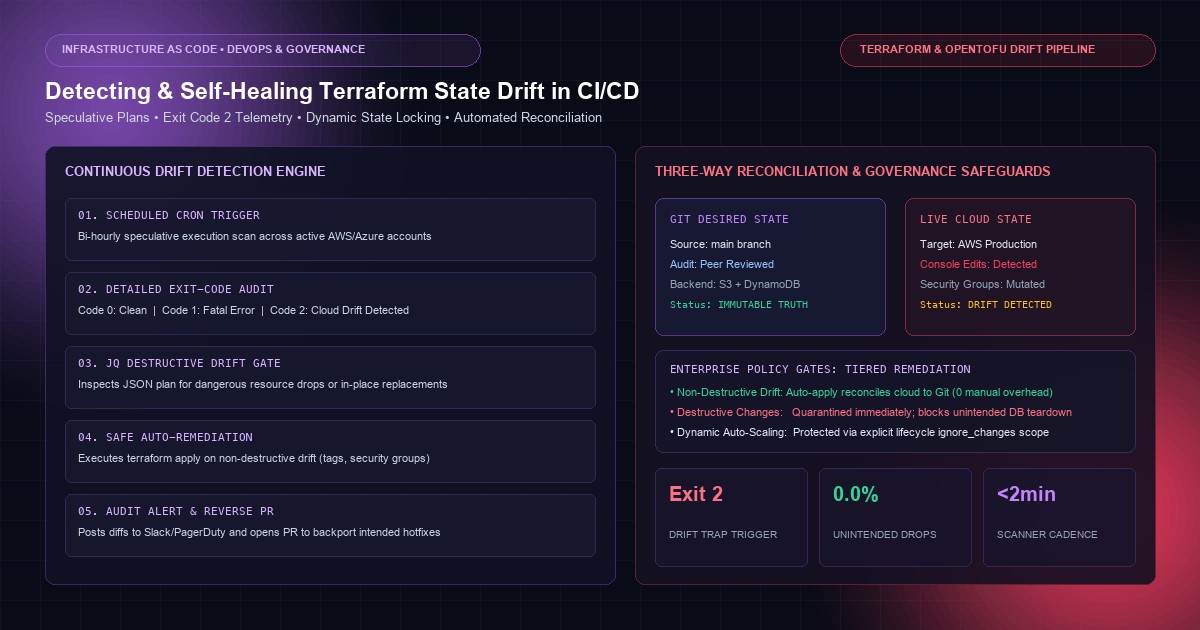
In enterprise infrastructure engineering, Infrastructure as Code (IaC) is anchored on a single foundational axiom: the committed Git repository is the absolute, immutable source of truth for all deployed cloud topology.
Yet in production reality, this axiom degrades continuously over time.
Engineers under high-severity incident pressure make emergency "hotfix" modifications via the AWS or Azure web console. Security engineers attach out-of-band monitoring agents or tweak network security group rules directly via CLI. Cloud provider background controllers inject default IAM tags, rotate TLS certificates, or update subnet routing tables.
Within weeks, the actual live state in the cloud diverges from the declared configuration stored in Git. This divergence is known as State Drift.
Unchecked state drift is among the most catastrophic latent vulnerabilities in cloud infrastructure. When a subsequent CI/CD pipeline runs terraform apply, Terraform attempts to reconcile the divergence, resulting in unexpected resource recreations, dropped database subnets, severed VPN tunnels, and unannounced production outages.
Achieving true infrastructure governance requires an Automated Drift Detection & Self-Healing Pipeline. By scheduling continuous speculative execution plans, leveraging exit-code telemetry (-detailed-exitcode), generating cryptographic drift signatures, and orchestrating automated reconciliation workflows, enterprises can detect, isolate, and remediate unauthorized cloud mutations within minutes.
At KNetwork's Cloud Migration & DevOps practice, we engineer zero-drift cloud foundations for regulated financial institutions and high-concurrency SaaS platforms. In this architectural guide, we dissect the mechanics of Terraform state corruption, build a continuous drift-detection engine in CI/CD, implement automated self-healing reconciliation loops, and establish an enterprise incident runbook.
1. Anatomy of State Drift: How Cloud Infrastructure Decays#
To detect drift effectively, we must first understand how Terraform tracks reality. Terraform maintains a state file (terraform.tfstate) that maps declared configuration blocks to real-world cloud resource IDs:
┌────────────────────────────────────────────────────────────────────────┐
│ TERRAFORM THREE-WAY RECONCILIATION MODEL                               │
└────────────────────────────────────────────────────────────────────────┘

    [Git Repository]                    [Terraform State File]
   Declared Desired State                Cached Recorded State
 (e.g. instance_type: t3.large)        (e.g. instance_type: t3.large)
            │                                      │
            │               ┌──────────────────────┘
            │               ▼
            │        [Cloud Provider API]
            │          Live Real State
            │    (Mutated: instance_type: t3.2xlarge via AWS Console)
            ▼               │
      [Terraform Plan] ◄────┘
      (Calculates Delta: Live State != Desired State)
During any terraform plan execution, Terraform performs a three-way reconciliation:
- Desired State: The declarative HCL code checked into the Git repository.
- Prior State: The cached metadata stored in the remote backend (S3 + DynamoDB locking, or Terraform Cloud).
- Live State: The real-time attributes returned by making live HTTP requests to cloud provider APIs (e.g.,
DescribeSecurityGroups,GetBucketPolicy).
1.1 The Three Categories of Drift#
State drift falls into three distinct operational vectors:
DRIFT TAXONOMY & THREAT VECTORS:

┌─────────────────┬───────────────────────────────┬────────────────────────────┐
│ Drift Type      │ Real-World Example            │ Blast Radius Risk          │
├─────────────────┼───────────────────────────────┼────────────────────────────┤
│ Security Drift  │ SSH (port 22) opened to 0.0.0.0 Security vulnerability;      │
│                 │ in production security group  │ breach exposure window     │
├─────────────────┼───────────────────────────────┼────────────────────────────┤
│ Financial Drift │ Instance 400 font-semibold">type upgraded 400 font-semibold">from   │ Budget overrun; unexpected │
│                 │ m5.xlarge to m5.8xlarge       │ cloud invoice spikes       │
├─────────────────┼───────────────────────────────┼────────────────────────────┤
│ Structural Drift│ Subnet CIDR modified or route │ Traffic blackholing during │
│                 │ table pointed to wrong transit│ next automated deployment  │
└─────────────────┴───────────────────────────────┴────────────────────────────┘
- In-Band Drift (Intended but Uncommitted): An engineer modifies infrastructure directly during an outage to restore service immediately, but forgets to backport the changes into the Git repository.
- Out-of-Band Drift (Security Violation / Rogue Change): A compromised credential or unauthorized developer alters resource boundaries outside approved Change Advisory Board (CAB) review.
- Provider-Side Drift (Implicit Cloud Mutation): Cloud provider APIs inject default values, modify sub-resource states, or update underlying hypervisor profiles without explicit user intervention.
2. The Core Detection Engine: -detailed-exitcode and Speculative Execution#
Standard terraform plan commands output human-readable text and exit with status code 0 regardless of whether differences exist. For automated CI/CD gating, this is unparseable.
The foundational primitive of automated drift detection is the -detailed-exitcode flag.
terraform plan -detailed-exitcode -no-color -out=drift.tfplan
2.1 The Return Code Contract#
When invoked with-detailed-exitcode, the Terraform binary returns standard POSIX exit codes:
┌───────────┬────────────────────────────────────────────────────────────┐
│ Exit Code │ Semantic Meaning in Pipeline Gating                       │
├───────────┼────────────────────────────────────────────────────────────┤
│ 0         │ Clean: No changes detected. Live state matches Git 100%.   │
│ 1         │ Fatal Error: Provider API failure, invalid credentials,     │
│           │ syntax error, or lock acquisition timeout.                 │
│ 2         │ Drift Detected: Differences exist between Git and Cloud.   │
└───────────┴────────────────────────────────────────────────────────────┘
By trapping Exit Code 2, CI/CD orchestrators (such as GitHub Actions, GitLab CI, or Argo Workflows) can immediately branch into specialized alerting, auditing, or remediation subroutines.
3. Remote State Locking & Concurrency Protection#
Before automating drift detection, the remote backend must be protected against race conditions. If an automated drift detection scanner runs a plan simultaneously with an engineer merging a feature branch, concurrent access could corrupt the state file or cause false-positive drift alarms.
3.1 Production AWS S3 + DynamoDB Backend Architecture (backend.tf)#
terraform {
  required_version = 400 font-semibold">class="text-emerald-300">">= 1.8.0"

  required_providers {
    aws = {
      source  = 400 font-semibold">class="text-emerald-300">"hashicorp/aws"
      version = 400 font-semibold">class="text-emerald-300">"~> 5.50.0"
    }
  }

  backend 400 font-semibold">class="text-emerald-300">"s3" {
    bucket         = 400 font-semibold">class="text-emerald-300">"knetwork-enterprise-tfstate-production"
    key            = 400 font-semibold">class="text-emerald-300">"infrastructure/networking/terraform.tfstate"
    region         = 400 font-semibold">class="text-emerald-300">"us-east-1"
    encrypt        = 400">true
    dynamodb_table = 400 font-semibold">class="text-emerald-300">"knetwork-tfstate-locks"

    400 font-semibold">class=400 font-semibold">class="text-emerald-300">"text-slate-500 italic"># Enforce TLS 1.3 on transport
    kms_key_id     = 400 font-semibold">class="text-emerald-300">"arn:aws:kms:us-east-1:112233445566:key/tfstate-key"
  }
}
DynamoDB uses the primary key LockID (string format: <bucket-name>/<key>-md5). When any Terraform operation begins, it writes an active lock item containing the operator's hostname, process ID, and timestamp. If another pipeline attempts to run concurrently, it receives a ResourceBusy exception and backs off automatically.
4. Architectural Decision: Self-Healing vs. Alert-Only Governance#
When drift is detected, systems must execute a response. The enterprise debate centers on whether to Self-Heal (Auto-Apply) or Alert-Only (Human Review):
┌────────────────────────────────────────────────────────────────────────┐
│ DRIFT REMEDIATION DECISION MATRIX                                      │
└────────────────────────────────────────────────────────────────────────┘

                         Drift Detected (Exit Code 2)
                                      │
                 ┌────────────────────┴────────────────────┐
                 ▼                                         ▼
       [NON-DESTRUCTIVE DRIFT]                    [DESTRUCTIVE DRIFT]
   (e.g., Security Group rule removed,      (e.g., Database cluster resized,
    IAM policy modified, tag altered)        VPC subnet CIDR changed)
                 │                                         │
                 ▼                                         ▼
      Automated Self-Healing                    Quarantine & Alert
  (Auto-run terraform apply)                 (Open P1 Incident & Draft PR)
                 │                                         │
                 ▼                                         ▼
     Cloud State Restored to Git               Engineer Reviews Out-of-Band Change
The Peril of Blind Auto-Apply: "Destructive Drift"#
Consider an emergency database resize: An engineer during a Black Friday traffic surge resizes a PostgreSQL Aurora cluster fromdb.r6g.large to db.r6g.4xlarge directly in the AWS console. The Git repository still specifies db.r6g.large.If an automated self-healing cron job wakes up and immediately executes terraform apply --auto-approve, it will downscale the production database during peak hours, inducing a major database reboot and severe downtime.
The Tiered Governance Solution#
- Tier 1 (Safe Self-Healing): For stateless compute, security groups, IAM policies, and tags, self-healing executes automatically.
- Tier 2 (Destructive Quarantine): If the plan indicates resource deletion (
destroy) or in-place replacement (forces replacement), the pipeline aborts automatic remediation, generates a high-severity P1 incident in PagerDuty, posts a sanitized visual diff to Slack, and opens an automated "Reverse PR" in GitHub.
5. Production Drift Pipeline: GitHub Actions Implementation#
Here is an end-to-end, production-grade GitHub Actions workflow that executes scheduled drift scans, parses output into JSON, alerts engineering teams via Slack, and generates audit artifacts.
5.1 The Workflow Manifest (.github/workflows/drift-detection.yml)#
name: 400 font-semibold">class="text-emerald-300">"Infrastructure Drift Detection"

on:
  schedule:
    400 font-semibold">class=400 font-semibold">class="text-emerald-300">"text-slate-500 italic"># Run every 2 hours on weekdays (08:00 to 20:00 UTC)
    - cron: 400 font-semibold">class="text-emerald-300">"0 */2 * * 1-5"
  workflow_dispatch: 400 font-semibold">class=400 font-semibold">class="text-emerald-300">"text-slate-500 italic"># Allows manual trigger

permissions:
  id-token: write 400 font-semibold">class=400 font-semibold">class="text-emerald-300">"text-slate-500 italic"># Required 400 font-semibold">for AWS OIDC authentication
  contents: read
  issues: write
  pull-requests: write

jobs:
  detect-drift:
    name: 400 font-semibold">class="text-emerald-300">"Scan & Analyze State Drift"
    runs-on: ubuntu-latest
    env:
      AWS_REGION: 400 font-semibold">class="text-emerald-300">"us-east-1"
      TF_ROOT: 400 font-semibold">class="text-emerald-300">"environments/production"

    steps:
      - name: 400 font-semibold">class="text-emerald-300">"Checkout Code Repository"
        uses: actions/checkout@v4

      - name: 400 font-semibold">class="text-emerald-300">"Configure AWS Credentials via OIDC"
        uses: aws-actions/configure-aws-credentials@v4
        with:
          role-to-assume: 400 font-semibold">class="text-emerald-300">"arn:aws:iam::112233445566:role/github-actions-terraform-drift"
          aws-region: ${{ env.AWS_REGION }}

      - name: 400 font-semibold">class="text-emerald-300">"Setup OpenTofu / Terraform"
        uses: hashicorp/setup-terraform@v3
        with:
          terraform_version: 400 font-semibold">class="text-emerald-300">"1.8.5"
          terraform_wrapper: 400">false 400 font-semibold">class=400 font-semibold">class="text-emerald-300">"text-slate-500 italic"># Preserves accurate binary exit codes

      - name: 400 font-semibold">class="text-emerald-300">"Initialize Terraform Backend"
        id: init
        run: |
          cd ${{ env.TF_ROOT }}
          terraform init -input=400">false

      - name: 400 font-semibold">class="text-emerald-300">"Execute Speculative Drift Plan"
        id: plan
        continue-on-error: 400">true
        run: |
          cd ${{ env.TF_ROOT }}
          400 font-semibold">class=400 font-semibold">class="text-emerald-300">"text-slate-500 italic"># Run plan with detailed exitcode
          terraform plan \
            -detailed-exitcode \
            -no-color \
            -out=drift.tfplan > plan_output.txt 2>&1

          EXIT_CODE=$?
          echo 400 font-semibold">class="text-emerald-300">"exitcode=$EXIT_CODE" >> $GITHUB_OUTPUT

          400 font-semibold">if [ $EXIT_CODE -eq 0 ]; then
            echo 400 font-semibold">class="text-emerald-300">"STATUS=CLEAN" >> $GITHUB_OUTPUT
          elif [ $EXIT_CODE -eq 2 ]; then
            echo 400 font-semibold">class="text-emerald-300">"STATUS=DRIFT_DETECTED" >> $GITHUB_OUTPUT
          400 font-semibold">else
            echo 400 font-semibold">class="text-emerald-300">"STATUS=FATAL_ERROR" >> $GITHUB_OUTPUT
          fi

      - name: 400 font-semibold">class="text-emerald-300">"Handle Clean State (No Drift)"
        400 font-semibold">if: steps.plan.outputs.exitcode == 400 font-semibold">class="text-emerald-300">'0'
        run: |
          echo 400 font-semibold">class="text-emerald-300">"✓ Infrastructure state is clean. Zero drift detected."

      - name: 400 font-semibold">class="text-emerald-300">"Handle Fatal Errors (Exit Code 1)"
        400 font-semibold">if: steps.plan.outputs.exitcode == 400 font-semibold">class="text-emerald-300">'1'
        run: |
          echo 400 font-semibold">class="text-emerald-300">"❌ Fatal error during plan execution."
          cat ${{ env.TF_ROOT }}/plan_output.txt
          exit 1

      - name: 400 font-semibold">class="text-emerald-300">"Process & Classify Drift (Exit Code 2)"
        400 font-semibold">if: steps.plan.outputs.exitcode == 400 font-semibold">class="text-emerald-300">'2'
        id: classify
        run: |
          cd ${{ env.TF_ROOT }}
          400 font-semibold">class=400 font-semibold">class="text-emerald-300">"text-slate-500 italic"># Convert binary plan to JSON 400 font-semibold">for machine parsing
          terraform show -json drift.tfplan > drift.json

          400 font-semibold">class=400 font-semibold">class="text-emerald-300">"text-slate-500 italic"># Inspect 400 font-semibold">if 400">any resources are marked 400 font-semibold">for destruction
          DELETES=$(jq 400 font-semibold">class="text-emerald-300">'[.resource_changes[] | select(.change.actions[] | contains("delete"))] | length' drift.json)
          echo 400 font-semibold">class="text-emerald-300">"deletions=$DELETES" >> $GITHUB_OUTPUT

          echo 400 font-semibold">class="text-emerald-300">"400 font-semibold">class="text-slate-500 italic400 font-semibold">class="text-emerald-300">">### ⚠️ TERRAFORM STATE DRIFT DETECTED" >> $GITHUB_STEP_SUMMARY
          echo 400 font-semibold">class="text-emerald-300">"Detected Out-of-Band Cloud Modifications." >> $GITHUB_STEP_SUMMARY
          echo 400 font-semibold">class="text-emerald-300">"Destructive Deletions in Plan: **$DELETES**" >> $GITHUB_STEP_SUMMARY
          echo '
diff' >> $GITHUB_STEP_SUMMARY
tail -n 100 plan_output.txt >> $GITHUB_STEP_SUMMARY
echo '``' >> $GITHUB_STEP_SUMMARY
- name: "Dispatch Security Alert to Slack"
if: steps.plan.outputs.exitcode == '2'
uses: slackapi/slack-github-action@v1.26.0
with:
payload: |
{
"text": "🚨 *Terraform Infrastructure Drift Detected in Production!*",
"blocks": [
{
"type": "section",
"text": {
"type": "mrkdwn",
"text": "⚠️ *Drift Alert: production Environment*\nLive cloud infrastructure has diverged from main branch Git state.\n*Destructive Deletions:* ${{ steps.classify.outputs.deletions }}\n*Scanner:* GitHub Actions Drift Cron"
}
},
{
"type": "actions",
"elements": [
{
"type": "button",
"text": { "type": "plain_text", "text": "View CI Run" },
"url": "${{ github.server_url }}/${{ github.repository }}/actions/runs/${{ github.run_id }}"
}
]
}
]
}
env:
SLACK_WEBHOOK_URL: ${{ secrets.SLACK_DEVOPS_WEBHOOK }}
- name: "Execute Safe Auto-Apply (If 0 Deletions)"
if: steps.plan.outputs.exitcode == '2' && steps.classify.outputs.deletions == '0' && env.ENABLE_SELF_HEAL == 'true'
run: |
cd ${{ env.TF_ROOT }}
echo "Reconciling non-destructive drift automatically..."
terraform apply -auto-approve drift.tfplan
echo "✓ Self-healing reconciliation complete."
__CODE_BLOCK_7__
hcl
resource "aws_autoscaling_group" "api_fleet" {
name_prefix = "knetwork-api-"
max_size = 50
min_size = 4
desired_capacity = 8
vpc_zone_identifier = var.private_subnet_ids
launch_template {
id = aws_launch_template.api_template.id
version = "$Latest"
}
# Isolate dynamic scaling from code repository drift
lifecycle {
ignore_changes = [
desired_capacity, # AWS ASG policies scale this dynamically
target_group_arns # Dynamic blue/green ingress switchers
]
}
}
__CODE_BLOCK_8__
REVERSE SYNCHRONIZATION WORKFLOW:
[Cloud Console Hotfix] ──► Emergency Change (e.g. timeout set to 60s)
│
▼
[Drift Scanner Alerts] ──► Identifies Delta: Cloud=60s, Git=30s
│
▼
[Architect Review] ──────► Approves Hotfix: "This change must stay."
│
▼
[Update Git Repository] ─► Edit HCL code: timeout = 60
│
▼
[Verify with Plan] ──────► terraform plan -detailed-exitcode
Exits with Status 0 (Clean).
__CODE_BLOCK_9__
bash
terraform plan -refresh-only
__CODE_BLOCK_10__
bash
terraform apply -refresh-only
__CODE_BLOCK_11__
DRIFT MANAGEMENT PLATFORM MATRIX:
┌───────────────────────────┬─────────────────────┬─────────────────────┬──────────────────┐
│ Architectural Vector │ Scheduled CI Cron │ GitOps Controller │ Commercial IaC │
│ │ (GitHub Actions) │ (Atlantis / Driftctl│ (Terraform Cloud)│
├───────────────────────────┼─────────────────────┼─────────────────────┼──────────────────┤
│ Detection Latency │ 1 - 2 Hours │ Real-time / Event │ Continuous (1h) │
│ Cost / Overhead │ Minimal (CI minutes)│ Cluster Pod Compute │ Per-resource fee │
│ Automated Self-Healing │ Configurable │ PR Bot / Auto-apply │ Policy-as-Code │
│ State Lock Protection │ DynamoDB Native │ Webhook Distributed │ Native Platform │
│ Security Boundary │ Cloud OIDC Roles │ Kubernetes Pod Role │ SaaS Connector │
│ Blast Radius Safeguards │ Scripted JQ Gates │ Custom Policy │ Sentinel / OPA │
└───────────────────────────┴─────────────────────┴───────────────────┴──────────────────┘
__CODE_BLOCK_12__
bash
aws dynamodb scan --table-name knetwork-tfstate-locks
__CODE_BLOCK_13__
bash
terraform plan -detailed-exitcode -no-color | tee /tmp/incident-drift.diff
__CODE_BLOCK_14__
bash
aws cloudtrail lookup-events \
--lookup-attributes AttributeKey=ResourceName,AttributeValue=sg-0a1b2c3d4e \
--max-results 5
`
4. **Determine Triage Path:**
   - If unauthorized / malicious: Execute
terraform apply -replace=... immediately to revert live cloud state back to Git baseline.
- If intentional hotfix: Execute Reverse Synchronization, update Git HCL code, run peer review, and merge to main.
---
## Frequently Asked Questions
### 1. What is the fundamental difference between State Drift and State Corruption?
State Drift occurs when the real-world cloud resources differ from the configuration defined in Git; both the cloud and the state file remain technically operational, but they disagree. State Corruption occurs when the terraform.tfstate file itself becomes invalid JSON, loses resource mapping pointers, or experiences truncated writes, preventing Terraform from executing any commands.
### 2. Why is terraform plan -detailed-exitcode required for automated drift detection?
Standard terraform plan returns an exit code of 0 even when differences exist between code and infrastructure. Adding -detailed-exitcode forces the CLI to return code 2 specifically when changes or drift are detected, allowing automated CI/CD scripts to trigger notifications or self-healing routines conditionally.
### 3. Can automated self-healing cause unintended outages?
Yes. If an engineer performed an emergency console modification (such as resizing an overloaded database or expanding an EBS volume) and the automated pipeline blindly runs terraform apply, it will revert the change, potentially re-triggering the original production outage. Production pipelines must inspect the plan for destructive actions (deletions or replacements) before auto-applying.
### 4. What is the modern replacement for terraform refresh?
In Terraform 1.5+, use terraform plan -refresh-only and terraform apply -refresh-only. Unlike legacy terraform refresh, which updated state immediately without human review, the -refresh-only flag allows engineers to inspect the exact changes that will be captured into the state before committing them.
### 5. How should dynamic attributes like Auto Scaling Group capacity be handled?
Attributes that are modified by cloud runtime controllers (such as AWS Auto Scaling policies or blue/green traffic shifts) should be declared inside a lifecycle { ignore_changes = [desired_capacity] }` block. This informs Terraform that mutations to this specific attribute are intended and should not trigger drift alerts.
Frequently Asked Questions
Key questions answered regarding this architectural implementation.
Danisur Rahman
Lead AuthorPrincipal Cloud & DevOps Architect • KNetwork Systems
Principal architect specializing in enterprise distributed systems, edge caching, and hardware integration pipelines. Leads engineering audits, high-concurrency database optimizations, and zero-trust VPC deployments across high-growth ventures.
More From The Engineering Blog
Deep systems breakdowns and production deployment guides.
First-Party Attribution Engines: Reconciling Offline CRM Sales with Web CAPI
Bypass pixel loss and iOS privacy barriers: Architect server-side first-party attribution, stitch deterministic identity graphs, and sync offline CRM deals to Meta CAPI.
Zero-Copy Parquet Lakehouses: Ingesting IoT Telemetry with Apache Iceberg
Eliminate Hive directory bottlenecks and small-file chaos: ACID snapshot trees, automated asynchronous compaction, hidden partitioning, and zero-copy multi-engine analytics.
Enjoyed this technical breakdown?
Subscribe to receive new architectural guides, system teardowns, and engineering benchmarks directly in your inbox.