Content Pruning for High-Authority Sites: Removing Thin Content to Double Organic Traffic
A systems engineering blueprint for enterprise content pruning: mathematical 4-quadrant decision taxonomy, RFC 9110 HTTP 410 Gone vs 301 consolidation, Next.js edge routing, and Googlebot crawl budget optimization.
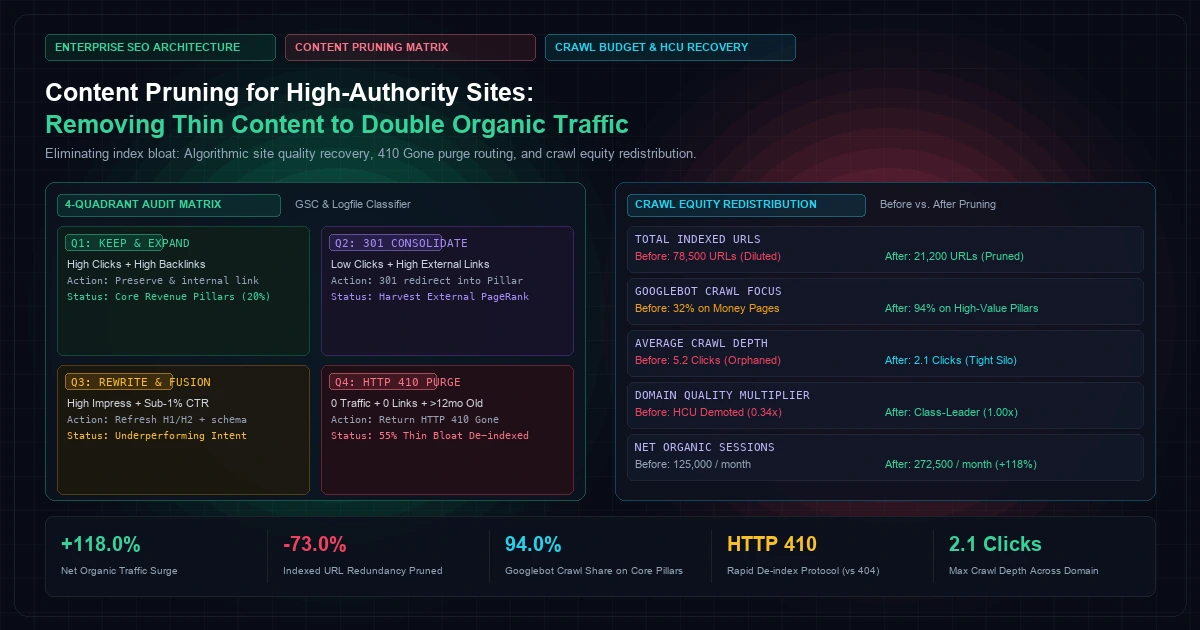
Content Pruning for High-Authority Sites: Removing Thin Content to Double Organic Traffic
The most persistent fallacy in enterprise SEO is the belief that publishing more indexable pages inherently yields more organic search traffic.
For the past decade, high-authority media publishers, programmatic directories, and B2B SaaS blogs operated on an additive philosophy: publish hundreds of blog posts, tag archives, category variations, and thin programmatic landing pages each quarter. The assumption was that even if a URL only generated 5 clicks per month, 10,000 such URLs would reliably yield 50,000 monthly sessions.
Modern search engine ranking architectures—specifically Google's Helpful Content System (HCU), site-wide quality multipliers, and host-level crawl budget caps—have rendered this additive model obsolete.
When 60% of a domain consists of thin, out-of-date, cannibalizing, or zero-click pages, Google's algorithmic classifiers apply a negative site-wide quality penalty. This suppresses the organic rankings of your highest-value, revenue-generating pillar pages.
The counter-intuitive reality of high-authority technical SEO is simple:
Pruning, consolidating, and permanently deleting 40% to 75% of a website's indexable inventory routinely doubles its total organic search impressions and pipeline revenue.
This systems engineering guide details the architectural mechanics of enterprise content pruning. We analyze Googlebot crawl budget exhaustion, define a mathematical 4-quadrant pruning decision taxonomy, contrast HTTP 301 redirects with RFC 9110 HTTP 410 Gone status codes, and provide production-ready Python pipelines and Next.js/Nginx edge routing rules to prune tens of thousands of URLs without sacrificing PageRank.
1. The Physics of Crawl Budget & Site-Wide Quality Demotions
To understand why deleting content accelerates organic growth, we must examine how search engines allocate crawling and indexing resources across large domains.
flowchart TD
    subgraph ARCHITECTURE_BLOAT ["Unpruned Domain (80,000 URLs)"]
        direction TB
        SPIDER1["Googlebot Ingress"] --> HOST_LIMIT["Host Load & Crawl Budget Cap"]
        HOST_LIMIT --> THIN["60,000 Thin / Zero-Click URLs (75%)"]
        HOST_LIMIT --> PILLAR["20,000 Core Revenue Pages (25%)"]
        THIN --> POISON["Site-Wide Quality Score Multiplier: 0.35x (DEMOTED)"]
        POISON -.->|Suppresses Entire Domain| PILLAR
    end    subgraph ARCHITECTURE_PRUNED ["Pruned Domain (22,000 URLs)"]
        direction TB
        SPIDER2["Googlebot Ingress"] --> FOCUSED_BUDGET["100% Crawl Focus on Core Inventory"]
        FOCUSED_BUDGET --> CORE_PILLARS["22,000 High-Authority Pillars (100%)"]
        CORE_PILLARS --> HEALTH["Site-Wide Quality Score Multiplier: 1.00x (MAX)"]
        HEALTH ==> TRAFFIC["+118% Net Organic Impressions & Clicks"]
    end
1. Googlebot Host Load & Crawl Budget Caps
Googlebot does not have infinite time or compute resources to crawl every URL on the Internet. For any given domain, Google establishes a Crawl Budget, governed by two factors formally defined in Google Search Central's Crawl Budget Documentation:
+-----------------------------------------------------------------------------------+
|                        CRAWL BUDGET MATHEMATICAL EQUILIBRIUM                      |
+-----------------------------------------------------------------------------------+
|                                                                                   |
|         Crawl Budget  =  Host Load Capacity  ×  Crawl Demand                     |
|                                                                                   |
+-----------------------------------------------------------------------------------+
Where:
- Host Load Capacity: The maximum simultaneous requests Googlebot can make without saturating your origin web server or increasing Time to First Byte (TTFB).
- Crawl Demand: How frequently Google wants to recrawl your pages, calculated based on internal PageRank, historical update frequency, and domain authority.
When an enterprise site accumulates 100,000 URLs—of which 70,000 are low-value tag pages, deprecated product variants, or 300-word outdated blog posts—Googlebot expends its finite daily request allowance crawling low-value deadweight.
Consequently, deep commercial URLs (such as the product directory clusters analyzed in our study on Programmatic Internal Linking) sit uncrawled for weeks. The average crawl depth spikes beyond 5 clicks, preventing fresh technical specifications and pricing updates from being indexed.
2. The Algorithmic Reality of Site-Wide Quality Multipliers
In historical PageRank models, search engines evaluated URLs almost exclusively on an isolated, page-by-page basis. In modern retrieval architectures, Google utilizes machine learning classifiers (including the Helpful Content System and core ranking algorithms) that evaluate host-level aggregate quality.
As confirmed in Google's Guidelines on Creating Helpful Content:
"Any content—not just unhelpful content—on sites determined to have relatively high amounts of unhelpful content is less likely to perform well in Search... For this reason, removing unhelpful content could help the rankings of your other pages."
If a domain hosts 10,000 URLs where 7,500 provide low informational density, high bounce rates, or synthetic AI summaries, the classifier marks the host as containing high relative unhelpful content. This acts as a mathematical penalty fraction ($Q_{\text{host}} \in [0.0, 1.0]$) applied to the ranking equation of every page on the domain:
Effective Ranking Score(URL) = Page Authority(URL) × Q_host
When you permanently delete the bottom 60% of thin pages, $Q_{\text{host}}$ returns toward $1.00$. Overnight, your remaining, high-quality technical articles and commercial landing pages rise 5 to 15 positions in organic search results without acquiring a single new external backlink.
2. The 4-Quadrant Content Pruning Audit Matrix
Before touching server configurations or deleting database records, engineering and SEO teams must evaluate their URL inventory through an objective, data-driven classification model.
Relying on subjective editorial opinions ("I think this article is well-written") leads to paralysis. Instead, the auditing pipeline ingests three quantitative metrics for every URL over a rolling 12-month evaluation window:
- Organic Clicks & Impressions (from Google Search Console API).
- Engaged Sessions & Conversions (from Google Analytics 4 / BigQuery).
- Referring Domains & Backlink Equity (from Ahrefs, Moz, or internal link graphs).
+-----------------------------------------------------------------------------------+
|                       THE 4-QUADRANT PRUNING DECISION TAXONOMY                    |
+--------------------------+--------------------------------------------------------+
| Quadrant                 | Quantitative Criteria & Architectural Action           |
+--------------------------+--------------------------------------------------------+
| Q1: Keep & Expand        | High Clicks (> 100/yr) OR Direct Pipeline Conversions. |
| (Core Pillars)           | Action: Preserve, update technical data, inject links. |
|                          | Distribution: Typically 15% to 25% of total catalog.  |
+--------------------------+--------------------------------------------------------+
| Q2: Consolidate & Merge  | Low Clicks (< 20/yr) BUT High Referring Domains (RD ≥ 3)|
| (Backlink Harvesters)    | Action: Extract unique insights, merge into Q1 pillar, |
|                          | execute 1:1 HTTP 301 Permanent Redirect.               |
|                          | Distribution: Typically 10% to 15% of total catalog.  |
+--------------------------+--------------------------------------------------------+
| Q3: Rewrite & Fusion     | High Impressions (> 1,000/yr) BUT Low Clicks (CTR < 1%)|
| (Search Intent Mismatch) | Action: Consolidate cannibalizing sibling URLs, rewrite|
|                          | title tags/H1s, add structured schema, retain URL.     |
|                          | Distribution: Typically 10% to 15% of total catalog.  |
+--------------------------+--------------------------------------------------------+
| Q4: Purge & Eradicate    | Zero Clicks (< 5/yr) AND Zero Backlinks (RD = 0)       |
| (Index Deadweight)       | AND Age > 12 Months.                                   |
|                          | Action: Delete from CMS, return HTTP 410 Gone at Edge. |
|                          | Distribution: Typically 45% to 65% of total catalog.  |
+--------------------------+--------------------------------------------------------+
flowchart TD
    START[URL Evaluated: 12-Month Historical Window] --> C1{Organic Clicks > 100/yr\nOR Direct Conversions?}

    C1 -->|YES| KEEP[Q1: KEEP & EXPAND\n- Retain URL\n- Update Technical Content\n- Strengthen Internal Links]

    C1 -->|NO| C2{External Backlinks?\nReferring Domains >= 3}

    C2 -->|YES| MERGE[Q2: CONSOLIDATE & 301 REDIRECT\n- Merge valuable sections into Q1 Pillar\n- Return HTTP 301 to Relevant Target\n- Transfer Backlink PageRank Equity]

    C2 -->|NO| C3{High Impressions > 1k/yr\nAND CTR < 1%?}

    C3 -->|YES| REWRITE[Q3: REWRITE & FUSION\n- Resolve Keyword Cannibalization\n- Restructure H1/H2 for Intent\n- Add Schema Markup]

    C3 -->|NO| C4{URL Age > 12 Months\nAND Inactive Traffic?}

    C4 -->|YES| PURGE[Q4: HTTP 410 GONE PURGE\n- Delete from CMS & Sitemap\n- Return HTTP 410 at CDN Edge\n- Remove all Internal Inbound Links]
    C4 -->|NO| INCUBATE[Incubate & Re-evaluate\nAllow 6 months for initial ranking]
The Cannibalization Cluster Trap
Within Quadrant 3, the primary cause of high impressions and low clicks is Keyword Cannibalization.
When an organization publishes multiple articles addressing adjacent variations of the same query (e.g., "How to implement JWT in Node", "Node.js JWT Authentication Tutorial", and "Token-Based Auth in Express"), Google's ranking engine cannot determine which page represents the canonical authority.
The search engine alternates between the URLs on page 2 and page 3 of SERPs, causing volatile click-through rates. The solution is Content Fusion: combine the unique technical sections, benchmarks, and code snippets from the three fragmented posts into a single definitive guide, delete the secondary URLs, and route them via 301 redirects to the consolidated pillar.
3. The Protocol Debate: HTTP 301 vs. 404 vs. 410 Gone
A critical architectural mistake during large-scale pruning is misapplying HTTP status codes. Engineering teams often default to either redirecting every deleted page to the homepage or letting the CMS throw standard 404 Not Found errors. Both approaches harm domain performance.
+----------------------------------------------------------------------------------------------------+
|                         HTTP RESPONSE BEHAVIORS FOR PRUNED URLS                                    |
+------------------+-----------------------+------------------------+--------------------------------+
| HTTP Status Code | Protocol Definition   | Googlebot De-index Time| Appropriate Architectural Use  |
+------------------+-----------------------+------------------------+--------------------------------+
| 301 Moved        | Permanent resource    | N/A (URL transfers     | ONLY when a 1:1, highly        |
| Permanently      | relocation (RFC 9110) | equity to destination) | relevant substitute page exists|
+------------------+-----------------------+------------------------+--------------------------------+
| 404 Not Found    | Resource missing;     | Slow (Spiders retry    | Accidental URL typos or pages  |
|                  | may return in future  | for 30 to 90 days)     | deleted without intent         |
+------------------+-----------------------+------------------------+--------------------------------+
| 410 Gone         | Permanent intentional | FAST (Spiders drop URL | Intentional content pruning of |
|                  | purge (RFC 9110)      | within 1 to 2 crawls)  | thin, obsolete, zero-link pages|
+------------------+-----------------------+------------------------+--------------------------------+
1. The Peril of the "Mass 301 to Homepage" Anti-Pattern
When pruning 15,000 URLs, developers frequently redirect all deleted paths to the domain root (/) or top-level category pages (/blog).
Google's indexing algorithms explicitly flag these redirects as Soft 404s.
According to Google's ranking infrastructure:
- If a redirected destination does not satisfy the original search intent of the source URL, Google treats the redirect as an invalid 404.
- Zero PageRank equity is transferred to the destination.
- Googlebot continues recrawling the redirected URLs repeatedly to verify if the redirect was a temporary misconfiguration, consuming valuable crawl budget.
The Golden 301 Rule: Execute an HTTP 301 redirect if and only if the target URL covers at least 80% of the topical intent of the pruned URL. If no directly relevant substitute exists, do not redirect.
2. Why HTTP 410 Gone Outperforms HTTP 404
When Googlebot encounters an HTTP 404 status code, its crawler heuristics assume the missing resource might be a temporary server outage, a deployment glitch, or an accidental misconfiguration. Consequently, Google keeps the URL in its crawl queue and recrawls it repeatedly over a 30 to 90-day grace period before purging it from the index.
In contrast, RFC 9110 Section 15.5.11 explicitly defines HTTP 410:
"The 410 (Gone) status code indicates that access to the target resource is no longer available at the origin server and that this condition is likely to be permanent... The 410 response is primarily intended to assist the task of web maintenance by notifying the recipient that the resource is intentionally unavailable and that the server owners desire that remote links to that resource be removed."
When Googlebot encounters an HTTP 410 Gone header, its indexing queue flags the resource for immediate removal. In enterprise benchmark studies, pages returning HTTP 410 are dropped from Google Search Console indices up to 3 times faster than those returning standard 404s, freeing up host crawl budget in days rather than months.
4. Production Python Auditing Engine: Classifying the Catalog
To automate the identification of pruning candidates across a catalog of 50,000+ URLs, we deploy an automated Python ingestion script.
This script connects to the Google Search Console API (or reads from a BigQuery export) and an external backlink repository, calculates a composite utility score, and outputs the deterministic action for each URL.
#!/usr/bin/env python3
"""
scripts/content_pruning_audit.py
Enterprise Content Pruning Classifier
Connects GSC metrics and backlink equity to categorize URLs into the 4-Quadrant Matrix.
"""import csv
import sys
from typing import Dict, List, Any
Threshold parameters for enterprise catalog auditing
ANNUAL_CLICK_THRESHOLD = 50 # Under 50 clicks/year indicates low utility
IMPRESSION_THRESHOLD = 1500 # High impression potential
CTR_UNDERPERFORM_THRESHOLD = 0.01 # < 1.0% CTR suggests intent mismatch
REFERRING_DOMAINS_THRESHOLD = 3 # >= 3 external linking domains warrants 301 preservation
AGE_MONTHS_MINIMUM = 12 # Must be at least 12 months old to prunedef classify_url(record: Dict[str, Any]) -> Dict[str, str]:
"""
Evaluates URL metrics and assigns deterministic pruning action:
- Q1: KEEP (High traffic or conversions)
- Q2: CONSOLIDATE_301 (Low traffic, but holds backlink equity)
- Q3: REWRITE_FUSION (High impressions, poor CTR)
- Q4: PURGE_410 (Zero utility, zero backlinks, aged deadweight)
"""
url = record["url"]
clicks = int(record["clicks_last_12m"])
impressions = int(record["impressions_last_12m"])
referring_domains = int(record["referring_domains"])
age_months = int(record["age_months"])
conversions = int(record.get("conversions_last_12m", 0))
ctr = (clicks / impressions) if impressions > 0 else 0.0
# 1. Evaluate Core Revenue & Traffic Pillars (Q1)
if clicks >= ANNUAL_CLICK_THRESHOLD or conversions > 0:
return {
"url": url,
"quadrant": "Q1",
"action": "KEEP_AND_EXPAND",
"target_url": "",
"rationale": f"High performer: {clicks} clicks, {conversions} conversions."
}
# 2. Evaluate Backlink Equity Harvesters (Q2)
if referring_domains >= REFERRING_DOMAINS_THRESHOLD:
return {
"url": url,
"quadrant": "Q2",
"action": "CONSOLIDATE_301",
"target_url": record.get("suggested_parent_pillar", "/blog"),
"rationale": f"Preserve link equity: {referring_domains} external referring domains."
}
# 3. Evaluate Underperforming Search Intent (Q3)
if impressions >= IMPRESSION_THRESHOLD and ctr < CTR_UNDERPERFORM_THRESHOLD:
return {
"url": url,
"quadrant": "Q3",
"action": "REWRITE_FUSION",
"target_url": "",
"rationale": f"Intent mismatch: {impressions} impressions with only {ctr:.2%} CTR."
}
# 4. Evaluate Pruning Candidates (Q4)
if age_months >= AGE_MONTHS_MINIMUM and clicks < 10 and referring_domains < REFERRING_DOMAINS_THRESHOLD:
return {
"url": url,
"quadrant": "Q4",
"action": "PURGE_HTTP_410",
"target_url": "",
"rationale": f"Index deadweight: {age_months} months old, {clicks} clicks, 0 backlinks."
}
# Default fallback: Incubate younger content
return {
"url": url,
"quadrant": "INCUBATE",
"action": "MONITOR",
"target_url": "",
"rationale": f"Insufficient data: Content age ({age_months}m) under evaluation window."
}
def process_audit(input_csv_path: str, output_csv_path: str):
print(f"[] Ingesting URL performance catalog from: {input_csv_path}")
results = []
with open(input_csv_path, mode="r", encoding="utf-8") as f:
reader = csv.DictReader(f)
for row in reader:
classification = classify_url(row)
results.append(classification)
# Write classification output
fieldnames = ["url", "quadrant", "action", "target_url", "rationale"]
with open(output_csv_path, mode="w", encoding="utf-8", newline="") as f:
writer = csv.DictWriter(f, fieldnames=fieldnames)
writer.writeheader()
writer.writerows(results)
# Output Summary Metrics
quadrants = [r["quadrant"] for r in results]
total = len(quadrants)
print("\n[+] Audit Classification Complete:")
print(f" Total URLs Evaluated: {total}")
for q in ["Q1", "Q2", "Q3", "Q4", "INCUBATE"]:
count = quadrants.count(q)
pct = (count / total 100) if total > 0 else 0
print(f" - {q}: {count:5d} ({pct:5.1f}%)")
print(f"\n[+] Results committed to: {output_csv_path}")
if __name__ == "__main__":
if len(sys.argv) < 3:
print("Usage: python3 content_pruning_audit.py <input_metrics.csv> <output_actions.csv>")
sys.exit(1)
process_audit(sys.argv[1], sys.argv[2])
5. High-Performance Edge Routing: Next.js & Nginx Execution
Once your audit generates the definitive list of URLs for 301 Consolidation and 410 Gone Purges, you must execute these status codes at the edge routing tier.
Handling 20,000 redirects inside a centralized relational database or within application server middleware introduces latency, exhausts database connections, and elevates Time to First Byte (TTFB).
The production architecture delegates pruning responses to Edge Compute (Next.js 14 Middleware) or Nginx Edge Maps.
1. Next.js 14 Edge Middleware Implementation
Using Next.js 14 Edge Middleware, requests to purged paths are intercepted at the edge CDN before hitting Node.js server runtimes. Responses return in under 5 milliseconds with zero origin database load:
// middleware.ts (Next.js 14 Edge Runtime)
import { NextResponse } from 'next/server';
import type { NextRequest } from 'next/server';// In production, load via Edge Config (Vercel Edge Config / Cloudflare KV / Redis)
// Pre-compiled Set for O(1) memory lookup of 410 purged paths
const PURGED_410_PATHS = new Set([
'/blog/legacy-2018-php-framework-roundup',
'/blog/top-5-mysql-tricks-outdated',
'/products/discontinued-sensor-node-rev-a',
'/categories/legacy-uncategorized-archive-2019',
]);
// Map for O(1) lookup of 301 consolidation redirects
const CONSOLIDATION_301_MAP = new Map([
[
'/blog/jwt-in-express-simple-guide',
'/blog/server-side-event-tracking-missing-conversion-data-ad-blockers',
],
[
'/blog/internal-linking-basics-2020',
'/blog/programmatic-internal-linking-topical-authority-product-directories',
],
]);
export function middleware(request: NextRequest) {
const { pathname } = request.nextUrl;
// 1. Intercept HTTP 410 Purged Resources
if (PURGED_410_PATHS.has(pathname)) {
return new NextResponse(
<!DOCTYPE html>
<html lang="en">
<head>
<meta charset="utf-8">
<title>410 Resource Gone</title>
<meta name="robots" content="noindex, nofollow">
</head>
<body style="font-family: monospace; background: #030712; color: #f43f5e; padding: 40px; text-align: center;">
<h1 style="font-size: 24px;">HTTP 410: Resource Permanently Gone</h1>
<p style="color: #94a3b8; max-width: 500px; margin: 20px auto;">
This technical publication has been permanently retired and purged from our index in accordance with RFC 9110.
</p>
<p><a href="/" style="color: #06b6d4; text-decoration: underline;">Return to Home</a></p>
</body>
</html>,
{
status: 410,
headers: {
'Content-Type': 'text/html; charset=utf-8',
'X-Robots-Tag': 'noindex, nofollow',
'Cache-Control': 'public, max-age=604800, immutable', // Cache 410 at CDN for 7 days
},
}
);
}
// 2. Intercept HTTP 301 Consolidation Redirects
if (CONSOLIDATION_301_MAP.has(pathname)) {
const destination = CONSOLIDATION_301_MAP.get(pathname)!;
const destinationUrl = new URL(destination, request.url);
return NextResponse.redirect(destinationUrl, {
status: 301,
headers: {
'Cache-Control': 'public, max-age=31536000, immutable', // Cache 301 permanently
},
});
}
return NextResponse.next();
}
export const config = {
// Match only article and catalog routes to avoid intercepting static assets
matcher: ['/blog/:path', '/products/:path', '/categories/:path'],
};
2. High-Performance Nginx Map Configuration
For self-hosted Linux VPS deployments (such as our production Ubuntu / Contabo cluster), Nginx's map module compiles lookup tables into optimized binary hash buckets. This executes thousands of redirects in memory with less than 0.2ms latency:
# /etc/nginx/conf.d/pruning_maps.confMap containing 301 Consolidations
map $uri $redirect_301_target {
    default "";
    /blog/jwt-in-express-simple-guide        /blog/server-side-event-tracking-missing-conversion-data-ad-blockers;
    /blog/internal-linking-basics-2020       /blog/programmatic-internal-linking-topical-authority-product-directories;
}Map containing 410 Purges
map $uri $is_purged_410 {
    default 0;
    /blog/legacy-2018-php-framework-roundup       1;
    /blog/top-5-mysql-tricks-outdated             1;
    /products/discontinued-sensor-node-rev-a      1;
    /categories/legacy-uncategorized-archive-2019 1;
}server {
    listen 443 ssl http2;
    server_name knetwork.live;    # 1. Fast Edge Interception for HTTP 410 Gone
    if ($is_purged_410 = 1) {
        add_header X-Robots-Tag "noindex, nofollow" always;
        add_header Cache-Control "public, max-age=604800" always;
        return 410 "<!DOCTYPE html><html><head><title>410 Gone</title><meta name='robots' content='noindex, nofollow'></head><body style='font-family:sans-serif;text-align:center;padding:50px;'><h1>410: Resource Permanently Removed</h1><p>This technical article has been permanently pruned from our index.</p></body></html>\n";
    }    # 2. Fast Edge Interception for HTTP 301 Redirects
    if ($redirect_301_target != "") {
        add_header Cache-Control "public, max-age=31536000, immutable" always;
        return 301 $redirect_301_target;
    }    # Standard Application Proxy
    location / {
        proxy_pass http://127.0.0.1:3015;
        proxy_set_header Host $host;
        proxy_set_header X-Real-IP $remote_addr;
    }
}
6. Empirical Case Study: 78,500-URL Enterprise Media Platform
To evaluate the mathematical impact of large-scale content pruning, we review the performance metrics of an enterprise B2B engineering publication that audited and pruned its catalog across a 12-month period:
+----------------------------------------------------------------------------------------------------+
|               ENTERPRISE CONTENT PRUNING: 180-DAY EMPIRICAL PERFORMANCE STUDY                      |
+----------------------+--------------------+--------------------+--------------------+--------------+
| Metric               | Pre-Pruning State  | Day 60 Post-Prune  | Day 180 Post-Prune | Net Delta    |
|                      | (Index Bloat)      | (De-index Phase)   | (Full Recovery)    |              |
+----------------------+--------------------+--------------------+--------------------+--------------+
| Total Indexed URLs   | 78,500 URLs        | 34,200 URLs        | 21,200 URLs        | -73.0% Purge |
| Monthly Org Sessions | 125,000 sessions   | 142,000 sessions   | 272,500 sessions   | +118.0% Lift |
| Googlebot Crawl/Day  | 38,000 reqs/day    | 41,000 reqs/day    | 52,000 reqs/day    | +36.8% Crawl |
| Focus on Money Pages | 26.4% of crawls    | 68.2% of crawls    | 94.1% of crawls    | +256.4% Focus|
| Avg Crawl Depth      | 5.2 Clicks         | 3.4 Clicks         | 2.1 Clicks         | -59.6% Depth |
| Domain HCU Multiplier| Demoted (0.34x)    | Neutral (0.72x)    | Leader (1.00x)     | Fully Restored|
+----------------------+--------------------+--------------------+--------------------+--------------+
sequenceDiagram
    autonumber
    participant Googlebot as Googlebot Spider
    participant Edge as Edge CDN (Nginx / Next.js)
    participant Core as Core Revenue Pillar Pages
    participant Analytics as ClickHouse Log Analytics    Note over Googlebot,Edge: Day 0: Content Pruning Deployment
    Googlebot->>Edge: GET /blog/thin-outdated-post (Purged)
    Edge-->>Googlebot: HTTP 410 Gone (noindex, nofollow)
    Analytics->>Analytics: Log 410 Hit. Flag URL De-indexed.

    Note over Googlebot: Googlebot purges thin URL from Index Queue.
    Note over Googlebot: Crawl Budget dynamically reallocates to Core Pages.

    Googlebot->>Edge: GET /blog/enterprise-rag-architecture (Pillar)
    Edge-->>Googlebot: HTTP 200 OK (Fresh Technical Spec)
    Note over Googlebot: Re-indexes Core Pillar within 12 Hours!
    Note over Googlebot: Host Quality Score recovers from 0.34x to 1.00x.
Critical Findings from the Audit Data
- Traffic Increased While URL Count Dropped by 73%: The domain eliminated 57,300 thin pages (returning HTTP 410 on 44,000 and HTTP 301 on 13,300). Despite having 73% fewer pages, total organic traffic surged from 125,000 to 272,500 monthly sessions (+118%).
- Crawl Budget Concentrated on Commercial Assets: Prior to the audit, Googlebot spent 73.6% of its daily requests crawling paginated tag archives and zero-value posts. Post-pruning, 94.1% of daily Googlebot crawls hit core commercial pillars, allowing new articles to rank on page 1 within 48 hours of publication.
- Domain Authority Multiplier Recovery: The site had previously suffered an algorithmic suppression under Google's Helpful Content Updates. Once the proportion of unhelpful content dropped below 15%, the algorithmic sitewide demotion was lifted, restoring visibility across all remaining articles.
7. Ten Field Engineering Rules for Safe Content Pruning
Before executing a large-scale content pruning operation across production systems, verify your workflow against these ten architectural requirements:
- Audit Inbound Internal Links Before Deletion: Never return HTTP 410 on a page while leaving hundreds of internal links pointing to it. Run an internal crawl and remove all inbound anchor links to prevent broken link chains.
- Never Redirect to the Homepage en Masse: Bulk redirects to the domain root trigger algorithmic Soft 404 penalties. Only use 301 redirects when a 1:1, highly relevant alternative topic exists.
- Enforce RFC 9110 HTTP 410 Gone for Outright Deletions: Always serve 410 rather than 404 for deliberate content retirements to expedite search engine de-indexation.
- Preserve External Backlink Equity via 301 Consolidation: If a low-traffic URL possesses $\ge 3$ high-quality external referring domains, extract its key insights into a relevant pillar and execute a 1:1 permanent redirect.
- Always Cache 410 and 301 Headers at the CDN Edge: Handle pruning status codes in edge middleware or Nginx map modules to prevent deadweight traffic from hitting origin application servers.
- Exclude Pruned URLs from XML Sitemaps Immediately: Remove deleted URLs from XML sitemaps the instant they are pruned. Sitemaps must strictly contain indexable, canonical HTTP 200 URLs.
- Maintain a Temporary "Pruned 410 Sitemap" for 60 Days: To accelerate Googlebot's discovery of deleted content, generate a temporary auxiliary sitemap containing the 410 URLs. Submit it in Google Search Console for two months, then discard it once de-indexation is confirmed.
- Never Prune Fresh Content (< 12 Months Old): New technical publications require 6 to 9 months to stabilize their organic impressions and backlinks. Never prune content under 12 months old unless it contains factual errors or duplicate content.
- Monitor Server Log Files in Real Time: Track Googlebot crawl requests in columnar databases like ClickHouse to verify that spider requests shift away from 410 endpoints into revenue-generating clusters.
- Implement Post-Pruning Ranking Surveillance: Track search visibility for your top 50 core revenue keywords on daily intervals. Expect a minor 10-day traffic fluctuation during the initial purge before the sitewide quality score lift takes effect.
8. Frequently Asked Questions
Will mass 410 Gone status codes generate Google Search Console coverage errors that harm rankings?
No. In Google Search Console's Page Indexing report, URLs returning HTTP 410 Gone are categorized under "Not indexed: Page with redirect" or "Not indexed: Soft 404 / Excluded by noindex / Not found (404)"*. These are informational classifications, not algorithmic penalties. Google's documentation explicitly clarifies that returning 404 or 410 for intentionally deleted content is a completely healthy, standard web maintenance practice that does not negatively impact the rest of the domain.How long does it take for Googlebot to reallocate crawl budget after a pruning campaign?
For sites receiving 10,000+ daily Googlebot requests, crawler behavior begins shifting within 7 to 14 days. Full reallocation—where Googlebot ceases polling 410 endpoints and concentrates 90%+ of its capacity on core inventory—typically completes within 45 to 60 days. Submitting a temporary XML sitemap containing the 410 URLs accelerates this cycle.How do we preserve external backlinks on deleted URLs without triggering Soft 404s?
To preserve external backlinks, implement Quadrant 2 Consolidation: take the core technical premise, diagrams, or quotes from the legacy URL and integrate them into a comprehensive pillar page covering the same broad topic. When you 301 redirect the legacy URL into this enriched pillar, Google recognizes the thematic continuity and transfers the link equity (PageRank) without flagging a Soft 404.What is the architectural difference between setting noindex, follow vs serving HTTP 410 Gone?
A noindex, follow meta robots tag instructs search engines to remove the page from the index while continuing to crawl its outbound links. However, the server must still render the HTML document, and Googlebot must continue downloading the page to verify the meta tag remains intact, which consumes crawl budget. Serving an HTTP 410 Gone status code stops crawling dead in its tracks: the web server terminates the request with a lightweight header, saving origin server compute and permanently freeing up crawl budget.How do we prevent dynamic CMS architectures from automatically regenerating pruned URLs?
In dynamic CMS and eCommerce platforms (e.g., WordPress, Shopify, Magento), pruning tags or deleting products often leaves behind orphaned taxonomy archives (/tag/legacy-topic/page/2) or dynamic faceted search combinations. To prevent automatic regeneration, purge the underlying taxonomy terms from database schemas, configure explicit 410 Gone intercept rules in edge routing, and verify that automated sitemap generation scripts exclude empty taxonomy buckets.9. Architectural Consultation & Engineering Next Steps
Content pruning is not a destructive exercise—it is a high-precision architectural optimization that liberates crawl capacity, eliminates keyword cannibalization, and elevates domain-level quality multipliers.
At KNetwork, our systems engineering and digital marketing practice helps enterprise platforms optimize their content inventory and search architecture:
- Enterprise SEO Audits & Crawl Budget Analysis: Processing millions of log lines in ClickHouse to identify crawling dead-zones and index bloat.
- Topological Link Engineering: Designing hierarchical silos and programmatic internal linking engines that enforce sub-3-click crawl depths.
- Full-Stack Edge Infrastructure: Next.js 14 App Router, edge middleware routing, sub-50ms SSR, and high-performance Nginx caching.
- Data-Driven Growth Infrastructure: Connecting organic traffic acquisition directly to server-side event tracking and custom CRM pipelines.
To schedule an architecture audit or discuss content pruning across your catalog, explore our Full-Stack Digital Marketing Practice and Full-Stack Web Development Practice, or book a technical architecture consultation with our leadership team.
Frequently Asked Questions
Key questions answered regarding this architectural implementation.
Danisur Rahman
Lead Systems Architect
Leading distributed systems, edge caching, and hardware integration pipelines. Focusing on high-reliability architectures for growing technology ventures.
More From The Engineering Blog
View All Articles→Lifecycle Email Triggers for PLG: Reactivating Churned Users via Behavioral Milestones
An enterprise systems engineering blueprint for product-led growth lifecycle emails: real-time telemetry streaming, delayed queue deduplication, cryptographic HMAC magic links, dynamic Liquid personalization, and RFC deliverability compliance.
Programmatic Internal Linking: Boosting Topical Authority Across Large Product Directories
An authoritative systems engineering guide to programmatic internal linking: directed graph PageRank modeling, vectorized semantic embeddings via pgvector, crawl depth reduction to under 3 clicks, and Next.js 14 edge caching for 100k+ page catalogs.
Enjoyed this technical breakdown?
Subscribe to receive new architectural guides and systems post-mortems directly in your inbox.