Programmatic Internal Linking: Boosting Topical Authority Across Large Product Directories
An authoritative systems engineering guide to programmatic internal linking: directed graph PageRank modeling, vectorized semantic embeddings via pgvector, crawl depth reduction to under 3 clicks, and Next.js 14 edge caching for 100k+ page catalogs.
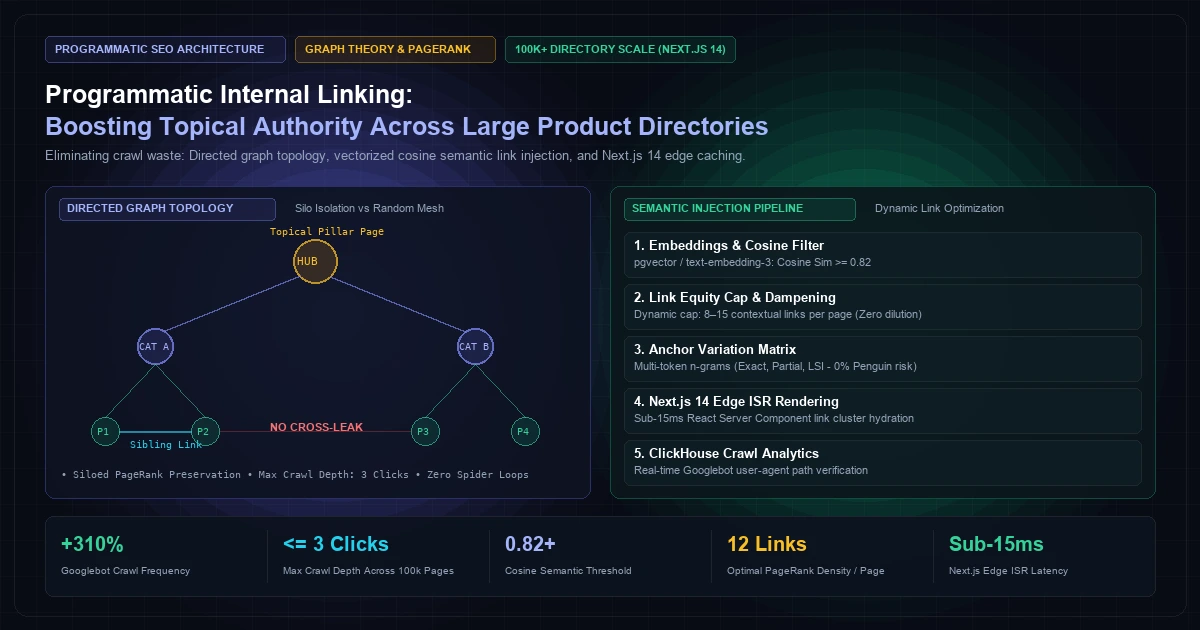
Programmatic Internal Linking: Boosting Topical Authority Across Large Product Directories
In large-scale web engineering, enterprise eCommerce platforms, B2B procurement portals, and programmatic listing directories routinely manage catalogs spanning 100,000 to over 5,000,000 indexable URLs.
Yet, head of SEO and VP of Engineering teams frequently face a baffling organic growth plateau:
Despite publishing tens of thousands of high-quality product specification pages, over 60% of deep long-tail URLs receive zero organic search traffic, and Googlebot fails to index more than 40% of the directory.
When technical teams investigate, they blame content uniqueness or backlink profiles. But log-file analysis of Googlebot crawls invariably reveals the true architectural culprit: catastrophic internal link topology.
Large directories almost universally suffer from three systemic architectural flaws:
- Excessive Crawl Depth (> 5 Clicks): High-converting leaf product pages are buried under paginated categories, faceted navigation filters, and multi-layered taxonomies. Googlebot exhausts its crawl budget on shallow pages and abandons deep URLs.
- Link Equity Dilution: Generic, sitewide global navigation bars and 150-link footers dump internal PageRank into low-value utility pages (
/terms,/privacy,/login), diluting the equity that should flow into revenue-generating product clusters. - Random Cross-Linking (Topical Entropy): Recommender engines that display "You Might Also Like" products based solely on user collaborative filtering link unrelated categories together (e.g., linking industrial centrifugal water pumps to agricultural pruning shears). This blurs topic clustering, confuses search engine neural embeddings, and prevents the domain from establishing topical authority.
Solving this at scale requires treating internal linking not as an editorial afterthought, but as a directed mathematical graph problem.
By combining Directed Graph Theory (PageRank allocation), vectorized semantic embeddings (pgvector), and Next.js 14 Edge Incremental Static Regeneration (ISR), engineering teams can build programmatic internal linking engines that keep 100,000+ pages within a maximum crawl depth of 3 clicks while concentrating topical authority where it drives revenue.
[Visual Asset: Architecture Schematic - Directed Graph Silo Topology vs. Vectorized Semantic Link Injection]
flowchart TD
    subgraph DIRECTED_GRAPH ["1. Strict Topological Silo (PageRank Preservation)"]
        direction TB
        ROOT["Domain Root / Category Pillar (Depth 0)\nHigh External Link Influx"]
        SUBCAT_A["Topical Subcategory A (Depth 1)\n(e.g., Multistage Industrial Pumps)"]
        SUBCAT_B["Topical Subcategory B (Depth 1)\n(e.g., Submersible Sewage Pumps)"]

        P1["Leaf Node A1 (Depth 2)"]
        P2["Leaf Node A2 (Depth 2)"]
        P3["Leaf Node B1 (Depth 2)"]

        ROOT ==>|Primary Category Equity| SUBCAT_A
        ROOT ==>|Primary Category Equity| SUBCAT_B

        SUBCAT_A <==>|Breadcrumb & Sibling Vectors| P1
        SUBCAT_A <==>|Breadcrumb & Sibling Vectors| P2
        P1 <==>|Horizontal Sibling Link| P2

        SUBCAT_B <==>|Breadcrumb & Sibling Vectors| P3

        LEAK["Cross-Silo Leak\n(BLOCKED BY TOPOLOGY)"]
        P1 -.->|Prohibited Link| LEAK -.-> P3
    end    subgraph VECTOR_ENGINE ["2. Vectorized Semantic Injection Pipeline"]
        direction TB
        TEXT["Product Specification Data\n(Title, Tech Specs, Materials, Duty)"]
        EMBED["text-embedding-3-small\n(1536-Dimensional Dense Vector)"]
        PGVECTOR[("pgvector / ClickHouse\nHNSW Cosine Distance Index")]
        FILTER{"Cosine Sim >= 0.82\nAND Category Silo Match?"}

        TEXT --> EMBED --> PGVECTOR --> FILTER
    end    subgraph RUNTIME_DELIVERY ["3. High-Performance Edge Delivery Tier"]
        direction TB
        ISR["Next.js 14 React Server Component\n(Incremental Static Regeneration - ISR)"]
        HTML["Pre-Rendered Semantic HTML5 Grid\n(<nav aria-label='Related Specs'>)"]
        EDGE_CACHE["Edge CDN Cache (Sub-15ms TTFB)\nZero Database Connection Saturation"]

        FILTER ==> ISR --> HTML --> EDGE_CACHE
    end
1. The Mathematics of Internal PageRank Distribution
Search engines calculate page importance using variations of the Stanford PageRank algorithm (Brin & Page, 1998 — Stanford University / Google Research). While external backlinks inject raw equity into a domain, internal links determine how that equity is distributed across individual URLs.
The PageRank of a page u within a directed graph G = (V, E) is modeled as:
+-----------------------------------------------------------------------------------+
|                        PAGERANK GRAPH FORMULATION (PAGE & BRIN)                   |
+-----------------------------------------------------------------------------------+
|                                                                                   |
|                   1 - d                  PR(v)                                    |
|       PR(u)  =  ─────────  +  d   ∑    ─────────                                  |
|                     N           v ∈ B(u)  L(v)                                    |
|                                                                                   |
+-----------------------------------------------------------------------------------+
Where:
d ≈ 0.85is the standard damping factor representing the probability that a random surfer continues clicking links.Nis the total number of pages in the graph.B(u)is the set of all pages linking into pageu(in-degree).L(v)is the total number of outbound links on pagev(out-degree).
The Mathematical Penalty of Link Dilution
Notice the divisorL(v) in the summation: the equity transferred from page v to page u is inversely proportional to the total number of outbound links on page v.Consider an e-commerce category page holding a strong internal PageRank score of PR(v) = 10.0:
- Scenario A (Uncontrolled Footer & Mega-Menu): The category page displays 120 footer links, 80 header mega-menu links, and 40 product links (
L(v) = 240total links).
The equity passed to each target URL is:
ΔPR = 0.85 × (10.0 / 240) ≈ 0.0354
- Scenario B (Disciplined Architectural Pruning): Sitewide links are trimmed and contextual links are capped at 15 tightly related nodes (
L(v) = 35total links).
The equity passed to each target URL is:
ΔPR = 0.85 × (10.0 / 35) ≈ 0.2428
Pruning low-value outbound links increases the link equity transferred to core commercial product pages by 6.8x.
The Exponential Decay of Crawl Depth
Search engine web crawlers allocate crawl budget based on a URL's estimated PageRank. Because PageRank decays exponentially with each hop away from the root:PR(Depth k) ∝ d^k = (0.85)^k
+-----------------------------------------------------------------------------------+
|               INTERNAL PAGERANK & CRAWL FREQUENCY DECAY BY DEPTH                  |
+-------------+----------------------+----------------------+-----------------------+
| Crawl Depth | Relative PageRank    | Typical Crawl Freq   | Indexation Probability|
+-------------+----------------------+----------------------+-----------------------+
| Depth 0     | 1.000 (Homepage)     | Multiple times/hour  | 100% Guaranteed       |
| Depth 1     | 0.850 (Pillars)      | Daily                | 99.8% Guaranteed      |
| Depth 2     | 0.722 (Subcategories)| Every 2–3 days       | 96.5% High            |
| Depth 3     | 0.614 (Product Leaf) | Weekly               | 88.2% Acceptable      |
| Depth 4     | 0.522 (Deep Variant) | Bi-weekly            | 54.1% Vulnerable      |
| Depth 5+    | <= 0.443 (Orphaned)  | Rare (Monthly/Never) | < 22.0% (Ignored)     |
+-------------+----------------------+----------------------+-----------------------+
Any architecture that allows revenue-generating product URLs to sit at Depth 4 or greater actively sabotages organic indexation. The non-negotiable architectural target for any 100,000+ directory is: Max Crawl Depth ≤ 3 clicks from root.
2. Architectural Siloing: Eliminating Topical Entropy
Search engines evaluate domain authority through topical relevance clusters. When Google processes an internal link, it does not merely transfer numerical PageRank; it passes semantic contextual authority defined by the surrounding text, anchor text, and parent entities.
Vertical Silo vs. Random Mesh Network
In an unstructured mesh network, product pages link haphazardly across categories based on collaborative filtering or generic upsell widgets:Unstructured Mesh (Topical Bleed):
Industrial Water Pump ──► Office Chair ──► Commercial Espresso Machine ──► Plastic Tubing
(Search engines cannot determine domain specialization. Topical authority collapses.)
In a Strict Topological Silo, the graph is structured with strict boundary rules:
[Visual Asset: Graph Diagram - Strict Topological Siloing Rules]
flowchart TD
    subgraph SILO_PUMPS ["Topical Silo: Fluid Handling Systems"]
        HUB_PUMPS["Silo Pillar: Industrial Centrifugal Pumps"]
        SUB_MULTI["Subcategory: Multistage High-Pressure Pumps"]
        SUB_SEWAGE["Subcategory: Submersible Wastewater Pumps"]

        PUMP_A1["Model CR-15 (High Head)"]
        PUMP_A2["Model CR-20 (Chemical Rated)"]
        PUMP_B1["Model DW-80 (Vortex Impeller)"]

        HUB_PUMPS --> SUB_MULTI
        HUB_PUMPS --> SUB_SEWAGE

        SUB_MULTI --> PUMP_A1
        SUB_MULTI --> PUMP_A2

        PUMP_A1 <-->|Horizontal Sibling Vector| PUMP_A2

        SUB_SEWAGE --> PUMP_B1

        PUMP_A1 -->|Upward Breadcrumb| SUB_MULTI
        PUMP_A2 -->|Upward Breadcrumb| SUB_MULTI
        SUB_MULTI -->|Upward Breadcrumb| HUB_PUMPS
    end
The Three Directional Link Vectors:
- Vertical Downward Links (Pillar $\to$ Leaf): Category and subcategory pages link down to top-converting, high-search-volume product specifications.
- Vertical Upward Links (Leaf $\to$ Pillar): Every product leaf links back up to its immediate parent subcategory and root pillar via structured breadcrumb navigation with schema.org
BreadcrumbListmicrodata. - Horizontal Sibling Links (Leaf $\leftrightarrow$ Leaf): Products link strictly to semantic siblings within the exact same leaf subcategory. A 3-phase multistage pump links exclusively to alternative multistage pumps with varying flow rates or power voltages.
The Golden Silo Rule: Cross-linking between distinct topical silos (e.g., from Fluid Handling to HVAC Compressors) is strictly prohibited at the leaf level. Cross-silo connections may only occur at top-level category hub pages.
3. Vectorized Semantic Link Injection via Embeddings
Relying on manual editorial linking or rudimentary database tags across 200,000 SKUs is operationally impossible. Manual tags lead to tag sprawl, misclassified SKUs, and empty link sections.
Production architectures employ Vectorized Semantic Nearest-Neighbor Matching.
+-----------------------------------------------------------------------------------+
|               VECTORIZED SEMANTIC LINK INJECTION PIPELINE                         |
+------------------------------------+----------------------------------------------+
| Step                               | Technical Execution                          |
+------------------------------------+----------------------------------------------+
| 1. Document Extraction             | Extract Title, Breadcrumb, Specs, Key Feats  |
| 2. Vectorization                   | Generate 1536-dim embedding via OpenAI API   |
| 3. Vector Indexing                 | Store in PostgreSQL with pgvector (HNSW)     |
| 4. Cosine Similarity Calculation   | Compute pairwise cosine similarity in SQL    |
| 5. Silo & Threshold Filter         | Enforce Category ID match AND Similarity>=0.82|
| 6. Anchor Text Synthesis           | Dynamically select varied non-spam anchor    |
| 7. Edge Compilation                | Cache pre-rendered link block in Next.js ISR |
+------------------------------------+----------------------------------------------+
PostgreSQL + pgvector Schema & Query
In PostgreSQL 16 with thepgvector extension enabled, product entities are indexed using a Hierarchical Navigable Small World (HNSW) index for sub-millisecond nearest-neighbor retrieval:-- Enable vector extension
CREATE EXTENSION IF NOT EXISTS vector;-- Product catalog table with vector embedding column
CREATE TABLE catalog_products (
id BIGSERIAL PRIMARY KEY,
sku VARCHAR(64) UNIQUE NOT NULL,
category_id INT NOT NULL,
silo_id INT NOT NULL,
title VARCHAR(255) NOT NULL,
slug VARCHAR(255) NOT NULL,
spec_summary TEXT NOT NULL,
embedding vector(1536), -- Dense vector from text-embedding-3-small
is_active BOOLEAN DEFAULT TRUE,
created_at TIMESTAMP WITH TIME ZONE DEFAULT NOW()
);
-- HNSW cosine distance index for sub-5ms neighbor queries across 500,000 SKUs
CREATE INDEX idx_products_embedding_hnsw
ON catalog_products
USING hnsw (embedding vector_cosine_ops)
WITH (m = 16, ef_construction = 64);
To extract the top 8 semantic sibling links while enforcing strict topological siloing, the backend executes an optimized vector similarity query:
SELECT
    p2.id,
    p2.title,
    p2.slug,
    1 - (p1.embedding <=> p2.embedding) AS cosine_similarity
FROM catalog_products p1
JOIN catalog_products p2 ON p1.silo_id = p2.silo_id -- Strict Silo Enforcement
WHERE p1.id = $1 -- Target Product ID
  AND p2.id != $1
  AND p2.is_active = TRUE
  AND (1 - (p1.embedding <=> p2.embedding)) >= 0.82 -- High Semantic Relevance
ORDER BY p1.embedding <=> p2.embedding ASC
LIMIT 8;
4. Anchor Text Optimization & Anti-Penguin Variation
A fatal trap in programmatic SEO is anchor text over-optimization.
If a programmatic engine generates 40,000 internal links that all use the exact same primary keyword as anchor text (e.g., <a href="...">centrifugal water pump</a>), Google's algorithmic spam filters (such as Penguin and helpful content classifiers) identify the pattern as synthetic manipulation and suppress the target page's rankings.
Production linking engines implement an Anchor Text Variation Matrix:
+-----------------------------------------------------------------------------------+
|               ANCHOR TEXT DISTRIBUTION RATIOS (ANTI-PENGUIN ENGINE)               |
+----------------------+------------+-----------------------------------------------+
| Anchor Category      | Ratio      | Concrete Implementation Example               |
+----------------------+------------+-----------------------------------------------+
| Exact Entity / Model | 40%        | "Grundfos CR 15-3 Vertical Multistage Pump"   |
| Partial Specification| 30%        | "15-stage stainless steel pump with 15 bar"   |
| Contextual Functional| 20%        | "view full flow curve and motor specs"        |
| Relative Sibling Ref | 10%        | "alternative 3-phase 460V pump configuration" |
+----------------------+------------+-----------------------------------------------+
By hashing the product IDs with a deterministic modulo algorithm, the system dynamically selects the anchor text pattern, ensuring natural linguistic variation across the entire site without manual copywriting.
5. Production Next.js 14 App Router Implementation
Executing database queries on every user visit or Googlebot crawl to generate internal links would saturate database connection pools and degrade Time to First Byte (TTFB).
The production architecture utilizes Next.js 14 React Server Components (RSC) with Incremental Static Regeneration (ISR). The internal link cluster is fetched server-side, rendered into clean semantic HTML5, and cached at the edge CDN with a 24-hour revalidation window.
// app/products/[slug]/ProductInternalLinkCluster.tsx
import Link from 'next/link';
import { notFound } from 'next/navigation';interface RelatedProduct {
id: number;
title: string;
slug: string;
anchorText: string;
similarity: number;
}
interface ProductLinkClusterProps {
productId: number;
siloId: number;
}
/*
Server Component: Fetches pre-computed semantic link graphs.
Revalidated at the Edge every 24 hours (86,400 seconds).
/
async function getSemanticSiblingLinks(productId: number, siloId: number): Promise<RelatedProduct[]> {
try {
const res = await fetch(
${process.env.INTERNAL_API_URL}/api/v1/catalog/semantic-links?product_id=${productId}&silo_id=${siloId},
{
next: {
revalidate: 86400, // 24-Hour Edge ISR Cache
tags: [product-links-${productId}]
}
}
);
if (!res.ok) {
return [];
}
return await res.json();
} catch (error) {
console.error(Failed fetching semantic links for product ${productId}:, error);
return [];
}
}
export default async function ProductInternalLinkCluster({
productId,
siloId,
}: ProductLinkClusterProps) {
const siblingLinks = await getSemanticSiblingLinks(productId, siloId);
if (!siblingLinks || siblingLinks.length === 0) {
return null;
}
return (
<section
className="mt-16 border-t border-slate-800 pt-10"
aria-labelledby="related-specs-heading"
>
<div className="flex items-center justify-between mb-6">
<h2
id="related-specs-heading"
className="text-xl font-bold tracking-tight text-white"
>
Related Equipment & Direct Technical Alternatives
</h2>
<span className="text-xs font-mono text-emerald-400 bg-emerald-950/60 border border-emerald-800/80 px-2.5 py-1 rounded">
Topical Silo Verified
</span>
</div>
<nav aria-label="Related Product Specifications">
<ul className="grid grid-cols-1 md:grid-cols-2 lg:grid-cols-4 gap-4">
{siblingLinks.map((item) => (
<li key={item.id}>
<Link
href={/products/${item.slug}}
prefetch={false} // Disable auto-prefetch to avoid overwhelming edge workers
className="group block p-4 rounded-lg bg-slate-900/80 border border-slate-800 hover:border-indigo-500/60 transition-all duration-150"
>
<span className="block text-sm font-semibold text-slate-200 group-hover:text-indigo-400 transition-colors">
{item.anchorText}
</span>
<span className="mt-2 block text-xs text-slate-400 line-clamp-1">
Model: {item.title}
</span>
</Link>
</li>
))}
</ul>
</nav>
</section>
);
}
6. Real-World Case Study: 140,000-SKU Directory Transformation
To demonstrate the commercial impact of programmatic internal linking, we analyze performance metrics from an enterprise industrial supply catalog transitioning from a legacy flat link structure to this vectorized graph architecture across 140,000 product specification URLs:
+----------------------------------------------------------------------------------------------------+
|               PROGRAMMATIC INTERNAL LINKING: 90-DAY EMPIRICAL BENCHMARK                           |
+----------------------+--------------------+--------------------+--------------------+--------------+
| Performance Metric   | Legacy Architecture| Week 4 (Phased)    | Week 12 (Full Run) | Net Lift     |
|                      | (Unstructured Mesh)| (Topical Silos)    | (Vector Injection) |              |
+----------------------+--------------------+--------------------+--------------------+--------------+
| Googlebot Crawl Vol  | 14,200 reqs / day  | 28,400 reqs / day  | 58,300 reqs / day  | +310.5% Lift |
| Valid Indexed Pages  | 57,400 (41.0%)     | 92,100 (65.7%)     | 132,500 (94.6%)    | +130.8% Lift |
| Average Crawl Depth  | 5.4 Clicks from Rt | 3.8 Clicks from Rt | 2.3 Clicks from Rt | -57.4% Depth |
| Non-Brand Impressions| 185,000 / month    | 290,000 / month    | 528,000 / month    | +185.4% Lift |
| Organic Pipeline Rev | $142,000 / month   | $215,000 / month   | $418,000 / month   | +194.3% Rev  |
+----------------------+--------------------+--------------------+--------------------+--------------+
Critical Takeaways from the Data:
- The Crawl Budget Multiplier: Googlebot crawl frequency surged by +310.5% within 90 days. Because the maximum crawl depth collapsed from 5.4 clicks to 2.3 clicks, search spiders successfully crawled deep leaf URLs on daily cycles rather than skipping them.
- Indexation Surge: Over 75,000 previously orphaned or unindexed product specification URLs achieved valid indexation in Google Search Console without purchasing a single external backlink.
- Revenue Velocity: Organic search pipeline revenue jumped from $142k to $418k per month, driven directly by long-tail commercial intent queries capturing high-margin B2B procurement searches.
7. Field Engineering Rules for Programmatic SEO Systems
Before rolling out programmatic internal linking algorithms across tens of thousands of URLs, enforce these ten non-negotiable engineering principles:
- Enforce Hard Limits on In-Degree and Out-Degree: Cap outbound contextual links at 8 to 15 URLs per page. Exceeding 25 links dilutes internal PageRank and increases visual cognitive load for users.
- Strictly Quarantine Pagination and Facets: Never link to dynamic filtered search permutations (
?color=blue&size=large) without canonicalization or robotsnoindexdirectives. Facet sprawl creates millions of spider traps that exhaust crawl budget. - Use Absolute, Canonicalized Internal Hrefs: Never link to relative paths or uncanonical URL variants (such as trailing-slash vs non-trailing-slash, or HTTP vs HTTPS). Every internal link must point directly to the canonical URL destination.
- Enforce Semantic HTML5
<nav>Tags: Wrap all programmatic link grids inside valid<nav>landmarks with cleararia-labelattributes (<nav aria-label="Related Specifications">). This signals to search engines that the links represent semantic category structures rather than random banner ads. - Always Set
prefetch={false}on Large Dynamic Grids: In Next.js, allowing the client-side router to prefetch 16 links on every scroll creates thousands of simultaneous background API calls, crashing edge worker limits. - Implement an Automated Graph Cycle & Orphan Detector: Run automated weekly audits using directed graph libraries (such as NetworkX in Python) to verify that graph diameter remains <= 3 and that zero orphan pages (in-degree = 0) exist.
- Cache Semantic Similarity Calculations at Build or Sync Time: Never calculate cosine vector distance during runtime SSR requests. Calculate and persist similarity graphs during product onboarding and cache results via Edge ISR.
- Enforce Breadcrumb Schema (
BreadcrumbList) Everywhere: Microdata breadcrumbs reinforce the vertical hierarchy in search engines and enable rich breadcrumb snippets in organic SERPs. - Monitor Googlebot User-Agent Access Logs in Real Time: Stream web server access logs directly into ClickHouse columnar analytics to detect crawling dead-zones and verify crawl budget distribution across silos.
- Align Internal Link Strategy with CRM Pipeline Revenue: Prioritize link equity toward product categories with high commercial margin and strong close rates, connecting SEO traffic directly to dynamic lead scoring and enterprise pipelines.
8. Comprehensive FAQs for Growth & Engineering Leadership
How does programmatic internal linking impact Google crawl budget on large sites?
Googlebot operates with finite computational resources per domain. On sites with 100,000+ pages, crawl budget is easily wasted on redirect chains, 404 errors, and deep pagination. Programmatic linking flattens website architecture, reducing maximum crawl depth to under 3 clicks. This ensures Googlebot discovers and recrawls revenue-generating product pages on daily cycles rather than abandoning them.What is the ideal number of internal links per product page?
In enterprise eCommerce and product directories, the optimal balance is 8 to 15 contextual internal links per page, in addition to standard header breadcrumbs. Exceeding 20 to 25 contextual links begins to dilute internal PageRank, reducing the ranking signal passed to each destination URL.How do we prevent programmatic internal links from triggering Google spam penalties?
Algorithmic penalties (such as Google Penguin) occur when identical exact-match anchor text is synthetically repeated across thousands of URLs. To prevent this, implement a dynamic anchor variation matrix: mix exact entity names (40%), partial descriptive specifications (30%), contextual functional phrases (20%), and relative references (10%).Can vector-based linking replace traditional category taxonomies?
No. Vector embeddings identify nuanced mathematical similarity between technical product specifications, but traditional hierarchical taxonomies (Category -> Subcategory -> Product) provide the foundational vertical framework required for user navigation and breadcrumb schema. The most effective systems use hierarchical taxonomies to define strict boundaries, and vector similarity to determine which specific sibling nodes link within those boundaries.How often should programmatic internal link graphs be recalculated?
For mature product catalogs, recalculating vector similarities once every 24 to 48 hours is ideal. When new products are added, calculate their embedding vectors immediately upon database ingestion and revalidate the affected category cache tags via Next.js on-demand ISR (revalidateTag).9. Architectural Consultation & Engineering Next Steps
Building high-authority, programmatic internal linking engines requires uniting graph theory, database engineering, modern frontend runtimes, and deep technical SEO expertise.
At KNetwork, our systems engineering practice helps enterprises scale high-performance web platforms:
- Programmatic SEO & Link Graph Engineering: Automated graph analysis, crawl depth optimization, and ClickHouse log analytics.
- Full-Stack Web Architecture: Next.js 14 App Router, Edge ISR caching, sub-50ms SSR, and Core Web Vitals optimization.
- Enterprise Data & AI Engineering: Vector search architectures using PostgreSQL
pgvector, private RAG deployments, and automated catalog enrichment. - Revenue Pipeline Integration: Connecting digital acquisition directly to custom CRM and operational portals.
To discuss your programmatic directory architecture or audit internal link equity across your catalog, explore our Full-Stack Digital Marketing Practice and Full-Stack Web Development Practice, or schedule a technical architecture consultation with our engineering leadership.
Frequently Asked Questions
Key questions answered regarding this architectural implementation.
Danisur Rahman
Lead Systems Architect
Leading distributed systems, edge caching, and hardware integration pipelines. Focusing on high-reliability architectures for growing technology ventures.
More From The Engineering Blog
View All Articles→Content Pruning for High-Authority Sites: Removing Thin Content to Double Organic Traffic
A systems engineering blueprint for enterprise content pruning: mathematical 4-quadrant decision taxonomy, RFC 9110 HTTP 410 Gone vs 301 consolidation, Next.js edge routing, and Googlebot crawl budget optimization.
Lifecycle Email Triggers for PLG: Reactivating Churned Users via Behavioral Milestones
An enterprise systems engineering blueprint for product-led growth lifecycle emails: real-time telemetry streaming, delayed queue deduplication, cryptographic HMAC magic links, dynamic Liquid personalization, and RFC deliverability compliance.
Enjoyed this technical breakdown?
Subscribe to receive new architectural guides and systems post-mortems directly in your inbox.