Smart City Infrastructure Physics: Acoustic Water Leak Detection & Radar Streetlighting
Why modern municipal IoT succeeds by prioritizing utility physics over citizen surveillance—slashing non-revenue water loss by 22% and lighting power by 58%.
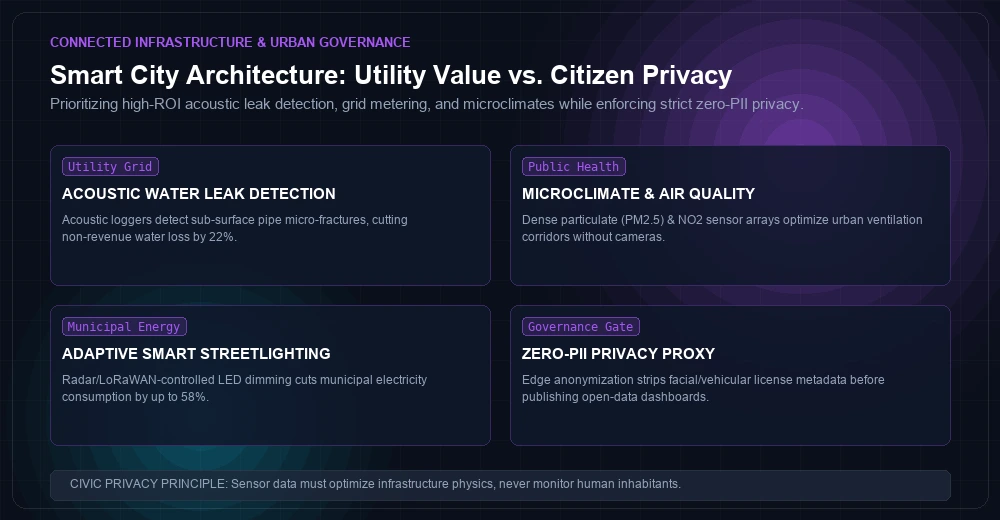
Early municipal "smart city" initiatives suffered from grandiose, disconnected ambitions. Technology vendors promised omniscient central control rooms, autonomous facial recognition networks, and intelligent trash bins. Most collapsed into pilot-phase graveyards as soon as municipal grant funding expired, leaving behind orphaned proprietary hardware and public backlash.
In 2026, smart municipal engineering has matured by abandoning vanity citizen tracking in favor of high-ROI utility infrastructure physics: water conservation, energy optimization, and public safety.
1. The Core Engineering Rule: Monitor Physics, Not People
The philosophical dividing line between successful municipal projects and those shut down by privacy regulators is simple:
By applying Privacy-by-Design, modern sensors process signals locally at the edge. A streetlighting sensor equipped with microwave radar calculates vehicle speed and pedestrian volume, immediately discarding raw radar reflections and transmitting only anonymized density metrics.
2. Acoustic Water Leak Telemetry with Sub-Surface LoRaWAN
Municipal utilities worldwide lose between 20% and 35% of all treated drinking water to subterranean pipe fractures before water ever reaches a customer meter. These fractures wash away road sub-bases, leading to catastrophic sinkholes and millions in repair costs.
How Acoustic Correlation Works:
- Quiet-Window Acoustic Capture: Between 02:00 AM and 04:00 AM, when urban traffic and domestic water consumption drop to minimal levels, magnetic acoustic sensors mounted on underground water distribution valves activate.
- Frequency Cross-Correlation: Pressurized water escaping a pipe fissure vibrates the iron pipe wall at specific acoustic frequencies (typically 500 Hz to 1,500 Hz).
- Propagation Delay Triangulation: Two loggers positioned 150 meters apart measure the arrival time difference $\Delta t$ of the acoustic waveform.
$$d_1 = \frac{L - (v \times \Delta t)}{2}$$
Where $L$ is distance between sensors and $v$ is the acoustic propagation velocity in cast iron (~1,200 m/s). This pinpoints subterranean fractures within a two-meter radius, allowing excavation crews to fix leaks before roadways collapse.
3. Radar-Dimmed Streetlighting: Slashing Power by 58%
Streetlighting typically represents 30% to 40% of a municipality's total electricity expenditure. Traditional solid-state LED retrofits provide a one-time 40% reduction, but leaving fixtures burning at 100% brightness on deserted streets between 01:00 AM and 05:00 AM wastes millions of kilowatt-hours.
Modern 24GHz Doppler Radar Mesh Architecture:
- Streetlights operate at a baseline 20% illumination during empty hours.
- When a fixture's miniature 24GHz Doppler radar detects an oncoming vehicle or cyclist at 70 meters, it ramps brightness to 100% in under 300 milliseconds.
- Simultaneously, it transmits a low-latency 2.4GHz mesh broadcast to adjacent fixtures ahead on the road vector, creating an illuminated "safety bubble" that travels with the commuter.
- The fixtures ramp back down to 20% thirty seconds after the vehicle passes.
- Documented Result: Municipalities achieve an additional 58% energy reduction on top of LED upgrades while eliminating light pollution.
4. Real-World Case Studies
- Zurich, Switzerland (WVZ): Deployed thousands of LoRaWAN-connected acoustic noise loggers across its sub-surface potable water grid. The program slashed Zurich's non-revenue water loss by over 22%, recouping full capital deployment costs in fourteen months.
- Barcelona, Spain: Installed sub-surface capacitive soil moisture probes across municipal parks. Sprinkler solenoids actuate only when root-zone soil water potential drops below threshold, saving the Mediterranean metropolis more than 425 million liters of drinking water annually.
Building connected physical systems that respect civil privacy while generating documented fiscal returns? Learn more in our IoT and Connected Hardware practice.
Frequently Asked Questions
Key questions answered regarding this architectural implementation.
Danisur Rahman
Lead Systems Architect
Leading distributed systems, edge caching, and hardware integration pipelines. Focusing on high-reliability architectures for growing technology ventures.
More From The Engineering Blog
View All Articles→Satellite NTN & 3GPP Release 18: Bridging Terrestrial Cellular and Orbital Direct-to-Device IoT
How 3GPP Release 17/18 standardized Direct-to-Device satellite connectivity, allowing standard NB-IoT modems with ordinary eSIMs to communicate with LEO constellations.
Closed-Loop Digital Twins: Bridging OPC UA Industrial Protocols and IT Event Streams
Moving beyond passive 3D dashboards: how bidirectional OT/IT event bridges with OPC UA and Apache Kafka reduce unplanned industrial downtime by up to 28%.
Enjoyed this technical breakdown?
Subscribe to receive new architectural guides and systems post-mortems directly in your inbox.