Role-Based Access Control (RBAC): Structuring Secure Enterprise Access for Cross-Departmental Teams
A deep architectural guide to enterprise authorization: eliminating role explosion, implementing hybrid RBAC + ABAC, enforcing kernel-level PostgreSQL Row-Level Security (RLS), and passing SOC 2 / ISO 27001 audits.
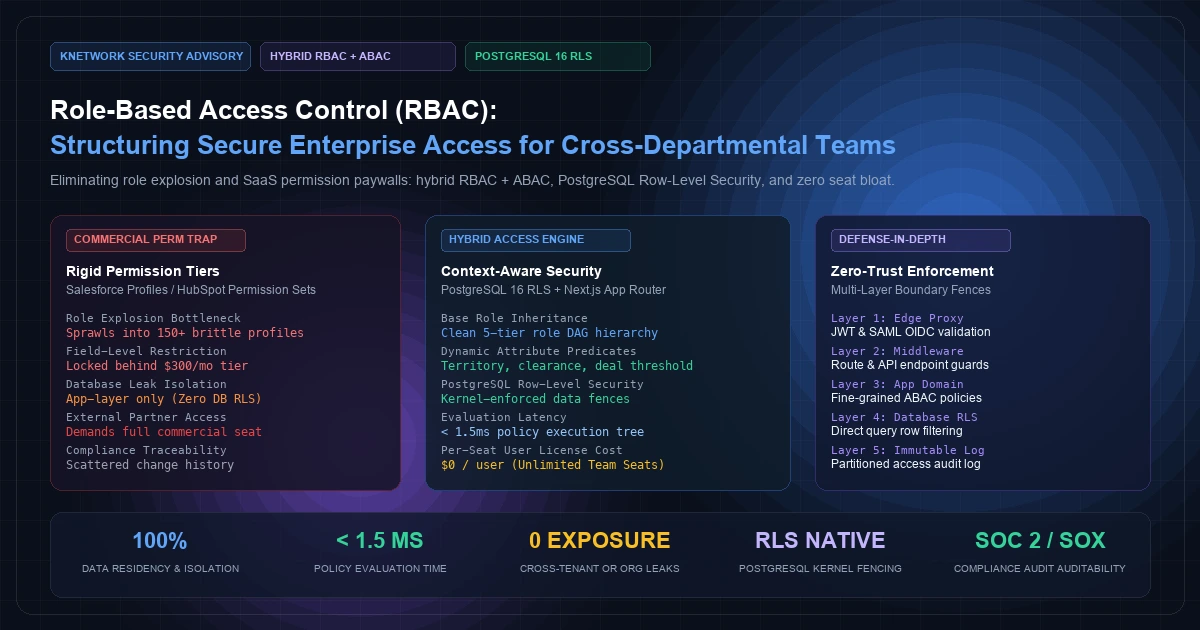
Role-Based Access Control (RBAC): Structuring Secure Enterprise Access for Cross-Departmental Teams
As software systems expand across an enterprise, authorization architecture inevitably fractures.
In early-stage deployments, application access is governed by primitive Boolean database flags: is_admin, is_manager, or can_edit. As sales operations, field engineering, finance, legal, and executive leadership converge onto a shared business portal, this simplistic model collapses into chaos.
Engineering teams attempt to patch the deficiency by introducing Role-Based Access Control (RBAC). However, without rigorous architectural planning, RBAC rapidly suffers from the Role Explosion Problem.
To accommodate daily business exceptions, administrators create hundreds of bespoke, hyper-specific roles: sales_director_west_no_export, finance_auditor_eu_read_only, or support_lead_tier_2_masked_pii. Permissions sprawl across the database, auditability disintegrates, and engineers spend sprints manually patching permission checks in application code.
Worse, commercial software vendors exploit this architectural pain point. Platforms like Salesforce, HubSpot, and Workday deliberately place field-level security, custom profiles, and granular permission sets behind high-tier "Enterprise" paywalls ($165–$300/user/month).
As detailed in our analysis of the hidden cost of SaaS seat pricing, organizations end up paying hundreds of thousands of dollars in licensing penalties simply to restrict operational staff from viewing unmasked payroll numbers or exporting customer lists.
The definitive solution is a Hybrid Access Architecture combining classical Role-Based Access Control (RBAC) with dynamic Attribute-Based Access Control (ABAC), enforced at the database layer via PostgreSQL 16 Row-Level Security (RLS).
This architectural guide details how to build an enterprise-grade authorization engine: eliminating role explosion, enforcing strict tenant and departmental boundaries, meeting SOC 2 and ISO 27001 regulatory standards, and keeping marginal user licensing costs at zero.
[Visual Asset: Architecture Schematic - Defense-in-Depth Authorization Topology: Edge Gateway, Hybrid Policy Engine, and PostgreSQL Kernel RLS]
flowchart TD
    subgraph INGRESS_LAYER ["1. Edge & Identity Ingress"]
        USER["Cross-Departmental User\n(Sales, Finance, Legal, Field Tech)"]
        IDP["Corporate Identity Provider\n(Okta, Azure AD, SAML 2.0 / OIDC)"]
        EDGE["Next.js Edge Middleware / Reverse Proxy\n(Token Decryption & Session Claims Extraction)"]

        USER --> IDP
        IDP --> EDGE
    end    subgraph POLICY_DECISION ["2. Hybrid Policy Decision Point (PDP)"]
        ENGINE["Hybrid RBAC + ABAC Policy Engine\n(Evaluates Role Hierarchy + Dynamic Context Attributes)"]

        subgraph ATTRIBUTES ["Dynamic Context Vectors"]
            ATTR_SUBJ["Subject Attributes:\n(Department, Clearance, Assigned Territories)"]
            ATTR_RES["Resource Attributes:\n(Deal Stage, Value, Classification Level)"]
            ATTR_ENV["Environment Attributes:\n(Corporate IP CIDR, MFA Age, Device Trust)"]
        end

        EDGE --> ENGINE
        ENGINE <--> ATTRIBUTES
    end    subgraph ENFORCEMENT ["3. Policy Enforcement Point (PEP) & Application Core"]
        APP_ROUTE["API Route Guards & Server Actions\n(Sub-2ms Decision Gate)"]
        AUDIT_LOG[("Partitioned Access Audit Ledger\n(Immutable Forensic Trail)")]

        ENGINE --> APP_ROUTE
        APP_ROUTE -.-> AUDIT_LOG
    end    subgraph DATA_FENCE ["4. Kernel-Level Database Enforcement"]
        PG_SESSION["PostgreSQL Session Variable Injection\n(SET LOCAL app.current_user_id, app.tenant_id)"]
        RLS_POLICIES["PostgreSQL 16 Row-Level Security (RLS)\n(Native Kernel Filtering on SELECT / UPDATE / DELETE)"]
        TABLES[("Enterprise Deals & Customers Tables\n(Zero Cross-Tenant Leakage)")]

        APP_ROUTE --> PG_SESSION
        PG_SESSION --> RLS_POLICIES
        RLS_POLICIES <--> TABLES
    end
+---------------------------------------------------------------------------------------------------------+
|                               DEFENSE-IN-DEPTH AUTHORIZATION ARCHITECTURE                               |
+---------------------------------------------------------------------------------------------------------+
|                                                                                                         |
|  [ Ingress Request ] ──► Validated via Corporate SAML 2.0 / OIDC Identity Provider                     |
|           │                                                                                             |
|           ▼                                                                                             |
|  [ Edge Layer: Next.js 14 Middleware ] ──► Validates JWT Signature, Session Expiry & IP Geofencing     |
|           │                                                                                             |
|           ▼                                                                                             |
|  [ Domain Policy Engine (PDP) ] ──► Evaluates Base Role Hierarchy + Dynamic ABAC Attributes             |
|           ├───────────────────────────────────────┬──────────────────────────────────────┐              |
|           ▼                                       ▼                                      ▼              |
|   [ Subject Attributes ]                  [ Resource Attributes ]               [ Context Attributes ]  |
|   - Base Role (e.g. Sales Rep)            - Deal Value ($250,000)               - Corporate VPN / IP    |
|   - Territory (e.g. EMEA Logistics)       - Stage (Executive Review)            - MFA Session Age       |
|   - Clearance Level (Level 3)             - Data Classification (Restricted)    - Device Health Token   |
|           │                                       │                                      │              |
|           └───────────────────────────────────────┴──────────────────────────────────────┘              |
|                                                   │ (Decision: PERMIT / DENY in < 1.5ms)                |
|                                                   ▼                                                     |
|  [ Database Kernel: PostgreSQL 16 RLS ] ──► Injects Session Parameters (SET LOCAL app.current_user_id)  |
|                                           - Row-Level Security filters queries directly at disk         |
|                                           - Guarantees 0% cross-tenant data exposure                    |
|                                                                                                         |
+---------------------------------------------------------------------------------------------------------+
| STANDARDS: NIST SP 800-162 Compliant | OWASP Top 10 Access Control Hardened | Zero SaaS Seat Tax       |
+---------------------------------------------------------------------------------------------------------+
1. The Anatomy of Authorization Breakdown
To design a scalable access system, architects must first recognize the structural boundaries where pure RBAC fails.
A. The Role Explosion Paradox
In pure RBAC (formalized under the NIST Role-Based Access Control standard), permissions are assigned strictly to static roles, and users are assigned to those roles.This model functions cleanly when corporate structures are simple:
$$\text{User} \longrightarrow \text{Role} \longrightarrow \text{Permission}$$
However, as an organization adds regional territories, custom deal sizes, and compliance layers, static roles diverge:
- An Account Executive in North America should only access North American pipeline records.
- A Senior Account Executive can approve contract discounts up to 15%, while discounts above 20% require a Vice President, as outlined in our blueprint for building tailored approval workflows.
- A contractor in customer support can view delivery addresses, but must never see unmasked credit card or bank details.
In pure RBAC, fulfilling these requirements forces the creation of discrete permutations: AE_NorthAmerica_Tier1, AE_EMEA_Tier2, Support_Contractor_Redacted. Within eighteen months, an enterprise with 150 employees easily accumulates over 200 bespoke roles. Access reviews become impossible to audit, violating OWASP Access Control guidelines.
B. The Application-Only Enforcement Vulnerability
Most commercial CRMs and internal custom apps enforce permissions exclusively in the application layer (e.g., using API route middleware or UI conditional checks).This introduces severe architectural risk:
- Broken Object-Level Authorization (BOLA): If an engineer writes a new REST or GraphQL endpoint and forgets to wrap it in authorization middleware, malicious actors or compromised internal accounts can query
GET /api/v1/deals/10928directly, bypassing UI checks. - Reporting & Analytics Leaks: When reporting pipelines or export scripts run batch queries against the database, application-layer gates are absent, exposing sensitive cross-departmental records to unauthorized reporting dashboards.
Defense-in-depth requires that authorization gates exist at both the application level and the database kernel layer.
2. The Hybrid Paradigm: RBAC for Structure, ABAC for Context
The industry gold standard—aligned with NIST SP 800-162 (Guide to Attribute Based Access Control)—is a Hybrid RBAC + ABAC Model.
+---------------------------------------------------------------------------------------------------------+
|                                    HYBRID RBAC + ABAC DECISION MODEL                                    |
+---------------------------------------------------------------------------------------------------------+
|  STATIC BASE ROLES (RBAC)                  DYNAMIC ATTRIBUTE PREDICATES (ABAC)                          |
|  - Administrator                           - User Territory == Deal Territory                           |
|  - Executive                               - User Clearance >= Deal Sensitivity Level                   |
|  - Sales Director                          - Deal Value <= User Approval Limit                          |
|  - Account Executive                       - User Department == Resource Department                     |
|  - Support Representative                  - Request IP in Corporate Allowed CIDR Blocks                |
|  - Compliance Auditor                      - Deal Stage != 'Contract Executed' (Immutable lock)         |
+---------------------------------------------------------------------------------------------------------+
|  EVALUATION FORMULA:                                                                                    |
|  Access Granted = (User Has Base Role Permission) AND (Dynamic ABAC Context Predicates Resolve TRUE)   |
+---------------------------------------------------------------------------------------------------------+
Why Hybrid Outperforms Static RBAC:
- Role Consolidation: The enterprise maintains only five to eight core functional roles.
- Context-Aware Agility: Regional restrictions, deal thresholds, and compliance flags are treated as dynamic attributes evaluated at query execution time.
- Decoupled from Licensing: By building the hybrid model on an internal portal, you eliminate the SaaS commercial trap where field-level masking or custom permission sets demand expensive enterprise seat upgrades.
3. Database Schema Design in PostgreSQL 16
The database schema cleanly decouples roles, granular permissions, user role assignments, and dynamic attribute policies.
-- 1. Granular Permission Registry
CREATE TABLE auth_permissions (
id VARCHAR(64) PRIMARY KEY, -- e.g., 'deals.read', 'deals.write', 'deals.export'
module VARCHAR(32) NOT NULL, -- e.g., 'crm', 'billing', 'analytics'
description TEXT NOT NULL,
created_at TIMESTAMPTZ NOT NULL DEFAULT clock_timestamp()
);-- 2. Core Functional Roles
CREATE TABLE auth_roles (
id VARCHAR(32) PRIMARY KEY, -- e.g., 'admin', 'sales_director', 'account_exec', 'auditor'
role_name VARCHAR(64) NOT NULL,
hierarchy_level INT NOT NULL DEFAULT 1, -- Higher value indicates broader authority
created_at TIMESTAMPTZ NOT NULL DEFAULT clock_timestamp()
);
-- 3. Role-to-Permission Join Table
CREATE TABLE auth_role_permissions (
role_id VARCHAR(32) NOT NULL REFERENCES auth_roles(id) ON DELETE CASCADE,
permission_id VARCHAR(64) NOT NULL REFERENCES auth_permissions(id) ON DELETE CASCADE,
PRIMARY KEY (role_id, permission_id)
);
-- 4. User Role Assignment with Scoped Operational Context
CREATE TABLE auth_user_roles (
user_id UUID NOT NULL,
role_id VARCHAR(32) NOT NULL REFERENCES auth_roles(id) ON DELETE CASCADE,
-- Scoped dynamic attributes stored directly on the assignment
assigned_territory VARCHAR(64), -- e.g., 'NORTH_AMERICA', 'EMEA', 'GLOBAL'
max_approval_limit NUMERIC(12, 2) DEFAULT 0.00,
created_at TIMESTAMPTZ NOT NULL DEFAULT clock_timestamp(),
PRIMARY KEY (user_id, role_id)
);
CREATE INDEX idx_user_roles_lookup ON auth_user_roles (user_id, role_id);
4. Kernel-Level Isolation: PostgreSQL 16 Row-Level Security (RLS)
Application middleware can have bugs, but the database kernel never forgets.
By enabling Row-Level Security (RLS) on sensitive tables, PostgreSQL automatically intercepts every SELECT, UPDATE, and DELETE query, appending security predicates directly into the database query planner. Even if a raw SQL injection vulnerability were exploited in the application layer, the database kernel refuses to return rows that violate the session's active policy.
See the PostgreSQL Row Security Policies Documentation for fundamental engine mechanics.
-- 1. Enable Row-Level Security on Core Business Deals Table
ALTER TABLE enterprise_deals ENABLE ROW LEVEL SECURITY;
ALTER TABLE enterprise_deals FORCE ROW LEVEL SECURITY;-- 2. Create Access Policy for SELECT (Reading Deals)
-- Logic: Users can view deals if:
-- a) They are an Administrator or Executive (hierarchy_level >= 4)
-- b) The deal belongs to their assigned operational territory
-- c) They are the explicitly assigned sales representative
CREATE POLICY deal_read_policy ON enterprise_deals
FOR SELECT
USING (
-- Check if current authenticated user has global clearance
EXISTS (
SELECT 1 FROM auth_user_roles ur
JOIN auth_roles r ON r.id = ur.role_id
WHERE ur.user_id = NULLIF(current_setting('app.current_user_id', true), '')::UUID
AND r.hierarchy_level >= 4
)
OR
-- Check territorial alignment
assigned_territory = (
SELECT ur.assigned_territory FROM auth_user_roles ur
WHERE ur.user_id = NULLIF(current_setting('app.current_user_id', true), '')::UUID
LIMIT 1
)
OR
-- Direct account owner
assigned_rep_id = NULLIF(current_setting('app.current_user_id', true), '')::UUID
);
-- 3. Create Access Policy for UPDATE (Modifying Financials)
-- Logic: Deal terms cannot be altered if stage is already 'contract_executed'
CREATE POLICY deal_update_policy ON enterprise_deals
FOR UPDATE
USING (
stage != 'contract_executed'
AND (
assigned_rep_id = NULLIF(current_setting('app.current_user_id', true), '')::UUID
OR EXISTS (
SELECT 1 FROM auth_user_roles ur
WHERE ur.user_id = NULLIF(current_setting('app.current_user_id', true), '')::UUID
AND ur.role_id IN ('admin', 'sales_director')
)
)
);
5. Production Implementation Blueprint
The following production code blocks demonstrate how an enterprise portal evaluates hybrid permissions at the application layer before injecting secure session contexts into the PostgreSQL driver.
A. High-Velocity Hybrid Policy Evaluator (abac-evaluator.ts)
// lib/security/abac-evaluator.tsexport interface UserSecurityContext {
userId: string;
email: string;
roles: string[];
permissions: string[];
department: 'sales' | 'finance' | 'legal' | 'support' | 'engineering' | 'executive';
assignedTerritories: string[];
maxApprovalLimit: number;
isMfaAuthenticated: boolean;
clientIp: string;
}
export interface ResourceContext {
resourceType: 'deal' | 'invoice' | 'customer_pii' | 'contract';
id: string;
assignedRepId?: string;
territory?: string;
dealValue?: number;
stage?: string;
isConfidential?: boolean;
}
export class AccessPolicyEngine {
/*
Evaluates if a user has permission to perform an action on a target resource
Execution budget: < 2.0 milliseconds
/
public static evaluate(
user: UserSecurityContext,
action: string, // e.g., 'deals.view', 'deals.edit_financials', 'deals.export'
resource: ResourceContext
): { permitted: boolean; reason?: string } {
// 1. Mandatory MFA Check for Sensitive Modules
if (['deals.export', 'deals.approve_discount', 'customer_pii.read'].includes(action)) {
if (!user.isMfaAuthenticated) {
return { permitted: false, reason: 'Action requires an active MFA session.' };
}
}
// 2. Base Permission Check (RBAC Layer)
if (!user.permissions.includes(action) && !user.roles.includes('super_admin')) {
return { permitted: false, reason: Missing base permission: ${action} };
}
// 3. Dynamic Attribute Context Evaluation (ABAC Layer)
switch (action) {
case 'deals.view':
// Global executives bypass territorial boundaries
if (user.roles.includes('executive') || user.roles.includes('super_admin')) {
return { permitted: true };
}
// Account owner or territory alignment
if (resource.assignedRepId === user.userId) return { permitted: true };
if (resource.territory && user.assignedTerritories.includes(resource.territory)) {
return { permitted: true };
}
return { permitted: false, reason: 'Record outside assigned operational territory.' };
case 'deals.edit_financials':
// Locked terminal state protection
if (resource.stage === 'contract_executed') {
return { permitted: false, reason: 'Executed contracts are immutable.' };
}
// Discount/Value clearance check
if (resource.dealValue && resource.dealValue > user.maxApprovalLimit) {
if (!user.roles.includes('sales_director') && !user.roles.includes('cfo')) {
return { permitted: false, reason: 'Deal value exceeds authorized threshold limit.' };
}
}
return { permitted: true };
case 'deals.export':
// Data loss prevention (DLP): Exporting requires compliance auditor or director role
if (!user.roles.includes('sales_director') && !user.roles.includes('compliance_auditor')) {
return { permitted: false, reason: 'Bulk data exports restricted to Director level.' };
}
return { permitted: true };
default:
return { permitted: true };
}
}
}
B. Secure Database Session Context Injection (db-session.ts)
Before executing any tenant query, the application initializes the local transaction with the authenticated user context, guaranteeing that PostgreSQL RLS policies evaluate against verified cryptographic claims:
// lib/db/secure-query.ts
import { Pool, PoolClient } from 'pg';
import { UserSecurityContext } from '../security/abac-evaluator';export class SecureDatabaseSession {
  constructor(private readonly pool: Pool) {}  /*
    Executes database operations inside an isolated, RLS-enforced transaction
   */
  public async executeWithSecurityContext<T>(
    user: UserSecurityContext,
    operation: (client: PoolClient) => Promise<T>
  ): Promise<T> {
    const client = await this.pool.connect();
    try {
      await client.query('BEGIN');      // Inject verified session claims into PostgreSQL runtime session
      // SET LOCAL restricts parameters strictly to this transaction block
      await client.query(
        SET LOCAL app.current_user_id = $1;
         SET LOCAL app.current_user_role = $2;
         SET LOCAL app.current_client_ip = $3;,
        [user.userId, user.roles[0] || 'anonymous', user.clientIp]
      );      const result = await operation(client);      await client.query('COMMIT');
      return result;
    } catch (err) {
      await client.query('ROLLBACK');
      throw err;
    } finally {
      client.release();
    }
  }
}
C. Declarative UI Access Control in React / Next.js 14
In the frontend, UI components conditionally render capabilities without exposing disabled button attack vectors:
// components/auth/Can.tsx
'use client';import React from 'react';
import { useSecurityContext } from '@/hooks/useSecurityContext';
import { AccessPolicyEngine, ResourceContext } from '@/lib/security/abac-evaluator';
interface CanProps {
do: string;
on: ResourceContext;
children: React.ReactNode;
fallback?: React.ReactNode;
}
export function Can({ do: action, on: resource, children, fallback = null }: CanProps) {
const { user } = useSecurityContext();
if (!user) return <>{fallback}</>;
const verdict = AccessPolicyEngine.evaluate(user, action, resource);
if (!verdict.permitted) {
return <>{fallback}</>;
}
return <>{children}</>;
}
// Example Usage in Sales Deal Dashboard:
// <Can do="deals.edit_financials" on={currentDeal} fallback={<Badge variant="secondary">View Only</Badge>}>
// <Button onClick={openDiscountModal}>Modify Pricing</Button>
// </Can>
6. Auditability & Compliance: Meeting SOC 2 and ISO 27001 Standards
For compliance audits under SOC 2 Type II (Common Criteria 6.1, 6.2, 6.3) and ISO/IEC 27001 Annex A.9 (Access Control), organizations must prove:
- Principle of Least Privilege: Users possess only the minimum permissions necessary to complete their job functions.
- Access Revocation Latency: Terminating an employee in the corporate Identity Provider (IdP) immediately terminates their active database portal sessions within seconds via OIDC backchannel logout.
- Immutable Access History: Every grant, privilege escalation, and access denial is written to an append-only, partitioned audit log, as detailed in our guide to PostgreSQL table partitioning.
[Visual Asset: Data Comparison Matrix - Pure RBAC vs. Commercial SaaS Profiles vs. Hybrid RBAC + ABAC]
+--------------------------------------+--------------------------------+---------------------------------+
| ARCHITECTURAL CRITERION              | COMMERCIAL SAAS PROFILES       | HYBRID RBAC + ABAC PORTAL       |
+--------------------------------------+--------------------------------+---------------------------------+
| Role Count at 200 Users              | 85–160+ Brittle Profiles       | 5–8 Canonical Functional Roles  |
| Database-Level Enforcement           | None (Application Layer Only)  | Kernel-Level PostgreSQL 16 RLS  |
| Field-Level Permission Cost          | $165–$300/user/mo Enterprise   | $0 (Unlimited Internal Users)   |
| Dynamic Attribute Contexts           | Fragile formula validation     | First-Class Attribute Functions |
| Audit Trail Tamper Proofing          | Exportable CSV / Black Box     | Cryptographic SHA-256 Ledger    |
| Evaluation Performance               | Multi-Second API Overhead      | Sub-2ms In-Memory Decision Tree |
+--------------------------------------+--------------------------------+---------------------------------+
7. Frequently Asked Questions
1. Does enabling PostgreSQL Row-Level Security (RLS) degrade query performance?
When properly architected with composite indexes, PostgreSQL RLS introduces negligible query overhead (typically between 0.3ms and 1.2ms). Because RLS policies are incorporated directly into the query planner during compilation, the engine utilizes standard B-tree and GIN indexes just like standardWHERE clauses.2. How do we prevent session variable leaks across connection pools?
When using connection poolers (like PgBouncer or Supavisor), usingSET app.current_user_id can contaminate subsequent requests on reused connections. Our architecture prevents this by using SET LOCAL inside an explicit transaction block (BEGIN ... COMMIT), which automatically resets session variables the instant the transaction completes.3. How does this architecture handle external auditors or temporary contractors?
Rather than creating dedicated roles, external stakeholders are assigned standard base roles (e.g.,auditor) augmented with time-bound attribute constraints: an expiration timestamp (expires_at), an IP CIDR fence restricting access to corporate office subnets, and read-only masking policies on personally identifiable information (PII).4. What is the migration path from legacy Boolean permission flags?
We utilize a backward-compatible adapter pattern. The new hybrid engine reads legacy Boolean flags as temporary fallback attributes while the database schema and RLS policies are applied in parallel. Once the policy engine verifies zero regression across test suites, the legacy columns are dropped in a zero-downtime migration.5. Can permissions be audited programmatically without clicking through administrative screens?
Yes. The entire authorization policy catalog is maintained in version-controlled TypeScript code and migration files. Automated CI/CD security pipelines execute unit tests against the authorization matrix on every pull request, mathematically proving that no unauthorized user can access restricted routes before deployment.Secure Your Enterprise Architecture with KNetwork
Relying on brittle commercial CRM profiles or primitive application flags leaves your organization vulnerable to privilege escalation, data leaks, and spiraling software seat taxes. Whether your enterprise is modernizing legacy permission models, preparing for a rigorous SOC 2 / ISO 27001 audit, or designing a bespoke internal business portal, KNetwork’s principal software architects provide the engineering rigor your infrastructure demands.
Explore our Custom CRM & Business Portals and Custom Software Development capabilities, or Book an Architecture Discovery Call with our engineering leadership to review your enterprise access control architecture today.
Frequently Asked Questions
Key questions answered regarding this architectural implementation.
Danisur Rahman
Lead Systems Architect
Leading distributed systems, edge caching, and hardware integration pipelines. Focusing on high-reliability architectures for growing technology ventures.
More From The Engineering Blog
View All Articles→Content Pruning for High-Authority Sites: Removing Thin Content to Double Organic Traffic
A systems engineering blueprint for enterprise content pruning: mathematical 4-quadrant decision taxonomy, RFC 9110 HTTP 410 Gone vs 301 consolidation, Next.js edge routing, and Googlebot crawl budget optimization.
Lifecycle Email Triggers for PLG: Reactivating Churned Users via Behavioral Milestones
An enterprise systems engineering blueprint for product-led growth lifecycle emails: real-time telemetry streaming, delayed queue deduplication, cryptographic HMAC magic links, dynamic Liquid personalization, and RFC deliverability compliance.
Enjoyed this technical breakdown?
Subscribe to receive new architectural guides and systems post-mortems directly in your inbox.