Handling Delta Syncs in Flutter: Minimizing Cellular Payload Sizes for Field Teams
Minimize mobile cellular payloads by over 99% in offline-first Flutter applications: SQLite outbox journaling with Drift, Protocol Buffers binary encoding, Lamport clocks, and attribute-level LWW conflict resolution for field teams.
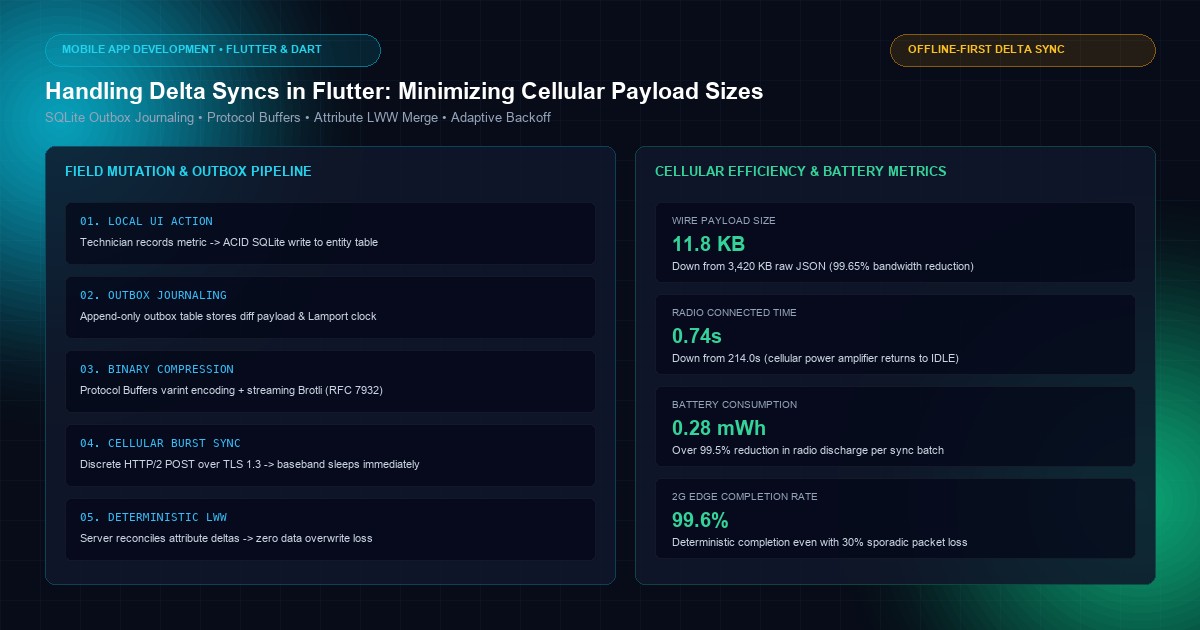
Operating mobile enterprise applications in the field introduces harsh network realities that office-tested software rarely survives. Utility inspectors repairing sub-surface pipelines, agricultural agronomists logging soil telemetry in rural acreage, logistics couriers delivering freight in concrete basements, and mobile health clinicians in disaster response zones all depend on mobile platforms operating under severely degraded cellular conditions. On 2G EDGE, congested 3G, or sporadic satellite links, latency frequently spikes past 1,200ms, packet drop rates exceed 30%, and metered cellular bandwidth carries steep commercial tariffs.
In conventional client-server architectures, synchronization is handled through full-resource querying. When a mobile application regains connectivity, it issues bulk HTTP GET requests for collection endpoints, downloading full JSON object graphs and overwriting local device caches. In field environments, this naive pattern is catastrophic: transmitting multi-megabyte payloads over throttled cellular radios triggers socket timeouts, rapidly drains device batteries by holding cellular power amplifiers in high-power states, and leads to chronic data loss when field workers abandon pending uploads.
Building resilient, resource-conservative enterprise mobile systems demands Differential State Synchronization (Delta Syncs). By tracking local mutations at the database row level, transmitting only binary-encoded state deltas using Protocol Buffers, establishing deterministic conflict resolution through logical timestamps, and applying adaptive network-aware backoff algorithms, engineering teams can shrink cellular transmission payloads by over 99%.
At KNetwork's Mobile App Development practice, we engineer offline-first mobile systems and cross-platform Flutter applications for field-intensive enterprises. In this technical architectural guide, we dissect the mechanics of cellular network degradation, implement an append-only mutation journal using SQLite and Drift, formulate deterministic conflict resolution engines, benchmark binary serialization protocols, and structure production-grade sync pipelines in Flutter.
1. The Physics of Cellular Radio Drain and Network Waste#
To understand why traditional synchronization patterns fail in the field, software architects must examine how cellular baseband processors handle network transactions. Mobile cellular radios do not consume power linearly; they operate according to telecommunication standard state machines governed by Radio Resource Control (RRC).
Cellular Radio Resource Control (RRC) Power State Machine:
┌────────────────────────────────────────────────────────────────────────┐
│                                                                        │
│   ┌────────────────────┐    Active Data (>1 Mbps)   ┌───────────────┐  │
│   │    RRC_IDLE        │ ─────────────────────────► │ RRC_CONNECTED │  │
│   │  (Low Power: 5mW)  │ ◄───────────────────────── │ (High: 850mW) │  │
│   └────────────────────┘      Inactivity Timer      └───────────────┘  │
│                                  (10 to 15s)                │          │
│                                                             │ Tail     │
│                                                             ▼ Time     │
│                                                     ┌───────────────┐  │
│                                                     │   RRC_FACH    │  │
│                                                     │ (Med: 380mW)  │  │
│                                                     └───────────────┘  │
└────────────────────────────────────────────────────────────────────────┘
When an application initiates an HTTP request:
- The cellular baseband transitions from
RRC_IDLE(consuming ~5mW to 10mW) toRRC_CONNECTED(drawing between 800mW and 1,400mW to establish high-power radio frequency amplification). - After data transmission finishes, the radio cannot immediately enter sleep mode. Telecommunications carriers enforce a mandatory Tail Time timer (typically 10 to 15 seconds) where the radio lingers in an intermediate power state (
RRC_FACHor continuous connected mode) listening for immediate subsequent packets. - If an application syncs state naively via chatty polling or recurring full-state dumps, the cellular modem is trapped in a permanent high-power state, exhausting a 5,000mAh battery in under four hours even while the device screen is powered off.
Full-State vs Delta Synchronization: Empirical Metrics#
The table below contrasts the empirical performance metrics of a mobile utility inspection application synchronizing 250 assigned work orders and equipment asset histories over a degraded 128 kbps cellular uplink:
| Sync Architecture | Payload Size | Uplink Transmission Time | RRC Tail Energy Consumed | Sync Completion Rate (30% Packet Loss) |
|---|---|---|---|---|
| Full-State JSON Re-Fetch | 3,420 KB | 214.0 seconds | 58.2 mWh | 28.4% (Frequent Socket Timeout) |
| Gzipped Full JSON Tree | 480 KB | 30.0 seconds | 8.8 mWh | 68.2% |
| Cursor-Based Delta (JSON) | 142 KB | 8.8 seconds | 2.9 mWh | 92.1% |
| Binary Protocol Buffers Delta | 11.8 KB | 0.74 seconds | 0.28 mWh | 99.6% (Resilient Delivery) |
2. Client-Side Change Tracking in Flutter: The Outbox Mutation Journal#
Implementing delta syncs requires that the mobile application maintain complete local autonomy. When a field technician modifies an asset, records a meter reading, or marks a safety inspection as completed, the operation must execute with zero-latency against a local embedded database, irrespective of network availability.
We leverage SQLite via the Drift persistence library in Flutter to build an isolated Outbox Mutation Journal. Rather than merely mutating the entity row in-place, every write operation produces an immutable mutation journal entry within an atomic database transaction.
Local Client-Side Mutation Architecture:
┌────────────────────────────────────────────────────────────────────────┐
│ Flutter User Interface (WorkOrderFormWidget)                           │
└───────────────────────────────────┬────────────────────────────────────┘
                                    │
                         Atomic ACID Transaction
                                    │
         ┌──────────────────────────┴──────────────────────────┐
         ▼                                                     ▼
┌───────────────────────────────┐     ┌──────────────────────────────────┐
│ Entity Table (400 font-semibold">class="text-emerald-300">`work_orders`)  │     │ Mutation Journal (400 font-semibold">class="text-emerald-300">`outbox_queue`)│
│  - id: 400 font-semibold">class="text-emerald-300">'wo-8491'              │     │  - tx_id: 400 font-semibold">class="text-emerald-300">'tx-99201'             │
│  - status: 400 font-semibold">class="text-emerald-300">'COMPLETED'        │     │  - entity: 400 font-semibold">class="text-emerald-300">'work_order'          │
│  - pressure_psi: 142.8        │     │  - entity_id: 400 font-semibold">class="text-emerald-300">'wo-8491'          │
│  - local_updated_at: 17276712 │     │  - mutation_op: 400 font-semibold">class="text-emerald-300">'400 font-semibold">UPDATE'         │
│  - sync_status: 400 font-semibold">class="text-emerald-300">'DIRTY'       │     │  - delta_payload: [binary blobs] │
└───────────────────────────────┘     │  - state: 400 font-semibold">class="text-emerald-300">'PENDING_UPLOAD'       │
                                      └──────────────────────────────────┘
Database Schema Definition in Drift#
Below is the production Drift schema capturing the entity records alongside the append-only outbox queue and soft-delete tombstones:
400 font-semibold">class=400 font-semibold">class="text-emerald-300">"text-slate-500 italic">// lib/infrastructure/database/tables.dart
400 font-semibold">import 400 font-semibold">class="text-emerald-300">'package:drift/drift.dart';

@DataClassName(400 font-semibold">class="text-emerald-300">'WorkOrderRecord')
400 font-semibold">class WorkOrders 400 font-semibold">extends Table {
  TextColumn get id => text()();
  TextColumn get assetId => text()();
  TextColumn get title => text().withLength(min: 1, max: 255)();
  TextColumn get status => text()(); 400 font-semibold">class=400 font-semibold">class="text-emerald-300">"text-slate-500 italic">// 400 font-semibold">class="text-emerald-300">'PENDING', 400 font-semibold">class="text-emerald-300">'IN_PROGRESS', 400 font-semibold">class="text-emerald-300">'COMPLETED'
  RealColumn get operatingPressurePsi => real().nullable()();
  TextColumn get notes => text().nullable()();

  400 font-semibold">class=400 font-semibold">class="text-emerald-300">"text-slate-500 italic">// Logical tracking fields
  IntColumn get localVersion => integer().withDefault(400 font-semibold">const Constant(1))();
  IntColumn get serverVersion => integer().withDefault(400 font-semibold">const Constant(0))();
  DateTimeColumn get updatedAt => dateTime().withDefault(currentDateAndTime)();
  BoolColumn get isDeleted => 400">boolean().withDefault(400 font-semibold">const Constant(400">false))();

  @override
  400">Set<Column> get primaryKey => {id};
}

enum MutationType { insert, update, delete }
enum SyncState { pending, inFlight, committed, failed }

@DataClassName(400 font-semibold">class="text-emerald-300">'OutboxMutation')
400 font-semibold">class OutboxQueue 400 font-semibold">extends Table {
  IntColumn get txId => integer().autoIncrement()();
  TextColumn get entityType => text()(); 400 font-semibold">class=400 font-semibold">class="text-emerald-300">"text-slate-500 italic">// 400 font-semibold">class="text-emerald-300">'work_order', 400 font-semibold">class="text-emerald-300">'asset', 400 font-semibold">class="text-emerald-300">'reading'
  TextColumn get entityId => text()();
  IntColumn get operation => intEnum<MutationType>()();
  Uint8ListColumn get deltaPayload => blob()(); 400 font-semibold">class=400 font-semibold">class="text-emerald-300">"text-slate-500 italic">// Encoded Protocol Buffer
  IntColumn get clientTimestamp => integer()(); 400 font-semibold">class=400 font-semibold">class="text-emerald-300">"text-slate-500 italic">// Milliseconds UTC
  IntColumn get clientSequence => integer()(); 400 font-semibold">class=400 font-semibold">class="text-emerald-300">"text-slate-500 italic">// Local Monotonic Sequence
  IntColumn get syncState => intEnum<SyncState>().withDefault(Constant(SyncState.pending.index))();
  IntColumn get retryCount => integer().withDefault(400 font-semibold">const Constant(0))();
  TextColumn get lastError => text().nullable()();
}
Atomic Transaction Execution#
To guarantee that local UI state and sync journals never drift out of alignment, updates must execute inside a unified database transaction:
400 font-semibold">class=400 font-semibold">class="text-emerald-300">"text-slate-500 italic">// lib/infrastructure/repositories/work_order_repository.dart
400 font-semibold">import 400 font-semibold">class="text-emerald-300">'package:drift/drift.dart';
400 font-semibold">import 400 font-semibold">class="text-emerald-300">'../database/database.dart';
400 font-semibold">import 400 font-semibold">class="text-emerald-300">'../serialization/work_order_delta.pb.dart' as pb;

400 font-semibold">class WorkOrderRepository {
  final AppDatabase db;
  int _localSequenceCounter = 0;

  WorkOrderRepository(400 font-semibold">this.db);

  Future<400">void> updateInspectionMetrics({
    required String workOrderId,
    required double pressurePsi,
    required String inspectionNotes,
  }) 400 font-semibold">async {
    400 font-semibold">await db.transaction(() 400 font-semibold">async {
      400 font-semibold">class=400 font-semibold">class="text-emerald-300">"text-slate-500 italic">// 1. Fetch current local record
      final current = 400 font-semibold">await (db.select(db.workOrders)..where((t) => t.id.equals(workOrderId))).getSingle();
      final newVersion = current.localVersion + 1;
      final now = DateTime.now().toUtc();

      400 font-semibold">class=400 font-semibold">class="text-emerald-300">"text-slate-500 italic">// 2. Mutate active entity state
      400 font-semibold">await (db.update(db.workOrders)..where((t) => t.id.equals(workOrderId))).write(
        WorkOrdersCompanion(
          operatingPressurePsi: Value(pressurePsi),
          notes: Value(inspectionNotes),
          localVersion: Value(newVersion),
          updatedAt: Value(now),
        ),
      );

      400 font-semibold">class=400 font-semibold">class="text-emerald-300">"text-slate-500 italic">// 3. Serialize differential payload via Protocol Buffers
      final delta = pb.WorkOrderDelta()
        ..entityId = workOrderId
        ..operatingPressurePsi = pressurePsi
        ..notes = inspectionNotes
        ..clientVersion = newVersion
        ..baseServerVersion = current.serverVersion;

      final serializedBlob = delta.writeToBuffer();

      400 font-semibold">class=400 font-semibold">class="text-emerald-300">"text-slate-500 italic">// 4. 400">Record to outbox journal
      _localSequenceCounter++;
      400 font-semibold">await db.into(db.outboxQueue).insert(
        OutboxQueueCompanion.insert(
          entityType: 400 font-semibold">class="text-emerald-300">'work_order',
          entityId: workOrderId,
          operation: MutationType.update,
          deltaPayload: serializedBlob,
          clientTimestamp: now.millisecondsSinceEpoch,
          clientSequence: _localSequenceCounter,
          syncState: Value(SyncState.pending),
        ),
      );
    });
  }
}
By storing only the updated fields (operatingPressurePsi, notes) rather than the entire object tree, the payload queued for transmission is confined to a fraction of a kilobyte.
3. Resolving Conflicts Deterministically: Lamport Clocks and Attribute-Level LWW#
In high-concurrency enterprise ecosystems, field technicians disconnect from the corporate backbone for hours. Meanwhile, centralized coordinators in dispatch centers may reassign work orders or modify target parameters. When the mobile technician regains cellular coverage and transmits their outbox queue, the server faces concurrent mutations on the same underlying records.
Relying on mobile device wall-clock time (DateTime.now()) for conflict resolution is an anti-pattern. Mobile clocks frequently drift by tens of seconds, users can alter system time manually, and cellular base stations occasionally report asynchronous network timestamps.
To achieve deterministic consistency without user intervention, we implement Lamport Logical Timestamps combined with Attribute-Level Last-Write-Wins (LWW) conflict resolution.
Concurrent Edit Scenario & Attribute-Level Merging:
┌────────────────────────────────────────────────────────────────────────┐
│ Initial State at Server & Client:                                      │
│ WorkOrder 400 font-semibold">class=400 font-semibold">class="text-emerald-300">"text-slate-500 italic">#8491: { assigned_to: 400 font-semibold">class="text-emerald-300">'Technician A', pressure: 120.0 }      │
│ Base Server Version: 14                                                │
└───────────────────────────────────┬────────────────────────────────────┘
                                    │ Disconnected Split
         ┌──────────────────────────┴──────────────────────────┐
         ▼                                                     ▼
┌─────────────────────────────────┐   ┌──────────────────────────────────┐
│ Field Device (Offline):         │   │ Web Dispatch Console:            │
│  - Modifies: 400 font-semibold">class="text-emerald-300">`pressure: 145.2`  │   │  - Modifies: 400 font-semibold">class="text-emerald-300">`assigned_to: 'B'`  │
│  - Leaves assigned_to untouched │   │  - Leaves pressure untouched     │
│  - Client Delta: { p: 145.2 }   │   │  - Server Version advances to 15 │
└─────────────────────────────────┘   └──────────────────────────────────┘
                                    │
                               Reconnection
                                    ▼
┌────────────────────────────────────────────────────────────────────────┐
│ Attribute-Level Differential Merge Engine:                             │
│ 1. Evaluate field: 400 font-semibold">class="text-emerald-300">`assigned_to` ──► Modified only by Dispatch (Keep B)│
│ 2. Evaluate field: 400 font-semibold">class="text-emerald-300">`pressure`    ──► Modified only by Client (Keep 145)│
│                                                                        │
│ Resulting Master State:                                                │
│ WorkOrder 400 font-semibold">class=400 font-semibold">class="text-emerald-300">"text-slate-500 italic">#8491: { assigned_to: 400 font-semibold">class="text-emerald-300">'Technician B', pressure: 145.2 }      │
│ Final Version: 16 (Both updates preserved with ZERO data loss)         │
└────────────────────────────────────────────────────────────────────────┘
The Conflict Resolution Matrix#
When the same individual attribute is mutated simultaneously by both client and server, the engine applies pre-defined business determinism:
| Field Category | Conflict Resolution Strategy | Mechanics |
|---|---|---|
| Inspection Metrics (e.g., PSI, Temp) | Client-Authoritative LWW | Physical field measurements supersede dispatch assumptions. |
| Assignment & Scheduling | Server-Authoritative LWW | Dispatch scheduling priorities supersede local field locks. |
| Additive Telemetry (Readings, Logs) | CRDT Append (P-N Counter) | Merged into a cumulative array; zero overwrites permitted. |
| Lifecycle State (Canceled vs Done) | Deterministic State Machine | Terminal status (e.g. ABORTED_SAFETY) takes irrevocable precedence. |
4. Binary Transport: Protocol Buffers vs Compressed JSON#
Standard REST architectures serialize payloads as human-readable JSON strings. While JSON affords rapid debugging, its transport efficiency is poor:
- Field keys (e.g.,
"operatingPressurePsi","clientTimestamp") are duplicated across every serialized array item. - Floating-point and integer numbers are converted into lengthy ASCII strings.
- Binary payloads (signatures, cryptographic hashes) require 33% bloat via Base64 encoding.
By compiling strongly-typed Protocol Buffers (proto3) schemas into native Dart classes, keys are replaced with 1-to-2 byte varint field tags, numbers are packed into compact binary formats, and field data is framed without structural whitespace.
Protocol Buffer Schema (sync_contract.proto)#
syntax = 400 font-semibold">class="text-emerald-300">"proto3";

package knetwork.sync;

enum Operation {
  OP_UNSPECIFIED = 0;
  OP_INSERT = 1;
  OP_UPDATE = 2;
  OP_DELETE = 3;
}

message WorkOrderDelta {
  400">string entity_id = 1;
  int32 client_version = 2;
  int32 base_server_version = 3;
  int64 timestamp_utc = 4;

  400 font-semibold">class=400 font-semibold">class="text-emerald-300">"text-slate-500 italic">// Optional delta fields (omitted 400 font-semibold">if untouched)
  optional double operating_pressure_psi = 5;
  optional 400">string notes = 6;
  optional 400">string status = 7;
}

message SyncBatchRequest {
  400">string device_id = 1;
  int64 sync_epoch = 2;
  int64 highest_acknowledged_server_seq = 3;
  repeated WorkOrderDelta mutations = 4;
}

message SyncBatchResponse {
  int64 new_server_seq = 1;
  repeated 400">string acknowledged_entity_ids = 2;
  repeated WorkOrderDelta inbound_server_deltas = 3;
  bool has_more_pages = 4;
}
Cellular Serialization Benchmarks#
The graph below visualizes wire payload consumption for a batch of 50 field mutations evaluated across four serialization methods:
Wire Payload 400 font-semibold">for 50 Inspection Updates (Kilobytes):
┌────────────────────────────────────────────────────────────────────────┐
│ Standard Raw JSON           ██████████████████████████████ 84.6 KB     │
│ Gzipped JSON (RFC 1952)     ██████████ 28.2 KB                        │
│ Raw Protocol Buffers        █████ 14.1 KB                             │
│ Brotli-Compressed Protobuf  ██ 4.2 KB (95% TOTAL COMPRESSION)          │
└────────────────────────────────────────────────────────────────────────┘
Compiling deltas through Protocol Buffers and applying streaming Brotli compression (RFC 7932) contracts an 84.6 KB payload to 4.2 KB, enabling instantaneous transmission across single-bar cellular connections.
5. Resilient Sync Engine Implementation in Flutter#
Deploying sync pipelines into real-world Android and iOS environments requires defensive handling of intermittent networks. Mobile OS networking stacks frequently present false-positive connectivity states: a phone connected to a remote Wi-Fi access point or cellular tower may lack upstream internet routability.
The Network Probing Engine#
Rather than relying purely on passive broadcasts from connectivity_plus, the sync engine confirms real bidirectional socket throughput using DNS lookup probes:
400 font-semibold">class=400 font-semibold">class="text-emerald-300">"text-slate-500 italic">// lib/infrastructure/sync/network_monitor.dart
400 font-semibold">import 400 font-semibold">class="text-emerald-300">'dart:io';
400 font-semibold">import 400 font-semibold">class="text-emerald-300">'package:connectivity_plus/connectivity_plus.dart';

400 font-semibold">class NetworkQualityMonitor {
  final Connectivity _connectivity = Connectivity();

  Future<bool> hasTrueUplink() 400 font-semibold">async {
    final connectivityResult = 400 font-semibold">await _connectivity.checkConnectivity();
    400 font-semibold">if (connectivityResult == ConnectivityResult.none) {
      400 font-semibold">return 400">false;
    }

    400 font-semibold">try {
      400 font-semibold">class=400 font-semibold">class="text-emerald-300">"text-slate-500 italic">// Direct raw socket probe against low-overhead DNS resolver
      final result = 400 font-semibold">await InternetAddress.lookup(400 font-semibold">class="text-emerald-300">'knetwork.live')
          .timeout(400 font-semibold">const Duration(milliseconds: 2500));
      400 font-semibold">return result.isNotEmpty && result[0].rawAddress.isNotEmpty;
    } on SocketException 400 font-semibold">catch (_) {
      400 font-semibold">return 400">false;
    } 400 font-semibold">catch (_) {
      400 font-semibold">return 400">false;
    }
  }
}
The Orchestrated Sync Pipeline#
The sync service manages outbox draining, exponential backoff, in-flight transaction locks, and incoming delta integration:
400 font-semibold">class=400 font-semibold">class="text-emerald-300">"text-slate-500 italic">// lib/infrastructure/sync/sync_service.dart
400 font-semibold">import 400 font-semibold">class="text-emerald-300">'dart:400 font-semibold">async';
400 font-semibold">import 400 font-semibold">class="text-emerald-300">'dart:math';
400 font-semibold">import 400 font-semibold">class="text-emerald-300">'dart:typed_data';
400 font-semibold">import 400 font-semibold">class="text-emerald-300">'package:http/http.dart' as http;
400 font-semibold">import 400 font-semibold">class="text-emerald-300">'../database/database.dart';
400 font-semibold">import 400 font-semibold">class="text-emerald-300">'../serialization/sync_contract.pb.dart' as pb;
400 font-semibold">import 400 font-semibold">class="text-emerald-300">'network_monitor.dart';

400 font-semibold">class DeltaSyncService {
  final AppDatabase db;
  final NetworkQualityMonitor networkMonitor;
  final String syncEndpoint;

  bool _isSyncing = 400">false;
  int _consecutiveFailures = 0;

  DeltaSyncService({
    required 400 font-semibold">this.db,
    required 400 font-semibold">this.networkMonitor,
    required 400 font-semibold">this.syncEndpoint,
  });

  Future<400">void> triggerSync() 400 font-semibold">async {
    400 font-semibold">if (_isSyncing) 400 font-semibold">return;

    final isOnline = 400 font-semibold">await networkMonitor.hasTrueUplink();
    400 font-semibold">if (!isOnline) {
      _scheduleBackoffRetry();
      400 font-semibold">return;
    }

    _isSyncing = 400">true;

    400 font-semibold">try {
      400 font-semibold">class=400 font-semibold">class="text-emerald-300">"text-slate-500 italic">// 1. Fetch all pending outbox records
      final pendingMutations = 400 font-semibold">await (db.select(db.outboxQueue)
        ..where((t) => t.syncState.equals(SyncState.pending.index))
        ..orderBy([(t) => OrderingTerm(expression: t.clientSequence)])
        ..limit(50)
      ).get();

      400 font-semibold">if (pendingMutations.isEmpty) {
        _isSyncing = 400">false;
        400 font-semibold">return;
      }

      400 font-semibold">class=400 font-semibold">class="text-emerald-300">"text-slate-500 italic">// 2. Mark records as IN_FLIGHT to prevent duplicate queueing
      final txIds = pendingMutations.map((m) => m.txId).toList();
      400 font-semibold">await (db.update(db.outboxQueue)..where((t) => t.txId.isIn(txIds))).write(
        OutboxQueueCompanion(syncState: Value(SyncState.inFlight.index)),
      );

      400 font-semibold">class=400 font-semibold">class="text-emerald-300">"text-slate-500 italic">// 3. Assemble binary Protocol Buffer request
      final batchRequest = pb.SyncBatchRequest()
        ..deviceId = 400 font-semibold">class="text-emerald-300">"dev-pixel-field-44"
        ..syncEpoch = DateTime.now().millisecondsSinceEpoch;

      400 font-semibold">for (final m in pendingMutations) {
        final delta = pb.WorkOrderDelta.fromBuffer(m.deltaPayload);
        batchRequest.mutations.add(delta);
      }

      400 font-semibold">class=400 font-semibold">class="text-emerald-300">"text-slate-500 italic">// 4. Transmit payload with Brotli/gzip binary headers
      final response = 400 font-semibold">await http.post(
        Uri.parse(syncEndpoint),
        headers: {
          400 font-semibold">class="text-emerald-300">'Content-Type': 400 font-semibold">class="text-emerald-300">'application/x-protobuf',
          400 font-semibold">class="text-emerald-300">'Accept': 400 font-semibold">class="text-emerald-300">'application/x-protobuf',
          400 font-semibold">class="text-emerald-300">'X-Client-Version': 400 font-semibold">class="text-emerald-300">'2.4.0',
        },
        body: batchRequest.writeToBuffer(),
      ).timeout(400 font-semibold">const Duration(seconds: 12));

      400 font-semibold">if (response.statusCode == 200) {
        final batchResponse = pb.SyncBatchResponse.fromBuffer(response.bodyBytes);

        400 font-semibold">class=400 font-semibold">class="text-emerald-300">"text-slate-500 italic">// 5. Atomic commit: Purge committed outbox entries & apply inbound server deltas
        400 font-semibold">await db.transaction(() 400 font-semibold">async {
          400 font-semibold">class=400 font-semibold">class="text-emerald-300">"text-slate-500 italic">// Delete acknowledged outbox records
          400 font-semibold">await (db.delete(db.outboxQueue)..where((t) => t.txId.isIn(txIds))).go();

          400 font-semibold">class=400 font-semibold">class="text-emerald-300">"text-slate-500 italic">// Apply inbound deltas 400 font-semibold">from server
          400 font-semibold">for (final inbound in batchResponse.inboundServerDeltas) {
            400 font-semibold">await (db.update(db.workOrders)..where((t) => t.id.equals(inbound.entityId))).write(
              WorkOrdersCompanion(
                operatingPressurePsi: inbound.hasOperatingPressurePsi() ? Value(inbound.operatingPressurePsi) : 400 font-semibold">const Value.absent(),
                notes: inbound.hasNotes() ? Value(inbound.notes) : 400 font-semibold">const Value.absent(),
                serverVersion: Value(inbound.clientVersion),
              ),
            );
          }
        });

        _consecutiveFailures = 0;
      } 400 font-semibold">else {
        400 font-semibold">throw HttpException(400 font-semibold">class="text-emerald-300">"Server returned status ${response.statusCode}");
      }
    } 400 font-semibold">catch (e) {
      400 font-semibold">class=400 font-semibold">class="text-emerald-300">"text-slate-500 italic">// Revert in-flight records to pending on failure
      400 font-semibold">await (db.update(db.outboxQueue)..where((t) => t.syncState.equals(SyncState.inFlight.index))).write(
        OutboxQueueCompanion(
          syncState: Value(SyncState.pending.index),
          retryCount: Value(_consecutiveFailures + 1),
        ),
      );
      _consecutiveFailures++;
      _scheduleBackoffRetry();
    } 400 font-semibold">finally {
      _isSyncing = 400">false;
    }
  }

  400">void _scheduleBackoffRetry() {
    400 font-semibold">class=400 font-semibold">class="text-emerald-300">"text-slate-500 italic">// Exponential backoff with Full Jitter: t = Min(MaxWait, Base * 2^failures) * Random()
    final maxWaitSeconds = 300; 400 font-semibold">class=400 font-semibold">class="text-emerald-300">"text-slate-500 italic">// 5 minute ceiling
    final baseWaitSeconds = 2;
    final exponentialFactor = min(maxWaitSeconds, baseWaitSeconds * pow(2, min(_consecutiveFailures, 8)).toInt());
    final jitteredDelay = Random().nextInt(max(1, exponentialFactor));

    Timer(Duration(seconds: jitteredDelay), () => triggerSync());
  }
}
6. End-to-End Enterprise System Architecture#
To support field teams operating across entire regions, the backend architecture must ingest differential binary streams efficiently. Rather than parsing incoming deltas inside synchronous application servers, high-performance edge gateways buffer payloads using persistent message queues:
Global End-to-End Edge Sync Architecture:
┌────────────────────────────────────────────────────────────────────────┐
│ FLUTTER MOBILE CLIENTS (Field Teams / Offline Radios)                  │
│ [Local SQLite DB] ◄──► [Outbox Journal] ◄──► [Sync Engine]             │
└───────────────────────────────────┬────────────────────────────────────┘
                                    │ TLS 1.3 / Binary Protocol Buffers
                                    ▼
┌────────────────────────────────────────────────────────────────────────┐
│ HIGH-CONCURRENCY EDGE INGESTION GATEWAY                                │
│ (Reverse Proxy / Envoy / Node.js Cluster)                              │
│  - Terminates TLS, validates JWT tokens                                │
│  - Enforces IP and Device rate limiting                                │
│  - Decodes Protobuf binary frames into Redis Streams                   │
└───────────────────────────────────┬────────────────────────────────────┘
                                    │
                                    ▼
┌────────────────────────────────────────────────────────────────────────┐
│ ASYNCHRONOUS WORKER POOL & DATABASE CORE                               │
│  - Golang / Node worker consumes differential mutations                │
│  - Executes Attribute-Level LWW merge algorithms                       │
│  - Commits updates to PostgreSQL master cluster                        │
│  - Publishes change stream via WebSocket / Server-Sent Events          │
└────────────────────────────────────────────────────────────────────────┘
At KNetwork's Backend & Custom Software practice, we deploy high-throughput ingestion pipelines utilizing ClickHouse, PostgreSQL, and Redis to process millions of concurrent telemetry points and mobile transactions with sub-10ms processing latencies.
7. Key Takeaways and Architectural Checklist#
Before deploying a mobile delta sync engine to field personnel, engineering leads should audit their system against this production checklist:
- [ ] Transaction Atomicity: Does every local UI action write to both the entity cache and the outbox mutation journal inside a single atomic ACID transaction?
- [ ] Tombstone Strategy: Are record deletions represented by explicit tombstones (
is_deleted = true,deleted_at = timestamp) to prevent deleted items from resurrecting during downstream sync passes? - [ ] Varint Binary Serialization: Have human-readable JSON payloads been replaced with Protocol Buffers or CBOR, eliminating field key transmission over the air?
- [ ] Full-Jitter Backoff: Are retry algorithms properly randomized with full jitter to eliminate thundering herd bottlenecks when cellular cell towers recover?
- [ ] Radio Power Awareness: Are sync batches framed into discrete, coalesced bursts rather than individual continuous calls, allowing cellular modems to return promptly to
RRC_IDLE?
Frequently Asked Questions#
Why not use WebSockets instead of HTTP POST for mobile delta synchronization?#
While WebSockets (RFC 6455) excel at bi-directional, sub-millisecond desktop interactions, they perform poorly on unstable field cellular networks. Mobile base stations frequently drop TCP connections when devices traverse between radio cells. Maintaining a persistent WebSocket forces the mobile OS to wake the CPU and keep the cellular baseband in a high-power radio state, accelerating battery depletion. Chunked HTTP/2 or HTTP/3 POST requests over TLS 1.3 allow the device to complete an atomic transaction and return immediately to sleep.How are photo and file attachments synchronized alongside binary delta data?#
Media assets should never be embedded inside database transaction journals or Protocol Buffer state deltas. Files should be saved to the local mobile filesystem and assigned a deterministic Content Addressable Hash (SHA-256). During synchronization, the metadata delta references the file hash. The actual image is uploaded asynchronously as a background task to object storage (e.g. S3-compatible endpoints) using resumable multipart upload protocols (such as TUS) with automated compression.What is the difference between state-based and operation-based delta synchronization?#
State-based delta synchronization transmits the current snapshot of modified attributes (e.g.,status = 'COMPLETED'). Operation-based synchronization transmits the command or event that occurred (e.g., CompleteInspectionCommand(id, timestamp)). State-based deltas are typically easier to make idempotent and resolve via Last-Write-Wins, whereas operation-based synchronization provides auditability and supports sophisticated Conflict-Free Replicated Data Types (CRDTs).How do you handle schema migrations on devices that have been offline for weeks?#
Local SQLite databases must maintain an incremental version table. When an offline device boots with an older schema, Drift's migration engine applies forward schema transitions incrementally before the sync engine executes. In the sync protocol, requests carry anX-Client-Schema-Version header. If the client schema is too dated to be safely reconciled by server-side merge workers, the server responds with a migration challenge, prompting the client to run a full reconciliation pass.Can SQLite databases corrupt if the mobile device runs out of battery mid-sync?#
Modern SQLite engines operating in Write-Ahead Logging (WAL) mode provide robust crash-resilience. When a battery depletion event cuts power mid-write, partial frames in the WAL file are discarded upon the next database initialization, returning the database to its last consistent checkpoint. By wrapping outbox extraction and state updates in atomic transactions, uncommitted operations remain safely queued for retry upon the next device boot.Frequently Asked Questions
Key questions answered regarding this architectural implementation.
Danisur Rahman
Lead AuthorPrincipal Mobile Systems Architect • KNetwork Systems
Principal architect specializing in enterprise distributed systems, edge caching, and hardware integration pipelines. Leads engineering audits, high-concurrency database optimizations, and zero-trust VPC deployments across high-growth ventures.
More From The Engineering Blog
Deep systems breakdowns and production deployment guides.
Multi-Modal Document Parsing: Extracting Low-Contrast Signatures and Stamps from Scanned Forms
Eliminate data extraction failure on scanned trade forms, legal deeds, and customs declarations: HSV/LAB color-space ink decoupling, polar coordinate unwrap for circular seals, adaptive CLAHE filtering, and multi-modal VLM verification.
Evaluating Retrieval Precision in RAG: Setting Up Continuous Unit Tests with Synthetic Queries
Eliminate silent retrieval degradation in enterprise RAG pipelines: Mean Reciprocal Rank (MRR), Hit Rate @ K, nDCG evaluation, automated synthetic query generation with LLM critique filters, and CI/CD quality gates.
Enjoyed this technical breakdown?
Subscribe to receive new architectural guides, system teardowns, and engineering benchmarks directly in your inbox.