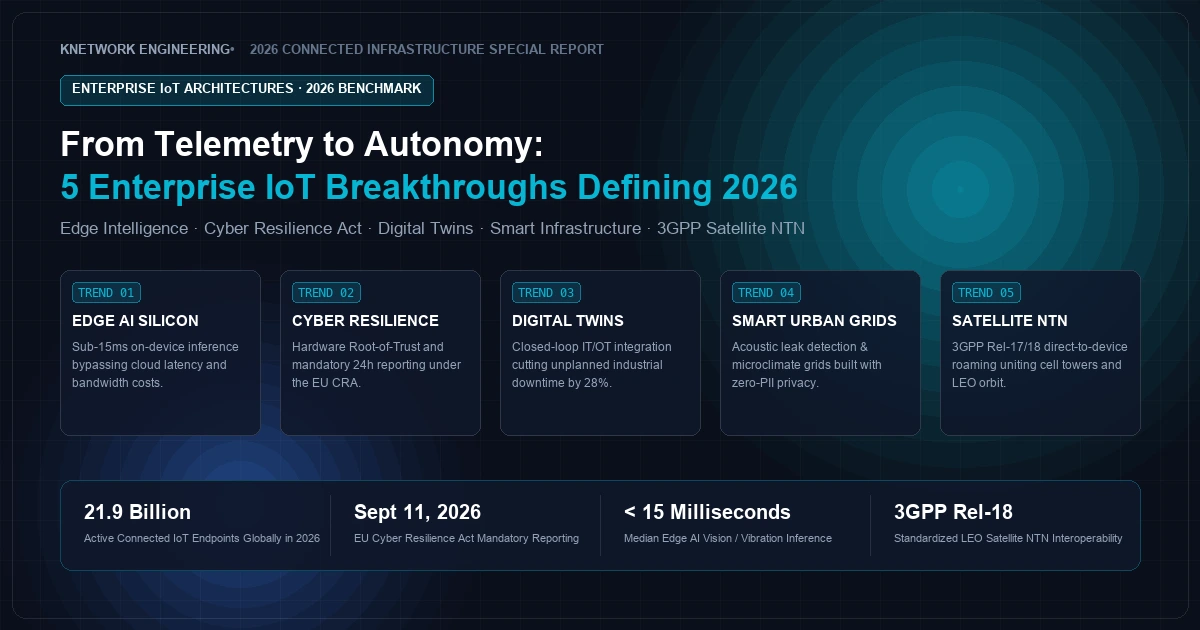
From Telemetry to Autonomy: 5 Enterprise IoT Breakthroughs Defining 2026
Active connected IoT devices have crossed 21.9 billion in 2026, but the vanity era of streaming raw sensor telemetry to central clouds is over. From sub-15ms Edge AI and mandatory EU Cyber Resilience Act compliance to closed-loop digital twins and 3GPP satellite roaming, here is how modern engineering leaders build autonomous physical systems.
Imagine an automotive assembly line in Bavaria. A robotic welding arm begins vibrating at an irregular 120-hertz oscillation—a microscopic hairline fracture forming inside its planetary gearbox. In 2020, this sensor would have streamed gigabytes of raw accelerometer telemetry across the internet to a cloud data lake. By the time a central analytics pipeline processed the batch, computed the Fourier transform, and returned an alert, the joint would have seized, shutting down production at $22,000 per minute.
In 2026, the machine does not ask the cloud for permission to protect itself.
A neural micro-accelerator embedded inside the sensor enclosure flags the harmonic distortion in under 12 milliseconds. It instructs the programmable logic controller (PLC) to adjust motor torque, schedules a replacement bearing for the overnight maintenance window, and sends a 140-byte signed status receipt to the plant ledger.
According to enterprise tracking by IoT Analytics, active connected IoT endpoints have surpassed 21.9 billion in 2026. Yet the real story is qualitative: the industry has abandoned the vanity era of the dumb sensor. Engineering leaders have hit the physical ceiling of centralized cloud streaming—bandwidth saturation, cellular egress bills, and unpredictable network latency.
The theme of 2026 is physical autonomy. Five architectural breakthroughs are dictating which connected initiatives generate lasting enterprise value.
1. Edge AI and On-Device Intelligence
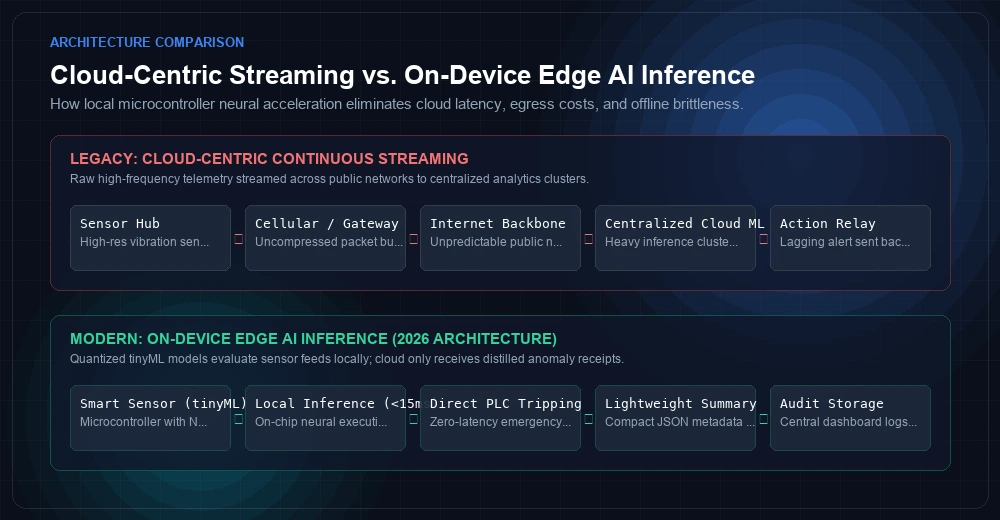
For years, the standard architecture was brute-force simple: attach an inexpensive sensor, stream all telemetry to AWS or Azure over MQTT, and run predictive models in the cloud. That playbook has collapsed under bandwidth costs and transmission latency.
Why pay to upload terabytes of static, normal vibration data just to detect a three-second anomaly?
Why It Matters
Deploying quantized machine learning models directly on microcontrollers (tinyML) and edge gateways changes operational economics:- Sub-15ms Latency: Local neural inference triggers emergency mechanical shutdowns before physical damage propagates.
- Over 90% Bandwidth Reduction: Raw sensor waveforms remain on-chip; the device transmits only compact JSON anomaly digests.
- Offline Sovereignty: Subterranean mines, offshore platforms, and cleanrooms continue operating during complete network blackouts.
Modern silicon—like the ARM Cortex-M85 with Helium vector extensions, NXP i.MX RT crossover MCUs, and STMicroelectronics STM32N6 chips with dedicated neural processing units (NPUs)—executes computer vision and vibration classification consuming under 50 milliwatts.
Real-World Example
German automaker Audi, collaborating with Siemens, deployed edge computer vision across its Neckarsulm stamping plant. Optical cameras running local neural models evaluate spot-weld seams on car bodies in real time. Rather than routing video across external networks, edge accelerators classify weld quality in under 18 milliseconds, reducing false-positive defect flags by over 50% without human intervention.What to Watch
The major trend in 2026 is continual on-device adaptation. Instead of deploying static models that drift as mechanical components age, microcontrollers now run lightweight weight updates locally, auto-calibrating to unique mechanical friction without cloud retraining.To explore custom embedded firmware design, review KNetwork's IoT and Connected Hardware Engineering capabilities.
2. IoT Security and Device Identity
For over a decade, IoT security was treated as an afterthought—subordinated to bill-of-materials cost cuts and fast shipping schedules. The result was predictable: millions of internet-connected cameras, industrial gateways, and smart meters hijacked by Mirai-variant botnets via default credentials and unpatched debug ports.
In 2026, regulators have turned device security into an unavoidable legal liability.
Why It Matters
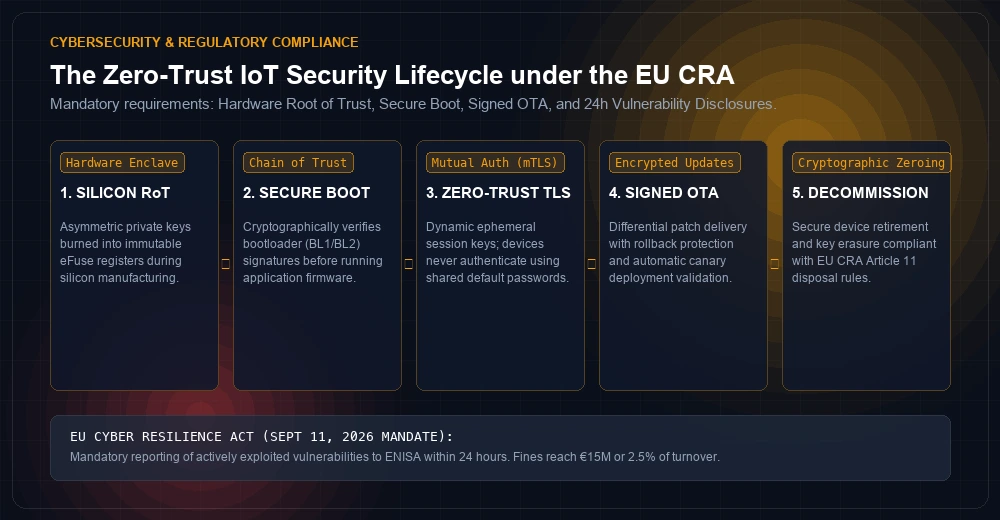
On September 11, 2026, the mandatory reporting rules of the European Union Cyber Resilience Act (CRA) take legal effect. Hardware vendors distributing connected products in the EU must report actively exploited vulnerabilities to ENISA within 24 hours, backed by penalties up to €15 million or 2.5% of global turnover.This mandate makes zero-trust hardware architecture mandatory:
- Silicon Root of Trust (RoT): Private keys burned into immutable eFuses during wafer fabrication replace vulnerable hardcoded passwords.
- Measured Secure Boot: Cryptographic signatures verify every bootloader stage (BL1 to application runtime) before executing flash code.
- Mutual TLS & Ephemeral Keys: Devices authenticate dynamically using short-lived session certificates.
- Cryptographically Signed Delta OTA: Firmware updates apply differential patches with automated rollback protection if health checks fail.
Real-World Example
Semiconductor manufacturers like STMicroelectronics and Nordic Semiconductor have embedded PSA Certified Level 3 secure enclaves into standard microcontrollers. Industrial automation provider Schneider Electric redesigned its connected motor platforms around these chips. Even if a bad actor physically extracts the external flash memory chip, the silicon enclave prevents key duplication, firmware tampering, or telemetry spoofing.What to Watch
Automated Cryptographic Decommissioning. Retiring 10,000 distributed utility endpoints requires a signed zeroization command that blows hardware security fuses remotely, permanently sterilizing private keys so retired hardware cannot re-emerge as rogue network nodes.For zero-trust ingestion infrastructure, consult our Cloud & DevOps Architecture team.
3. Digital Twins and Industrial IoT (IIoT)
The phrase "digital twin" spent years as an overused marketing buzzword. Early implementations were often little more than static 3D CAD illustrations linked to a lagging temperature reading—pleasing to look at in executive briefings, but useless on the factory floor.
In 2026, digital twins have evolved into bidirectional, closed-loop operational engines.
Why It Matters
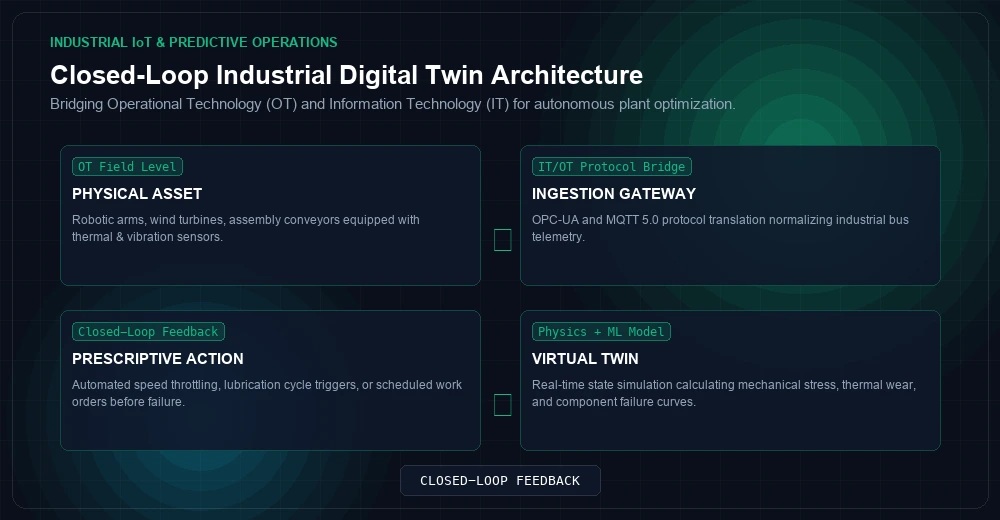
A modern industrial digital twin is a dynamic mathematical model mirroring the mechanical wear, fluid dynamics, and thermodynamic state of an asset in real time.By pairing high-frequency sensor streams with physics-informed neural networks (PINNs), the system moves from reactive alerting to prescriptive actuation:
- It simulates mechanical stress under current load.
- It forecasts that a pump impeller will suffer cavitation fatigue within 40 operating hours.
- It autonomously throttles pump velocity by 12%, preventing catastrophic seizure while keeping the production line operational until the next scheduled maintenance shift.
The primary engineering challenge is bridging Operational Technology (OT) and Information Technology (IT). OT prioritizes sub-millisecond determinism across fieldbus protocols (Modbus, Profinet, OPC-UA). IT demands scalable JSON event buses. Intelligent edge gateways now bridge this gap by translating legacy registers into structured MQTT 5.0 and Sparkplug B topics at the machine boundary.
Real-World Example
The BMW Group deployed synchronized virtual factory twins across its assembly plants, including the Regensburg and Debrecen iFactory facilities, using Siemens automation and NVIDIA Omniverse. By validating every robotic tool path and conveyor handoff in a digital twin before physically retooling lines, BMW shortened EV retooling timelines by months and cut unplanned downtime by 24% to 28%.In renewable energy, Equinor uses digital twins on offshore floating wind turbines. The system models structural hydrodynamic fatigue from wave action, predicting bearing wear two months in advance and saving millions in offshore maintenance vessel mobilization.
What to Watch
Federated Supply Chain Twins. Rather than operating plant twins in isolation, manufacturers share selective telemetry endpoints with logistics partners via secure data spaces (like Catena-X). If a tier-2 supplier suffers equipment failure, your factory twin adjusts production pacing hours before parts fail to arrive.Explore our Custom Software Development practice to learn how we build real-time event pipelines.
4. Smart Cities and Connected Infrastructure
Early municipal smart city concepts suffered from bloated ambitions. Tech vendors promised omniscient central control rooms, automated citizen tracking, and intelligent trash bins. Most collapsed into pilot-phase graveyards when grant funding evaporated, leaving behind orphaned proprietary hardware.
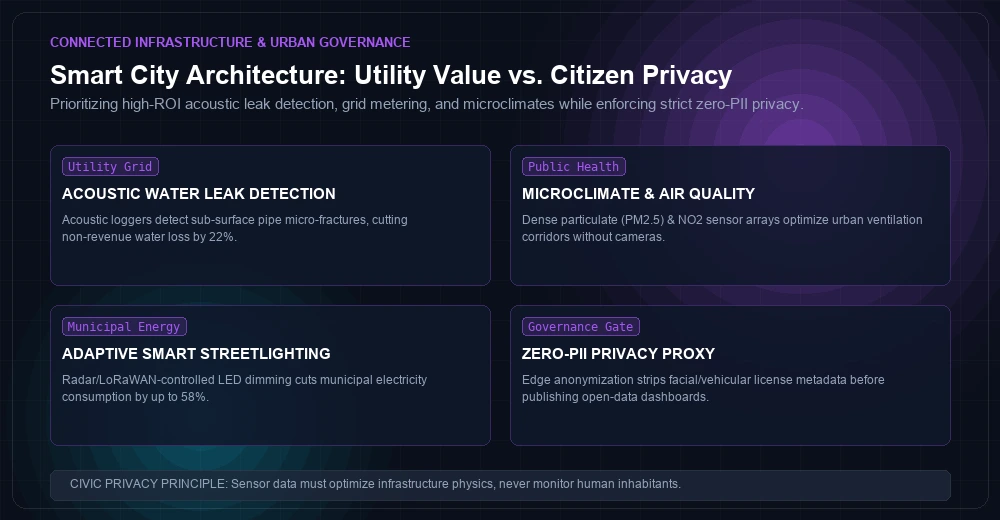
In 2026, smart city engineering has matured by focusing on high-ROI utility infrastructure physics: water conservation, energy optimization, and public safety.
Why It Matters
Urban centers face mounting climate shocks and deteriorating underground utilities. Successful municipalities deploy low-power wide-area networks (LPWAN) targeted at concrete operational pain points:- Acoustic Water Leak Detection: Municipalities lose up to 30% of treated drinking water through underground pipe fractures. Sub-surface acoustic sensors identify the acoustic frequency of pipe fissures, directing excavation crews before sinkholes form.
- Adaptive Radar Streetlighting: Solid-state LED streetlights equipped with microwave radar dim to 20% during empty hours and brighten upon detecting oncoming vehicles, slashing municipal electricity consumption by up to 58%.
- Microclimate & Particulate Mapping: Low-cost optical PM2.5 and nitrogen dioxide sensor arrays on public transit fleets identify neighborhood heat islands and pollution corridors.
Real-World Example
The municipal utility of Zurich, Switzerland (WVZ) deployed thousands of LoRaWAN-connected acoustic noise loggers across its subterranean water distribution grid.By analyzing acoustic noise correlations in the quiet early morning hours (02:00 to 04:00), the system pinpoints sub-surface pipe micro-leaks within a two-meter radius. The program slashed Zurich's non-revenue water loss by over 22%, recouping full deployment costs in fourteen months.
Similarly, Barcelona transformed municipal park management using sub-surface soil moisture capacitance sensors. Valves open only when root-zone water tension drops below threshold, saving the Mediterranean city more than 425 million liters of potable water each year.
The Governance & Privacy Line
Why did water and lighting grids succeed while pedestrian-tracking cameras provoked intense citizen backlash? The difference is Privacy by Design:Modern city sensors sanitize data at the hardware edge, calculating vehicle throughput or foot-traffic volume inside temporary memory and discarding raw frames immediately.
5. IoT Connectivity: 5G, LPWAN, and the Satellite NTN Revolution
There is no universal IoT wireless protocol. Specifying high-speed 5G for an agricultural soil sensor will bankrupt a project on battery replacements within weeks; choosing LoRaWAN for a warehouse automated guided vehicle (AGV) will result in collision shutdowns caused by transmission latency.
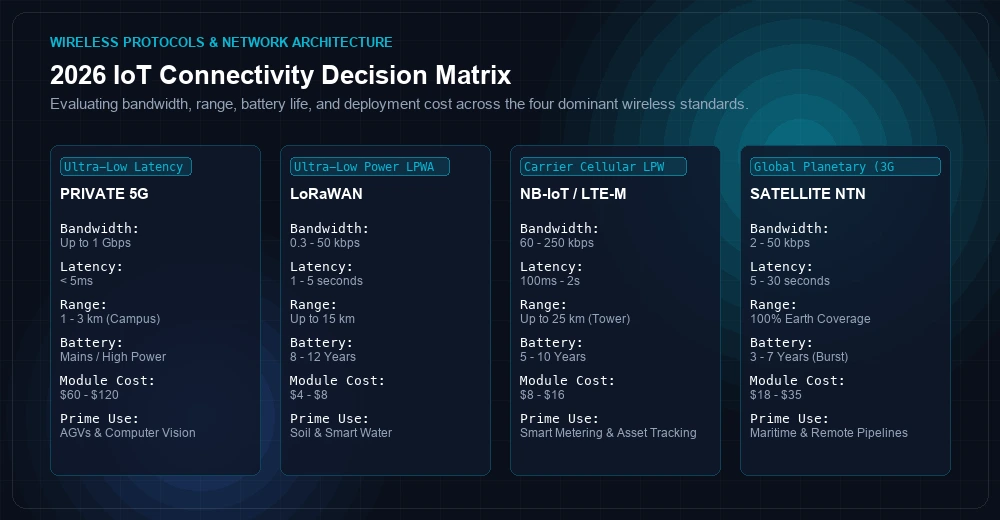
In 2026, wireless protocol selection has hardened into clear engineering tiers.
Why It Matters
Selecting the wrong transport layer remains the leading cause of field device retrofits. Successful deployments align payload volume and power budgets to the appropriate network:| Connectivity Tier | Bandwidth | Range | Battery Life | Module Cost | Prime Enterprise Use Case |
|---|---|---|---|---|---|
| Private 5G | Up to 1 Gbps | 1–3 km (Campus) | Hours to Days (Mains) | $60–$120 | Autonomous mobile robots (AMRs), high-res optical inspection, real-time safety interlocks. |
| LoRaWAN | 0.3–50 kbps | Up to 15 km | 8–12 Years | $4–$8 | Sub-surface water metering, soil moisture probes, building HVAC damper monitoring. |
| NB-IoT / LTE-M | 60–250 kbps | Up to 25 km (Tower) | 5–10 Years | $8–$16 | Smart electricity meters, connected streetlighting, inter-city cold chain logistics. |
| Satellite NTN | 2–50 kbps | Global (100% Earth) | 3–7 Years (Burst) | $18–$35 | Maritime cargo containers, trans-continental oil pipelines, remote mining telemetry. |
The Breakthrough: 3GPP Release 18 Satellite NTN
The decisive connectivity milestone of 2026 is the commercial availability of Direct-to-Device Satellite IoT, standardized under 3GPP Release 17 and Release 18 (5G-Advanced).Previously, connecting an asset outside terrestrial cellular coverage required a bulky, proprietary satellite transceiver costing hundreds of dollars, paired with an expensive airtime contract. Release 18 eliminated that barrier by enabling standard, low-cost NB-IoT silicon to communicate directly with Low Earth Orbit (LEO) satellite constellations.
Real-World Example
Spanish satellite pioneer Sateliot, in partnership with Deutsche Telekom, operates an orbital constellation of LEO nanosatellites functioning as roaming cell towers in space.A maritime cargo container equipped with a standard cellular eSIM travels through inland Europe on terrestrial cellular. When the ship moves into the mid-Atlantic—hundreds of miles beyond terrestrial coverage—the modem roams onto the LEO satellite network using the same SIM card, data plan, and protocol stack. The asset transmits location, internal temperature, and shock alerts without dedicated satellite hardware.
What to Watch
The expansion of 5G RedCap (Reduced Capability). Bridging high-speed 5G broadband and low-speed NB-IoT, RedCap provides 150 Mbps downlink with low latency at half the silicon cost, emerging as the primary standard for industrial wearables and plant robotics.To see how we integrate cellular telemetry into vehicle tracking, read our Taxi Jee Fleet Telemetry Case Study.
Building Resilient Physical Systems in 2026
The experimental era of enterprise IoT is over. Corporate boards and engineering directors are no longer persuaded by novelty dashboards tracking disconnected, passive sensors.
The organizations pulling ahead in 2026 approach connected devices as a rigorous, end-to-end systems discipline. They have abandoned brute-force cloud streaming in favor of sub-15ms on-device Edge AI, anchored their security architectures in immutable silicon to satisfy the EU Cyber Resilience Act, and unified physical machinery with bidirectional, closed-loop digital twins. By combining localized edge autonomy with standard 3GPP satellite roaming and privacy-preserving urban grids, they build physical infrastructure engineered to self-protect and self-optimize.
The transition from passive monitoring to physical autonomy is here. The only question is whether your systems are engineered to act—or built to wait.
Key Takeaways
- Edge AI replaces raw data streaming: Quantized neural networks running on sub-50mW microcontrollers deliver sub-15ms inference while slashing cloud bandwidth by over 90%.
- IoT security is legally enforceable: The EU Cyber Resilience Act's mandatory 24-hour vulnerability reporting taking effect September 11, 2026, makes silicon Root of Trust and signed OTA pipelines mandatory.
- Digital twins must close the loop: Real-time integration between OT industrial fieldbuses and IT machine learning models cuts unplanned factory downtime by up to 28%.
- Smart city returns come from utility physics: Acoustic water leak detection and radar-dimmed streetlighting deliver documented municipal ROI within 14 months while protecting citizen privacy.
- Satellite IoT has standardized: 3GPP Release 18 allows standard NB-IoT modems to connect directly to LEO satellites using standard cellular eSIMs, eliminating proprietary dishes.
Designing or securing enterprise connected hardware? Contact KNetwork Engineers to review your IoT systems architecture roadmap.
Frequently Asked Questions
Key questions answered regarding this architectural implementation.
Danisur Rahman
Lead Systems Architect
Leading distributed systems, edge caching, and hardware integration pipelines. Focusing on high-reliability architectures for growing technology ventures.
More From The Engineering Blog
View All Articles→Satellite NTN & 3GPP Release 18: Bridging Terrestrial Cellular and Orbital Direct-to-Device IoT
How 3GPP Release 17/18 standardized Direct-to-Device satellite connectivity, allowing standard NB-IoT modems with ordinary eSIMs to communicate with LEO constellations.
Smart City Infrastructure Physics: Acoustic Water Leak Detection & Radar Streetlighting
Why modern municipal IoT succeeds by prioritizing utility physics over citizen surveillance—slashing non-revenue water loss by 22% and lighting power by 58%.
Enjoyed this technical breakdown?
Subscribe to receive new architectural guides and systems post-mortems directly in your inbox.