EU Cyber Resilience Act (CRA) Compliance: Silicon Root of Trust & Secure OTA Pipelines
Architecting hardware-anchored device identities, immutable bootloaders, and ECDSA-signed dual-bank firmware updates to satisfy mandatory 2026 EU CRA security standards.
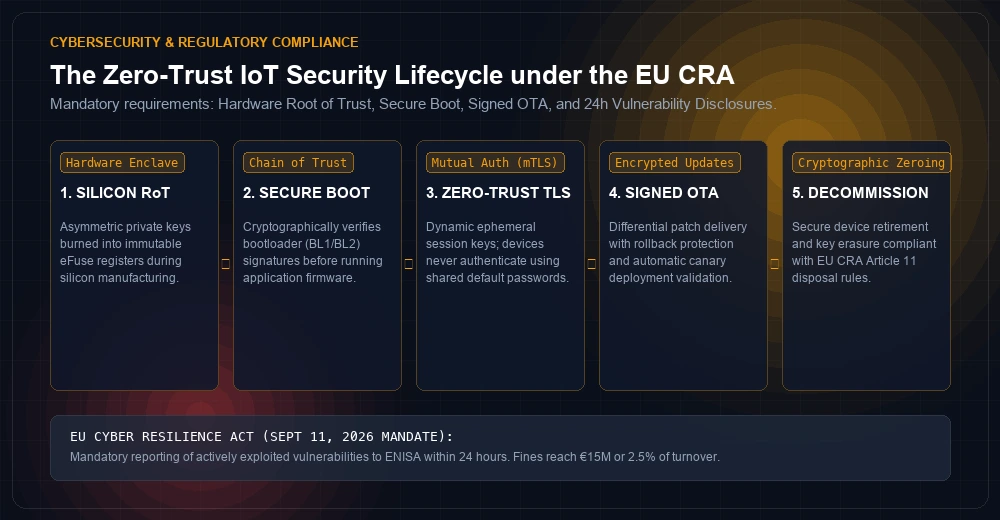
For over a decade, consumer and enterprise IoT security was treated as an afterthought—subordinated to bill-of-materials cost cuts and aggressive time-to-market pressure. The inevitable result was millions of connected security cameras, routers, and smart meters hijacked into Mirai-variant botnets via hardcoded default passwords and unpatched JTAG debug ports.
In 2026, that era is permanently over. Regulators have converted device security into an unavoidable corporate liability.
The European Union Cyber Resilience Act (CRA) introduces mandatory cybersecurity requirements for all hardware and software products sold in the European single market, backed by financial penalties reaching up to €15 million or 2.5% of global annual turnover.
1. The Legal Mandates of the CRA (Effective September 2026)
Beginning September 11, 2026, manufacturers must comply with severe statutory enforcement rules:
- 24-Hour Mandatory Vulnerability Notification: Manufacturers must notify ENISA and national CSIRTs of any actively exploited vulnerability within 24 hours of awareness.
- Secure by Default: Products must ship with unique cryptographic identities—generic default passwords (e.g.
admin:admin) are strictly illegal. - Automatic Cryptographically Signed Updates: Devices must feature secure, authenticated Over-The-Air (OTA) update mechanisms that protect code integrity.
- Mandatory 5-Year Security Support: Hardware must receive security patches for its expected product lifecycle (minimum 5 years).
2. Architecture: Anchoring Device Identity in Silicon
Software-based keys stored in plain Flash memory cannot satisfy zero-trust standards. An attacker with a $15 logic analyzer can desolder the flash chip, dump the binary, and extract private TLS certificates.
Modern architecture requires a Hardware Root of Trust (RoT):
+---------------------------------------------------------------+
|                      MICROCONTROLLER CORE                      |
|                                                               |
|  +--------------------+         +--------------------------+  |
|  | Bootloader (ROM)   |         | Application Flash (SLOT A)|  |
|  | - Immutable Hash   |         | - Signed Runtime Binary   |  |
|  +---------+----------+         +--------------------------+  |
|            |                                                  |
|            v (Verifies Signature via ECDSA-P256)              |
|  +---------------------------------------------------------+  |
|  |             SECURE ENCLAVE / CRYPTO CO-PROCESSOR        |  |
|  |  - Hardware eFuses (Immutable Device Certificate)       |  |
|  |  - True Random Number Generator (TRNG)                  |  |
|  |  - Elliptic Curve Accelerator (ECC / AES-256-GCM)       |  |
|  +---------------------------------------------------------+  |
+---------------------------------------------------------------+
- Immutable ROM Bootloader (BL1): Hard-coded into silicon during manufacturing; cannot be reprogrammed or flashed over the air.
- Measured Boot: BL1 calculates the SHA-256 hash of the secondary bootloader (BL2). It queries the Secure Enclave to verify the vendor's public key signature before executing a single instruction.
- Mutual TLS (mTLS) with Ephemeral Keys: Devices authenticate to MQTT brokers using private keys locked inside Secure Enclave hardware, preventing device impersonation.
3. Dual-Bank A/B OTA Partitioning & Rollback Guardrails
To prevent field devices from being permanently bricked by corrupted downloads or incomplete flashing, production hardware utilizes a Dual-Bank (A/B) Memory Partition:
+------------------------+------------------------+
|   Flash Bank A (Active)|  Flash Bank B (Staging)|
|   Firmware v2.4.1      |  Firmware v2.5.0 (OTA) |
|   STATUS: BOOTED_OK    |  STATUS: UNVERIFIED    |
+------------------------+------------------------+
Verification Workflow:
- Device downloads the encrypted delta patch into Bank B.
- The Secure Enclave computes the cryptographic digest and validates the ECDSA P-256 digital signature against the vendor's root certificate.
- If valid, the bootloader points the reset vector to Bank B and starts a 120-second hardware watchdog timer.
- If the new firmware establishes cloud connectivity and passes memory integrity self-tests, it writes a
BOOTED_OKflag to non-volatile memory. - If the watchdog expires or a kernel panic occurs, the bootloader automatically reverts execution to Bank A without manual intervention.
4. Automated Firmware Signing Script
Below is a production Python signing utility using the cryptography library to generate compliant signed firmware manifests:
import hashlib
from cryptography.hazmat.primitives.asymmetric import ec
from cryptography.hazmat.primitives import hashes
from cryptography.hazmat.primitives.serialization import load_pem_private_keydef generate_signed_ota_manifest(firmware_bin_path: str, private_key_pem_path: str, output_manifest_path: str):
    with open(firmware_bin_path, "rb") as f:
        firmware_bytes = f.read()    # 1. Compute SHA-256 digest of binary
    sha256_hash = hashlib.sha256(firmware_bytes).digest()    # 2. Sign digest using ECDSA SECP256R1 (NIST P-256)
    with open(private_key_pem_path, "rb") as key_file:
        private_key = load_pem_private_key(key_file.read(), password=None)    signature = private_key.sign(
        firmware_bytes,
        ec.ECDSA(hashes.SHA256())
    )    # 3. Compile cryptographically auditable manifest
    manifest = {
        "hardware_rev": "KNET-IOT-REV3",
        "firmware_version": "2.5.0",
        "binary_size_bytes": len(firmware_bytes),
        "sha256": sha256_hash.hex(),
        "ecdsa_signature": signature.hex(),
        "cra_compliance_id": "EU-CRA-2026-ENISA-V2"
    }    with open(output_manifest_path, "w") as out:
        import json
        json.dump(manifest, out, indent=2)
    print("Firmware signed successfully with hardware-grade attestation.")
5. Summary Checklist for Engineering Directors
To ensure your connected products remain legally compliant across global markets:
- [x] Replace shared credentials with factory-burned silicon private keys (ATECC608, TPM 2.0).
- [x] Implement measured boot chains with hardware rollback protection.
- [x] Configure dual-bank A/B memory partitions with autonomous watchdog recovery.
- [x] Establish a 24-hour CVE disclosure pipeline to report incidents to ENISA.
- [x] Integrate automated cryptographic decommissioning to zeroize hardware keys at end-of-life.
Need an independent security audit of your connected device architecture? Contact KNetwork Hardware Engineers to evaluate your firmware security posture.
Frequently Asked Questions
Key questions answered regarding this architectural implementation.
Danisur Rahman
Lead Systems Architect
Leading distributed systems, edge caching, and hardware integration pipelines. Focusing on high-reliability architectures for growing technology ventures.
More From The Engineering Blog
View All Articles→Satellite NTN & 3GPP Release 18: Bridging Terrestrial Cellular and Orbital Direct-to-Device IoT
How 3GPP Release 17/18 standardized Direct-to-Device satellite connectivity, allowing standard NB-IoT modems with ordinary eSIMs to communicate with LEO constellations.
Smart City Infrastructure Physics: Acoustic Water Leak Detection & Radar Streetlighting
Why modern municipal IoT succeeds by prioritizing utility physics over citizen surveillance—slashing non-revenue water loss by 22% and lighting power by 58%.
Enjoyed this technical breakdown?
Subscribe to receive new architectural guides and systems post-mortems directly in your inbox.