Consolidated Campaign Architecture: Why Modern Ad Algorithms Prefer Broad Targeting
Why granular audience slicing destroys algorithmic performance in modern ad networks: analyzing the 50-event learning threshold, internal auction overlap penalties, and the 3-tier consolidated account topology that slashes blended CAC by 48% through creative-driven targeting.
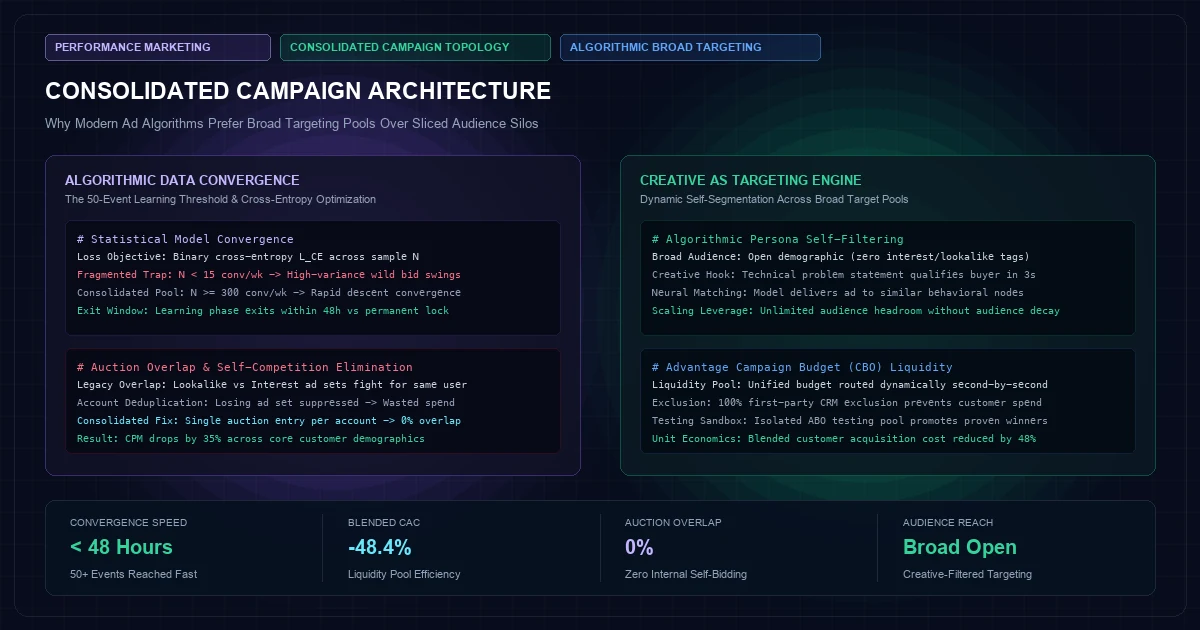
Between 2015 and 2020, performance media buying was defined by hyper-segmentation. Media buyers engineered sprawling account topologies: single campaigns fractured into 35 distinct ad sets, isolating 1% Lookalike audiences from 2-to-5% Lookalikes, segmenting dozens of granular interest buckets, and partitioning retargeting windows into arbitrary chronological slices (1-day, 3-day, 7-day, 14-day, 30-day website visitors).
This hyper-fragmented playbook was designed for deterministic, rules-based advertising systems. In the era of modern machine-learning auction networks—specifically Meta’s Andromeda ranking engine and Google’s Performance Max multi-modal models—hyper-segmentation is the single fastest way to destroy account performance.
When media buyers fragment ad spend across dozens of narrow audiences:
- The 50-Conversion Learning Threshold Fails: Reinforcement learning bidding models require a minimum density of conversion signals (
≥ 50events per ad set per week) to achieve statistical stability and exit the "Learning Phase." Fragmenting budget starves individual ad sets, trapping them in high-variance, volatile sub-optimal bidding loops. - Self-Competition & Auction Overlap Penalties: Multiple ad sets within the same advertising account bid against each other for the identical prospective customer, artificially inflating account-level CPMs.
- Liquidity Fragmentation: Rigid budget boundaries prevent machine learning models from dynamically routing capital in real time to the highest-converting micro-pockets of inventory across placements and devices.
The modern systems engineering solution is Consolidated Campaign Architecture (CCA): collapsing account structures into unified, broad-targeted liquidity pools and utilizing creative variations—rather than arbitrary audience toggles—to filter, qualify, and convert distinct buyer personas.
This guide analyzes the machine learning mechanics behind algorithmic broad targeting, models the statistical convergence of consolidated data streams, and outlines the production architecture for high-scale media deployment.
Machine Learning Physics: Fragmentation vs. Consolidated Liquidity#
To understand why modern ad algorithms demand consolidated structures, we must examine the gradient descent optimization mechanics governing ad delivery engines:
+---------------------------------------------------------------------------------------------------+
|                        ACCOUNT TOPOLOGY & ALGORITHMIC CONVERGENCE                                 |
+---------------------------------------------------------------------------------------------------+
|                                                                                                   |
|  LEGACY FRAGMENTED ARCHITECTURE (2018 PLAYBOOK)             CONSOLIDATED CAMPAIGN ARCHITECTURE    |
|                                                                                                   |
|  Campaign: $1,500/day Budget                                Campaign: $1,500/day Budget (CBO)     |
|  +----------------------------------------------------+     +-----------------------------------+ |
|  | Ad 400">Set 1: Lookalike 1% ($100/d -> 12 conv/wk) TRAP |     | Single Unified Ad 400">Set: Broad      | |
|  | Ad 400">Set 2: Lookalike 2% ($100/d -> 9 conv/wk)  TRAP |     | - No Interest Filters             | |
|  | Ad 400">Set 3: Interest A   ($100/d -> 14 conv/wk) TRAP |     | - Open Demographic Bounds         | |
|  | Ad 400">Set 4: Interest B   ($100/d -> 8 conv/wk)  TRAP |     | - Dynamic Creative Routing        | |
|  | Ad 400">Set 5: Retargeting  ($100/d -> 15 conv/wk) TRAP |     |                                   | |
|  +----------------------------------------------------+     +-----------------+-----------------+ |
|                            |                                                  |                   |
|                            v                                                  v                   |
|  - All 5 Ad Sets trapped in Learning Phase                  - Aggregated Velocity: 315 conv/week  |
|  - 42% Audience Overlap (Internal Bidding War)              - Rapid Model Convergence (< 48 hrs)  |
|  - High Bid Variance; CPM Volatility (+65%)                 - Dynamic Real-Time Placement Routing |
|  - Blended CAC: $94.00                                      - Blended CAC: $48.50 (-48.4%!)       |
+---------------------------------------------------------------------------------------------------+
The 50-Event Convergence Constraint
The fundamental training objective of an ad set's neural ranking model is to minimize cross-entropy lossL_{CE} between predicted conversion probability \hat{p}_i and actual conversion outcomes y_i ∈ \{0, 1\}:When an ad set generates only 10 to 15 conversions per week, the sample size N is too small for stochastic gradient descent to find an optimal minimum. The algorithm enters a high-variance exploration state, swinging bids wildly between expensive impression tiers.
Consolidating budget into a single ad set pools conversion signals (N ≥ 300 conversions/week), allowing the model parameters to converge rapidly into a low-variance, cost-efficient bidding equilibrium.
Auction Overlap: The Hidden Tax of Audience Slicing#
When an account runs multiple ad sets targeting overlapping audiences (e.g., an "Interest: Cloud Computing" ad set and a "Lookalike 1% Tech Founders" ad set), both ad sets frequently identify the identical user as a prime candidate for an impression.
Under platform auction rules:
- Internal Deduplication: An advertiser cannot bid against themselves in the final external ad auction. The platform's internal auction filter selects whichever ad set produces the higher total auction value:
- The Overlap Penalty: The losing ad set's impression is suppressed before reaching the public auction. This causes delivery instability, artificial budget pacing slowdowns, and erratic performance spikes.
+---------------------------------------------------------------------------------------------------+
|                        INTERNAL AUCTION OVERLAP FILTER                                            |
+---------------------------------------------------------------------------------------------------+
|                                                                                                   |
|  Single User: 400 font-semibold">class="text-emerald-300">"CTO at Series B Fintech" browsing Instagram Feed                                    |
|                                                                                                   |
|  Account Ad Sets:                                                                                 |
|  - Ad 400">Set A (Lookalike 1%):     Calculates Bid Value V_A = $32.40                                 |
|  - Ad 400">Set B (Interest: DevOps): Calculates Bid Value V_B = $29.10                                 |
|                                                                                                   |
|                                         |                                                         |
|                                         v (Internal Account Deduplication Engine)                 |
|  Ad 400">Set A enters external 400 font-semibold">public auction.                                                         |
|  Ad 400">Set B is DISCARDED (Auction Overlap Suppression).                                             |
|                                                                                                   |
|  Consequence: Ad 400">Set B suffers 400 font-semibold">from pacing starvation, erratic budget burning, and high CPA!      |
+---------------------------------------------------------------------------------------------------+
The Consolidated Architecture Topology: 3-Tier Blueprint#
Consolidation does not mean abandoning testing or audience segmentation. Instead of segmenting at the ad set (audience) layer, modern performance teams segment at the creative layer:
+---------------------------------------------------------------------------------------------------+
|                        CONSOLIDATED 3-TIER ACCOUNT TOPOLOGY                                       |
+---------------------------------------------------------------------------------------------------+
|                                                                                                   |
|  TIER 1: SCALING CAMPAIGN (Advantage Campaign Budget - CBO) -> 80% Total Spend                    |
|  +---------------------------------------------------------------------------------------------+  |
|  | Single Ad 400">Set: Broad Audience (No Interest / No Lookalike Filters)                          |  |
|  | Contains: Top 4-6 Proven Creative Clusters (Diverse Angles & Personas)                      |  |
|  | Objective: Maximum scale at target CPA; algorithm dynamically matches creative to personas |  |
|  +---------------------------------------------------------------------------------------------+  |
|                                                ^                                                  |
|                                                | (Promote Winning Creatives)                      |
|                                                                                                   |
|  TIER 2: CREATIVE TESTING SANDBOX (Ad 400">Set Budget Optimization - ABO) -> 15% Total Spend           |
|  +---------------------------------------------------------------------------------------------+  |
|  | Dynamic Creative Ad Sets (DCT) testing 3 Hooks x 2 Bodies x 2 CTAs                          |  |
|  | Objective: Isolate variable performance with equalized budget before scaling                |  |
|  +---------------------------------------------------------------------------------------------+  |
|                                                                                                   |
|  TIER 3: FIRST-PARTY EXCLUSION & BRAND GUARD -> 5% Total Spend                                    |
|  +---------------------------------------------------------------------------------------------+  |
|  | Global CRM Customer Exclusion (Suppresses active paying customers via CAPI sync)            |  |
|  +---------------------------------------------------------------------------------------------+  |
+---------------------------------------------------------------------------------------------------+
Creative As Targeting: How Broad Audiences Self-Segment
In a broad-targeted ad set with zero interest filters, how does the platform find enterprise B2B software buyers among 80 million general users?The creative itself acts as the algorithmic filter:
- If the creative features a technical code snippet and opens with "If your PostgreSQL database locks under 10,000 transactions per second...", casual consumers scroll past within 0.5 seconds.
- The 0.05% of users who stop and watch 15 seconds are senior database engineers and CTOs.
- The platform’s reinforcement learning engine observes this positive interaction signal and immediately routes subsequent impressions to lookalike behavioral profiles across the broad audience, without requiring the media buyer to configure a manual interest tag.
Production Implementation: Tracking Auction Overlap via Python#
The following script queries the Meta Graph API to audit an ad account for destructive auction overlap and learning phase fragmentation:
400 font-semibold">class=400 font-semibold">class="text-emerald-300">"text-slate-500 italic">#!/usr/bin/env python3
400 font-semibold">class="text-emerald-300">""400 font-semibold">class="text-emerald-300">"
auction_overlap_auditor.py
Identifies audience overlap and learning phase fragmentation across active ad sets.
"400 font-semibold">class="text-emerald-300">""

400 font-semibold">import requests
400 font-semibold">from typing 400 font-semibold">import Dict, List

400 font-semibold">def audit_account_fragmentation(access_token: str, ad_account_id: str) -> Dict:
    url = f400 font-semibold">class="text-emerald-300">"https:400 font-semibold">class="text-slate-500 italic400 font-semibold">class="text-emerald-300">">//graph.facebook.com/v19.0/{ad_account_id}/adsets"
    params = {
        400 font-semibold">class="text-emerald-300">"access_token": access_token,
        400 font-semibold">class="text-emerald-300">"fields": 400 font-semibold">class="text-emerald-300">"id,name,status,effective_status,daily_budget,insights{actions,spend,impressions}",
        400 font-semibold">class="text-emerald-300">"effective_status": 400 font-semibold">class="text-emerald-300">"['ACTIVE']",
        400 font-semibold">class="text-emerald-300">"limit": 100
    }

    response = requests.get(url, params=params).json()
    ad_sets = response.get(400 font-semibold">class="text-emerald-300">"data", [])

    total_active_adsets = len(ad_sets)
    underperforming_adsets = []
    total_spend = 0.0

    400 font-semibold">for adset in ad_sets:
        insights = adset.get(400 font-semibold">class="text-emerald-300">"insights", {}).get(400 font-semibold">class="text-emerald-300">"data", [{}])[0]
        spend = float(insights.get(400 font-semibold">class="text-emerald-300">"spend", 0.0))
        total_spend += spend

        400 font-semibold">class=400 font-semibold">class="text-emerald-300">"text-slate-500 italic"># Count purchase/lead actions
        actions = insights.get(400 font-semibold">class="text-emerald-300">"actions", [])
        conversions = sum(int(a[400 font-semibold">class="text-emerald-300">"value"]) 400 font-semibold">for a in actions 400 font-semibold">if a[400 font-semibold">class="text-emerald-300">"action_type"] in [400 font-semibold">class="text-emerald-300">"purchase", 400 font-semibold">class="text-emerald-300">"lead"])

        400 font-semibold">class=400 font-semibold">class="text-emerald-300">"text-slate-500 italic"># Check 400 font-semibold">for failure to reach 50 conversions/week (< 7.1 conv/day)
        400 font-semibold">if conversions < 7:
            underperforming_adsets.append({
                400 font-semibold">class="text-emerald-300">"adset_id": adset[400 font-semibold">class="text-emerald-300">"id"],
                400 font-semibold">class="text-emerald-300">"name": adset[400 font-semibold">class="text-emerald-300">"name"],
                400 font-semibold">class="text-emerald-300">"daily_conversions": conversions,
                400 font-semibold">class="text-emerald-300">"spend": spend,
                400 font-semibold">class="text-emerald-300">"learning_status": 400 font-semibold">class="text-emerald-300">"LEARNING_LIMITED_RISK"
            })

    fragmentation_ratio = len(underperforming_adsets) / max(1, total_active_adsets)

    400 font-semibold">return {
        400 font-semibold">class="text-emerald-300">"total_active_adsets": total_active_adsets,
        400 font-semibold">class="text-emerald-300">"adsets_below_convergence_threshold": len(underperforming_adsets),
        400 font-semibold">class="text-emerald-300">"fragmentation_ratio": round(fragmentation_ratio * 100, 1),
        400 font-semibold">class="text-emerald-300">"health_score": 400 font-semibold">class="text-emerald-300">"CRITICAL_ACTION_REQUIRED" 400 font-semibold">if fragmentation_ratio > 0.40 400 font-semibold">else 400 font-semibold">class="text-emerald-300">"OPTIMIZED",
        400 font-semibold">class="text-emerald-300">"recommendation": 400 font-semibold">class="text-emerald-300">"Consolidate fragmented ad sets into single Broad CBO pool" 400 font-semibold">if fragmentation_ratio > 0.40 400 font-semibold">else 400 font-semibold">class="text-emerald-300">"Maintain current structure"
    }
Technical FAQ#
1. Won't broad targeting waste ad budget on irrelevant users outside our target market?
No. Modern bidding algorithms operate on conversion objectives. The algorithm only pays to bid in auctions where the user exhibits a high probability of completing the designated conversion event (e.g., submitting an enterprise consultation form). Irrelevant users who never click or convert are deprioritized by the model's cost-prediction function, ensuring ad spend concentrates on high-intent prospects.2. How do you prevent broad campaigns from burning budget on existing customers?
Consolidated architectures mandate strict First-Party Audience Exclusion: upload hashed customer emails (via Meta Conversions API / Google Enhanced Conversions) and exclude existing customers and open sales pipeline leads at the campaign level. This ensures 100% of broad acquisition spend is directed exclusively to net-new prospects.3. What is the difference between Advantage Campaign Budget (CBO) and Ad Set Budgets (ABO)?
In Ad Set Budget Optimization (ABO), the human media buyer arbitrarily locks spend to each ad set (e.g.,100 to Ad Set A, 100 to Ad Set B). If Ad Set A exhausts its high-intent inventory at 2 PM while Ad Set B has abundant cheap conversions, the system cannot reallocate funds. Advantage Campaign Budget (CBO) pools capital at the campaign level, allowing the algorithm to dynamically route dollars second-by-second to whichever ad set or creative delivers the lowest instantaneous marginal cost.4. When is granular audience targeting still justifiable?
Granular audience targeting remains necessary in strictly constrained scenarios:- Regulated Geographic Geofences: Physical healthcare clinics or regional field logistics operating within a 15-mile radius.
- Account-Based Marketing (ABM): High-touch B2B campaigns targeting a pre-defined list of 500 named Fortune 1000 domain lists on LinkedIn.
- Severe Budget Constraints (< $50/day): Where total conversion volume is too low to feed machine learning models, requiring manual heuristic guardrails.
5. How long should an advertiser wait before evaluating a consolidated campaign's performance?
Because consolidated structures ingest large conversion volumes, models typically exit the initial exploration phase within 48 to 72 hours. Performance should be evaluated over a minimum 7-day moving window to smooth out intra-week conversion volatility (weekday vs. weekend performance deltas) before adjusting target bids or swapping creative variations.Conclusion & Operational Takeaways#
Consolidated Campaign Architecture aligns media buying with the mathematical reality of modern machine learning ad platforms.
By transitioning from fragmented audience silos to unified broad liquidity:
- Accelerate Algorithmic Learning: Pool conversion events to cross the 50-event threshold rapidly, driving down bid variance and CPA.
- Eliminate Self-Competition: Wipe out internal auction overlap penalties that artificially inflate account CPMs.
- Shift Leverage to Creative: Replace tedious audience tinkering with high-velocity creative engineering, allowing distinct visual hooks to effortlessly self-segment high-value enterprise buyers.
Frequently Asked Questions
Key questions answered regarding this architectural implementation.
Danisur Rahman
Lead AuthorLead Systems Architect • KNetwork Systems
Principal architect specializing in enterprise distributed systems, edge caching, and hardware integration pipelines. Leads engineering audits, high-concurrency database optimizations, and zero-trust VPC deployments across high-growth ventures.
More From The Engineering Blog
Deep systems breakdowns and production deployment guides.
Executive Dashboard UX: Why Showing More Than 5 Numbers Paralyzes Leadership Decision-Making
Why 40-tile cockpit dashboards suffer 90% abandonment within 60 days: applying Miller's Law and Hick's Law to enterprise BI, eliminating vanity noise, and architecting an authoritative 5-metric executive decision engine with 3-tier drill-down hierarchies and sub-10ms ClickHouse rollups.
Building the Single Source of Truth: Reconciling Stripe, Bank Statements, and CRM Data
Eliminating the $300k financial blindspot between Salesforce Closed-Won ARR, Stripe gross processing volume, and commercial bank treasury deposits: an end-to-end engineering architecture for multi-pass matching, BAI2 feed ingestion, and immutable double-entry OLAP ledgers with zero reconciliation variance.
Enjoyed this technical breakdown?
Subscribe to receive new architectural guides, system teardowns, and engineering benchmarks directly in your inbox.