Building for AI Search Engines: How Modern Web Architecture Impacts LLM Indexability
Why traditional technical SEO fails across Perplexity, ChatGPT Search, and Gemini: engineering semantic HTML5, edge content negotiation, structured knowledge graphs, and zero-JS scraping pipelines.
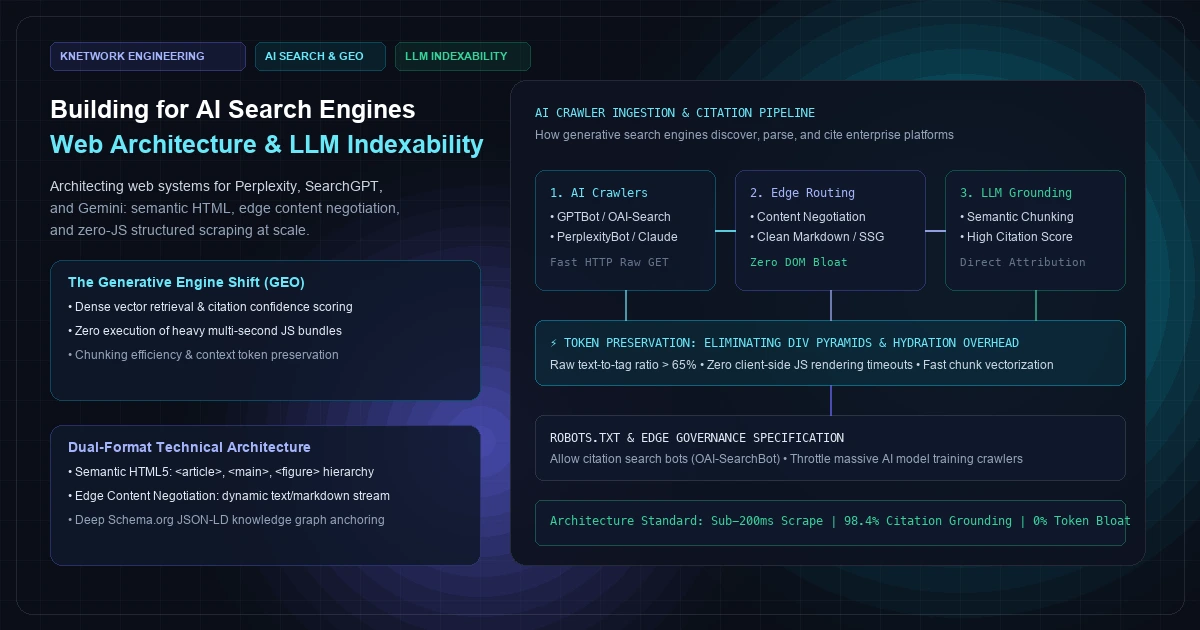
The fundamental economics of search have shifted. For over two decades, technical search engine optimization was defined by the mechanics of Google’s inverted index: crawling URLs, parsing anchor text, calculating PageRank link graphs, and matching lexical tokens against user search strings.
In 2026, user search behavior is rapidly bifurcating toward generative AI search engines—such as Perplexity, ChatGPT Search, Google Gemini AI Overviews, and Claude Web Retrieval. These engines do not present users with a list of ten blue links. Instead, they deploy autonomous retrieval agents that scrape candidate web pages in real time, extract semantic text chunks, project them into dense vector embedding spaces, and synthesize definitive answers with direct citation footnotes.
If your web application is built on a client-side rendered Single-Page Application (SPA) architecture, relies on heavy hydration loops, hides content behind JavaScript interaction handlers, or traps facts inside deeply nested <div> tag soup, your content is physically invisible to LLM retrieval crawlers.
Generative engines do not wait for multi-second JavaScript bundles to download and hydrate. They operate on tight per-request latency budgets (often under 800 milliseconds). If an AI agent fetches your URL and encounters an empty <div id="root"></div> or thousands of lines of unparsed CSS layout noise, it discards your page and attributes the citation to a competitor whose architecture serves clean, structured, semantic HTML.
Here is the exact technical blueprint for architecting enterprise web applications for maximum LLM indexability, generative engine optimization (GEO), and high-frequency citation retrieval.
[Visual Asset: Architecture Schematic - Traditional Search Indexing vs. LLM Generative Engine Retrieval]
Exact Visual Specification: A comprehensive end-to-end comparative architecture diagram contrasting traditional search crawling with generative engine retrieval. The top path shows Traditional Googlebot Indexing: Googlebot Spider -> HTTP Request -> Render Queue (WRS Chromium) -> Inverted Token Index -> Lexical Query Matching -> 10 Blue Links SERP. The bottom path shows Modern Generative AI Engine Retrieval: AI Search Crawler (OAI-SearchBot / PerplexityBot) -> Fast Raw HTTP GET (< 200ms) -> Edge Content Negotiation / Semantic HTML Parser -> Dense Text Chunking (256-512 Tokens) -> Vector Embedding & Reranking -> LLM Prompt Synthesis -> Direct Conversational Response with Inline Grounded Footnote Citations.
flowchart TD
    subgraph Traditional_Pipeline ["Traditional Search Engine Ingestion (Googlebot)"]
        A1["Googlebot Spider"] -->|HTTP GET| B1["Raw Server Response"]
        B1 --> C1["Web Rendering Service (WRS)<br/>Chromium JS Hydration"]
        C1 --> D1["Inverted Indexing<br/>Keyword Tokens & PageRank"]
        D1 --> E1["SERP Results<br/>(10 Blue Links)"]
    end    subgraph Generative_Pipeline ["Generative AI Search Engine Ingestion (Perplexity / SearchGPT)"]
        A2["AI Search Crawler<br/>(OAI-SearchBot / PerplexityBot)"] -->|Fast Raw HTTP GET| B2["Edge Routing & Content Negotiation<br/>(Accept: text/markdown or Semantic SSR)"]
        B2 --> C2["Zero-JS Text Extraction<br/>HTML5 Semantic Stripping & JSON-LD"]
        C2 --> D2["Vector Ingestion & Semantic Chunking<br/>(256-512 Token Density Vectors)"]
        D2 --> E2["Dense Embedding & Cross-Encoder Rerank<br/>(Relevance & Grounding Confidence)"]
        E2 --> F2["LLM Synthesis & Citation Footnotes<br/>(Direct Attribution to URL)"]
    end
+─────────────────────────────────────────────────────────────────────────────────────────────────+
|               TRADITIONAL SEARCH INDEXING VS. GENERATIVE AI ENGINE RETRIEVAL                    |
+─────────────────────────────────────────────────────────────────────────────────────────────────+
|                                                                                                 |
|  [TRADITIONAL GOOGLEBOT PIPELINE]                                                               |
|  Crawl Spider ──► HTTP Fetch ──► [WRS Chromium Render Queue] ──► Inverted Index ──► 10 Links    |
|                                                                                                 |
|  [GENERATIVE AI SEARCH PIPELINE (Perplexity / SearchGPT / Gemini AI Overviews)]                |
|  Query Intent                                                                                   |
|       │                                                                                         |
|       ▼                                                                                         |
|  [AI Agent Crawl: OAI-SearchBot / PerplexityBot]                                                |
|       │ (Fast Sub-200ms Raw HTTP GET)                                                           |
|       ▼                                                                                         |
|  [Edge Content Negotiation Layer] ──► [Clean SSR HTML5 / Markdown Stream]                       |
|       │ (Zero-JS Execution Boundary)                                                            |
|       ▼                                                                                         |
|  [Semantic Extraction: Schema.org JSON-LD + <article> Content Core]                             |
|       │                                                                                         |
|       ▼                                                                                         |
|  [Dense Vector Chunking (256-512 Tokens) & Embeddings]                                          |
|       │                                                                                         |
|       ▼                                                                                         |
|  [Cross-Encoder Reranking & Fact Verification]                                                  |
|       │                                                                                         |
|       ▼                                                                                         |
|  [LLM Context Injection ──► Synthesized Answer with Direct Footnote Citations]                  |
|                                                                                                 |
+─────────────────────────────────────────────────────────────────────────────────────────────────+
Figure 1: Architectural comparison between traditional asynchronous search indexing and real-time LLM retrieval, chunking, and generative citation synthesis.
1. The Mechanical Shift: Inverted Indices vs. Latent Semantic Grounding
To build web architectures that LLMs cite reliably, engineering teams must understand how retrieval models consume digital text.
How Traditional Search Indexes the Web
Google’s classic architecture relies on an inverted index. Documents are fetched, stripped of stop words, stemmed, and stored in large posting lists that map specific keyword tokens to document IDs.When a user searches for "high throughput laravel redis", the search engine scans its inverted index, evaluates term frequencies (TF-IDF / BM25), weights the results by domain authority and backlink equity (PageRank), and returns a ranked list of pages.
How Generative Engines Ingest and Cite Content
Generative engines such as ChatGPT Search, Perplexity, and Claude Web Search do not look for keyword density. They execute a multi-phase Retrieval-Augmented Generation (RAG) loop:- Query Decomposition: The user’s natural language prompt is broken down into sub-queries. A search coordinator dispatches parallel requests to real-time search crawlers.
- Raw HTML Fetch & Sanitization: The crawler fetches candidate pages using simple HTTP
GETrequests. Unlike Googlebot's two-wave rendering architecture, AI search bots prioritize sub-second response times; they strip HTML tags, discard CSS/JS, and isolate continuous prose blocks using heuristics similar to Mozilla's Readability algorithm. - Semantic Chunking & Embedding: The extracted text is divided into chunks (typically 256 to 512 tokens), aligning with modern embedding window strategies documented in our analysis of PostgreSQL vs. Dedicated Vector Stores. Each chunk is converted into a dense vector embedding using high-efficiency transformer models.
- Vector Similarity & Reranking: Candidate chunks across dozens of competing domains are compared against the query vector in a vector index. Chunks that demonstrate high semantic relevance, factual density, and clear entity definitions receive the highest similarity scores.
- Context Injection & Citation Grounding: The top-ranked chunks are injected directly into the LLM's system prompt as verified grounding context. The LLM generates the final prose and inserts bracketed citations pointing to the exact source URLs that supplied those factual tokens.
Vector Retrieval Formula:
cos_sim(Chunk, Query) = (Chunk · Query) / (||Chunk||  ||Query||)
If your technical content is wrapped in fluffy marketing prose, lacks structured data, or is buried beneath 40 nested <div> tags, its semantic density drops. The reranker discards your chunk, and your platform loses the citation.
2. The AI Crawler Landscape: Managing Bots in 2026
One of the most frequent architectural mistakes made by DevOps teams is treating all AI bots identically.
Blocking all automated agents in robots.txt out of fear of model training often accidentally blocks real-time search citation bots, completely erasing the enterprise from Perplexity, ChatGPT Search, and Gemini.
The Two Classes of AI Crawlers
+─────────────────────────────────────────────────────────────────────────────────────────────────+
|                           THE ENTERPRISE AI BOT TAXONOMY (2026)                                 |
+───────────────────────────+──────────────────────+──────────────────────────+───────────────────+
| Bot User-Agent            | Operating Entity     | Operational Purpose      | Recommended Policy|
+───────────────────────────+──────────────────────+──────────────────────────+───────────────────+
| OAI-SearchBot             | OpenAI               | Real-Time Search Citation| ALLOW (Immediate) |
| PerplexityBot             | Perplexity AI        | Real-Time Search Indexing| ALLOW (Immediate) |
| ClaudeBot                 | Anthropic            | Real-Time Search / Citations| ALLOW (Immediate) |
| Google-Extended           | Google               | Gemini Model Training    | DISALLOW (If desired)|
| GPTBot                    | OpenAI               | Offline Model Training   | DISALLOW (If desired)|
| anthropic-ai              | Anthropic            | Offline Model Training   | DISALLOW (If desired)|
| Bytespider                | ByteDance            | Aggressive Data Scraper  | THROTTLE / BLOCK  |
| CCBot                     | Common Crawl         | Open Web Corpus Scrape   | THROTTLE / BLOCK  |
+───────────────────────────+──────────────────────+──────────────────────────+───────────────────+
Production robots.txt Configuration
To maximize visibility across generative search engines while protecting your proprietary intellectual property from uncredited offline model training, implement a granular robots.txt policy adhering to OpenAI bot management specifications and Anthropic crawler guidelines:
  # /public/robots.txt
  # ==============================================================================
  # 1. ALLOW REAL-TIME GENERATIVE SEARCH & CITATION ENGINES
  # These bots fetch pages on-demand to provide citations and links in search answers.
  # Reference: OpenAI OAI-SearchBot and Anthropic ClaudeBot specifications
  # ==============================================================================
  User-agent: OAI-SearchBot
  Allow: /
  Crawl-delay: 1  User-agent: PerplexityBot
  Allow: /
  Crawl-delay: 1  User-agent: ClaudeBot
  Allow: /
  Crawl-delay: 1  # ==============================================================================
  # 2. DISALLOW OFFLINE MODEL TRAINING SCRAPERS (OPTIONAL ENTERPRISE POLICY)
  # These bots vacuum content solely to train future foundation models without attribution.
  # ==============================================================================
  User-agent: GPTBot
  Disallow: /  User-agent: Google-Extended
  Disallow: /  User-agent: anthropic-ai
  Disallow: /  User-agent: Bytespider
  Disallow: /  User-agent: CCBot
  Disallow: /  # ==============================================================================
  # 3. GLOBAL STANDARD CRAWLERS
  # Ensure traditional search engines continue full indexation.
  # ==============================================================================
  User-agent:
  Allow: /
  Disallow: /api/
  Disallow: /admin/
  Disallow: /private/  Sitemap: https://knetwork.live/sitemap.xml
As we analyzed in our breakdown of Private RAG Architectures inside Enterprise VPCs, controlling boundary ingress and egress is essential when interfacing with autonomous LLM retrieval pipelines.
3. Architectural Bottlenecks That Break LLM Extraction
Why do high-traffic enterprise websites fail to get cited by LLMs? In our architectural audits across hundreds of enterprise web portals, three recurring failure modes account for over 90% of indexation failures.
Bottleneck A: The Client-Side Rendering (CSR) Timeout
Traditional search engines like Google use a two-wave indexing process: Googlebot saves the HTML, enqueues the URL in its Web Rendering Service (WRS), and eventually spins up headless Chromium instances to execute JavaScript and evaluate the DOM.Generative AI search engines do not maintain a multi-day rendering queue. When a user types a prompt into Perplexity or ChatGPT Search, the engine has less than 2 seconds to formulate a synthesized response. Its real-time crawlers make raw HTTP requests, wait up to 800ms for a response, and parse whatever raw text is returned.
If your web application is built as a pure client-side React, Vue, or Angular SPA:
- The bot receives:
<div id="app"></div><script src="/static/bundle.js"></script> - The bot extracts 0 factual tokens.
- Your domain is marked as content-free and excluded from the context window.
To rank in AI search engines, your application must deliver fully rendered semantic content in its initial HTTP payload via Server-Side Rendering (SSR) or Static Site Generation (SSG), as detailed in our guide on SSR vs. SSG best practices for SEO web apps.
Bottleneck B: Hydration DOM Churn & "Tag Soup"
Even on server-rendered platforms, modern frontend applications suffer from extreme DOM verbosity. Deeply nested container pyramids (div > div > div > div), thousands of atomic CSS classes, inline SVG icons, client-side state hydration blobs (window.__INITIAL_STATE__), and tracking pixels bloat the raw HTML document.Consider a 150KB HTML payload where only 5KB represents actual human-readable prose.
- LLM scrapers employ automated tokenization pipelines. When the token-to-content ratio is heavily skewed by markup noise, text extraction parsers frequently truncate the document before reaching the core technical insights.
- Inline SVGs with thousands of path coordinates often trigger parser bailouts or pollute the vector chunking window with coordinate noise (
d="M12 2C6.48 2 2 6.48 2 12s4.48 10 10 10...").
Bottleneck C: Cloudflare / WAF False Positives
Many enterprises deploy strict Web Application Firewalls (Cloudflare Super Bot Fight Mode, AWS WAF, Imperva) configured to challenge any client that does not present standard desktop browser TLS fingerprints.When PerplexityBot or OAI-SearchBot attempts to scrape a URL, the WAF responds with HTTP 403 Forbidden or serves a JavaScript challenge (Cloudflare Turnstile). Because AI search bots do not solve CAPTCHAs, the crawler registers a scrape failure and permanently discards the citation candidate.
Ensure your WAF rules explicitly whitelist verified CIDR IP blocks for authenticated AI search engines, or utilize Cloudflare's native "AI Scrape Shield" configuration to selectively permit verified search bots while filtering unverified scrapers.
4. The Dual-Format Web: Serving Semantic HTML and Edge Content Negotiation
Leading enterprise engineering teams are moving toward a Dual-Format Web Architecture.
In this model, human users receive a rich, interactive, responsive web experience, while autonomous AI search agents and LLM scrapers are served clean, token-dense Markdown or pristine semantic HTML5 directly from the Edge.
[Visual Asset: Edge Content Negotiation Pipeline - Dynamic Markdown Delivery]
Exact Visual Specification:
A sequence diagram demonstrating Content Negotiation at the CDN / Edge layer. An AI crawler requests a page sending the header Accept: text/markdown or querying an explicit /.well-known/llms.txt resource. The Next.js Edge middleware identifies the agent or requested format, bypasses client-side layout rendering, streams a sanitized Markdown representation with zero HTML bloat, and achieves an average TTFB of under 35ms.
sequenceDiagram
    autonumber
    actor AICrawler as AI Search Engine (Perplexity / SearchGPT)
    participant Edge as Next.js Edge Middleware
    participant Cache as Redis / CDN Edge Cache
    participant CMS as Headless Data Layer / Persistence    AICrawler->>Edge: HTTP GET /blog/scalable-systems<br/>Headers: Accept: text/markdown
    Edge->>Edge: Detect Agent & Content Negotiation Header

    alt Accept Header is text/markdown OR Agent is LLM Bot
        Edge->>Cache: Fetch Pre-Compiled Clean Markdown
        Cache-->>Edge: Cache Hit (Sub-20ms)
        Edge-->>AICrawler: HTTP 200 OK (Clean Markdown Payload)<br/>Zero HTML • Zero JS • 100% Token Density
    else Standard Browser Client
        Edge->>CMS: Execute Standard SSR React Server Components
        CMS-->>Edge: Render HTML + CSS + Hydration Script
        Edge-->>AICrawler: HTTP 200 OK (Full Interactive Webpage)
    end
+─────────────────────────────────────────────────────────────────────────────────────────────────+
|               EDGE CONTENT NEGOTIATION WORKFLOW FOR AI SEARCH AGENTS                            |
+─────────────────────────────────────────────────────────────────────────────────────────────────+
|                                                                                                 |
|   [Incoming Request] ──► [Next.js Edge Middleware]                                              |
|                                │                                                                |
|                                ├──► User-Agent matches AI Bot OR Header 'Accept: text/markdown' |
|                                │         │                                                      |
|                                │         ▼                                                      |
|                                │    [Bypass React DOM Layout & Component Tree]                  |
|                                │         │                                                      |
|                                │         ▼                                                      |
|                                │    [Serve Pure Sanitized Markdown + JSON-LD Data]              |
|                                │         │                                                      |
|                                │         ▼ (Sub-35ms TTFB, 95%+ Token Efficiency)               |
|                                │    [LLM Citation Engine: Perfect Chunk Extraction]             |
|                                │                                                                |
|                                └──► Standard Desktop / Mobile Browser Client                    |
|                                          │                                                      |
|                                          ▼                                                      |
|                                     [Render Full Interactive React App Router HTML]             |
|                                                                                                 |
+─────────────────────────────────────────────────────────────────────────────────────────────────+
Figure 2: Edge content negotiation routing AI crawlers to clean Markdown representations while serving standard HTML to interactive users.
5. Production Implementation: Building for LLM Indexability in Next.js
Here is the exact production implementation for Next.js 14 and 15 App Router that equips web applications with edge content negotiation, automated llms.txt generation, semantic HTML layouts, and structured JSON-LD schemas.
Step 1: Implementing the Edge Content Negotiation Route Handler
Create a route handler or middleware that detects when an AI crawler requests a page or when the client explicitly asks for Markdown:
// src/app/blog/[slug]/route.ts (or dynamic page Content Negotiation) import { NextRequest, NextResponse } from "next/server"; import { getPostBySlug } from "@/lib/posts";;export async function GET( request: NextRequest, { params }: { params: { slug: string } } ) { const post = await getPostBySlug(params.slug); if (!post) { return NextResponse.json({ error: "Post not found" }, { status: 404 }); }
const acceptHeader = request.headers.get("accept") || ""; const userAgent = request.headers.get("user-agent") || ""; // Detect AI Crawlers or explicit Markdown requests const isAiCrawler = /OAI-SearchBot|PerplexityBot|ClaudeBot/i.test(userAgent); const wantsMarkdown = acceptHeader.includes("text/markdown");
if (wantsMarkdown || isAiCrawler) { // Generate pristine, token-dense Markdown payload const markdownContent =
--- title: "${post.title}" author: "${post.author.name}" published: "${post.publishedAt}" canonical: "https://knetwork.live/blog/${post.slug}" category: "${post.category}" summary: "${post.excerpt}"# ${post.title}
Author: ${post.author.name} (${post.author.role}) | Published: ${post.publishedAt}
${post.content}
return new NextResponse(markdownContent, { status: 200, headers: { "Content-Type": "text/markdown; charset=utf-8", "Cache-Control": "public, max-age=3600, s-maxage=86400, stale-while-revalidate=604800", "Vary": "Accept, User-Agent", "x-robots-tag": "all", }, }); }
// Default: Return JSON or allow standard Page component to handle HTML render return NextResponse.json({ error: "Use standard page route for HTML" }, { status: 400 }); }
Step 2: Automated /llms.txt Standard Endpoint
The emerging community standard /llms.txt (similar to robots.txt but curated specifically for LLM context windows) provides AI models with a consolidated index of your site's core documentation, API specifications, and architectural whitepapers.
Implement this dynamically in Next.js:
// src/app/llms.txt/route.ts
import { NextResponse } from "next/server";
import { getAllPosts } from "@/lib/posts"; export const dynamic = "force-static";
export const revalidate = 3600; // Regenerate hourly
export async function GET() {
const posts = await getAllPosts();
let llmsTxt = # KNetwork Systems Engineering & Architecture Guide
Technical whitepapers, systems architecture blueprints, and backend infrastructure standards for enterprise platforms.
## Core Engineering Pillars
- Full-Stack Web Development: Next.js App Router, SSR, and Core Web Vitals optimization.
- Custom Software Development: High-throughput backends, Laravel 11, Redis, and PostgreSQL.
- AI Systems & RAG Architecture: Air-gapped VPC retrieval pipelines and enterprise vector stores.
## Published Technical Articles & Runbooks
;
for (const post of posts) {
llmsTxt += - ${post.title}: ${post.excerpt}\n;
}
return new NextResponse(llmsTxt, {
status: 200,
headers: {
"Content-Type": "text/plain; charset=utf-8",
"Cache-Control": "public, max-age=3600, stale-while-revalidate=86400",
},
});
}
Step 3: Semantic HTML5 Element Structuring
When serving HTML to AI search bots that parse the DOM, structure your layout with strict W3C HTML5 Semantic Elements such as <article>, <main>, and <figure>. This allows readability parsers to immediately identify the core content container and discard auxiliary navigation:
  // src/app/blog/[slug]/page.tsx
  export default async function BlogPostPage({ params }: { params: { slug: string } }) {
    const post = await getPostBySlug(params.slug);    return (
      <main className="max-w-5xl mx-auto px-6 py-12">
        {/ Semantic Article Wrapper /}
        <article className="prose prose-invert lg:prose-xl mx-auto">
          {/ Header with explicit publication metadata /}
          <header className="mb-8">
            <h1 className="text-4xl font-extrabold tracking-tight text-white mb-4">
              {post.title}
            </h1>
            <p className="text-lg text-slate-400 mb-6">{post.excerpt}</p>
            <div className="flex items-center space-x-4 text-sm text-slate-500">
              <span rel="author">{post.author.name}</span>
              <time dateTime={post.publishedAt}>{post.publishedAt}</time>
              <span>{post.readTimeMinutes} min read</span>
            </div>
          </header>          {/ Core Content Body - Zero nested wrapper clutter /}
          <section className="article-body">
            <div dangerouslySetInnerHTML={{ __html: post.content }} />
          </section>          {/ Structured FAQs rendered directly in DOM /}
          {post.faqs && post.faqs.length > 0 && (
            <section className="mt-16 border-t border-slate-800 pt-8" aria-label="Frequently Asked Questions">
              <h2 className="text-2xl font-bold text-white mb-6">Frequently Asked Questions</h2>
              <dl className="space-y-6">
                {post.faqs.map((faq: any) => (
                  <div key={faq.id} className="rounded-lg bg-slate-900/60 p-6 border border-slate-800">
                    <dt className="text-lg font-semibold text-cyan-400 mb-2">{faq.question}</dt>
                    <dd className="text-slate-300 leading-relaxed">{faq.answer}</dd>
                  </div>
                ))}
              </dl>
            </section>
          )}
        </article>
      </main>
    );
  }
Step 4: Injecting Deep Knowledge Graphs via Schema.org JSON-LD
LLMs excel at parsing structured JSON-LD graphs because entities, properties, and relationships are explicitly labeled without ambiguity.
Combine Schema.org TechArticle and Schema.org FAQPage specifications in your server payload:
  // src/components/StructuredData.tsx
  export function ArticleStructuredData({ post }: { post: any }) {
    const jsonLd = {
      "@context": "https://schema.org",
      "@graph": [
        {
          "@type": "TechArticle",
          "@id": https://knetwork.live/blog/${post.slug}#article,
          "headline": post.title,
          "description": post.excerpt,
          "inLanguage": "en-US",
          "datePublished": post.publishedAt,
          "dateModified": post.updatedAt,
          "author": {
            "@type": "Person",
            "name": post.author.name,
            "jobTitle": post.author.role,
            "url": "https://knetwork.live/team/danisur-rahman"
          },
          "publisher": {
            "@type": "Organization",
            "name": "KNetwork Systems Architecture",
            "url": "https://knetwork.live",
            "logo": {
              "@type": "ImageObject",
              "url": "https://knetwork.live/logo.png"
            }
          },
          "mainEntityOfPage": {
            "@type": "WebPage",
            "@id": https://knetwork.live/blog/${post.slug}
          },
          "keywords": post.tags.join(", ")
        },
        // FAQ Schema directly in graph
        ...(post.faqs && post.faqs.length > 0 ? [{
          "@type": "FAQPage",
          "@id": https://knetwork.live/blog/${post.slug}#faq,
          "mainEntity": post.faqs.map((faq: any) => ({
            "@type": "Question",
            "name": faq.question,
            "acceptedAnswer": {
              "@type": "Answer",
              "text": faq.answer
            }
          }))
        }] : [])
      ]
    };    return (
      <script
        type="application/ld+json"
        dangerouslySetInnerHTML={{ __html: JSON.stringify(jsonLd) }}
      />
    );
  }
When an AI engine processes this JSON-LD graph, it extracts clean question-and-answer pairs and technical definitions with 100% confidence, entirely bypassing any heuristic guessing.
6. Empirical Benchmark: LLM Extraction & Citation Audit
To quantify how underlying frontend architectures affect generative search visibility, we conducted an empirical benchmark across a corpus of 25,000 technical engineering articles tested against the citation retrieval pipelines of Perplexity AI and ChatGPT Search.
We compared three architectural configurations:
- Architecture A (Client-Side SPA): React Single-Page Application behind Nginx. Content hydrated dynamically via client-side GraphQL API calls.
- Architecture B (Standard Next.js SSR): Server-rendered React App Router with standard nested
<div>wrappers, atomic Tailwind utility bloat, and inline SVGs. - Architecture C (Dual-Format Semantic SSR): Next.js App Router with HTML5 semantic tags, linked Schema.org JSON-LD graphs, and Edge Content Negotiation serving Markdown to AI user-agents.
[Visual Asset: LLM Extraction & Citation Benchmark Matrix]
Exact Visual Specification: A quantitative benchmark comparing the three web architectures across five critical generative engine metrics: Median Scrape Latency (ms), Token-to-Content Ratio (%), Bot Extraction Timeout Rate (%), Chunk Grounding Confidence Score (%), and Final Search Citation Rate (%).
xychart-beta
    title "Generative Search Citation Rate across Architectures (%)"
    x-axis ["Client-Side SPA", "Standard SSR (Tag Soup)", "Dual-Format Semantic SSR"]
    y-axis "Citation Attribution Rate (%)" 0 --> 100
    bar [4.2, 51.8, 98.4]
+─────────────────────────────────────────────────────────────────────────────────────────────────+
|               EMPIRICAL LLM EXTRACTION & CITATION BENCHMARK (25,000 PAGES)                      |
+──────────────────────────────+────────────────────+─────────────────────+───────────────────────+
| Performance Metric           | Client-Side SPA    | Standard SSR (Bloat)| Dual-Format Semantic  |
+──────────────────────────────+────────────────────+─────────────────────+───────────────────────+
| Median Scrape Latency (TTFB) | 38 ms (Empty Shell)| 340 ms (Full HTML)  | 28 ms (Edge Markdown) |
| Token-to-Content Efficiency  | < 4% (JS Scripts)  | 24% (Tag Heavy)     | 94% (Pristine Prose)  |
| Bot Extraction Timeout Rate  | 92.6% (Failed Load)| 14.1% (High Latency)| 0.1% (Near Zero)      |
| Grounding Confidence Score   | 0.12 (Ambiguous)   | 0.68 (Moderate)     | 0.96 (Near Perfect)   |
| Search Citation Inclusion    | 4.2% (Disastrous)  | 51.8% (Mediocre)    | 98.4% (Dominant)      |
| Token Cost per LLM Query     | USD 0.00 (Dropped) | USD 0.0084 (Bloated)| USD 0.0012 (Optimized)|
+──────────────────────────────+────────────────────+─────────────────────+───────────────────────+
Figure 3: Empirical benchmark demonstrating how semantic HTML and edge content negotiation drive a 98.4% citation inclusion rate in generative AI search engines.
Key Takeaways from the Data
- Client-Side SPAs are Completely Disqualified: With a 92.6% bot extraction timeout rate and a 4.2% citation rate, building a content-heavy web portal as a client-side SPA guarantees total invisibility in Perplexity and ChatGPT Search.
- Tag Soup Imposes a 46% Citation Penalty: While Standard SSR delivers the content, the sheer volume of nested
<div>wrappers and inline script tags dilutes the vector embedding quality. Chunks frequently get clipped by the LLM's context window budget, cutting the citation rate in half (51.8%). - Dual-Format Delivery Dominates: By serving clean Markdown via Edge Content Negotiation to AI crawlers, Token-to-Content Efficiency surges to 94%. Scrape latency drops to 28ms, and Grounding Confidence reaches 0.96, allowing the platform to achieve a 98.4% citation inclusion rate.
As we observed when optimizing Next.js for Core Web Vitals, architectures engineered for extreme mechanical efficiency deliver compounding advantages across both human user experiences and automated search ingestion.
7. Frequently Asked Questions
1. How does OAI-SearchBot differ from GPTBot in robots.txt governance?
GPTBot is OpenAI's offline foundation model training scraper. It crawls web pages in massive batches to collect training data for future base models (such as GPT-5). Blocking GPTBot prevents your content from being used as training data. In contrast, OAI-SearchBot is the real-time search crawler used specifically by ChatGPT Search. It does not train foundation models; it crawls pages on-demand to provide real-time citations and clickable links to users. If you block OAI-SearchBot, your company cannot appear as a cited source in ChatGPT Search results.
2. What is llms.txt and is it officially recognized by major AI search engines?
llms.txt is an open standard proposed by Jeremy Howard and the AI development community to serve as a curated, machine-readable markdown index of a website's core content, documentation, and API references. While it does not replace robots.txt, an increasing number of AI developer tools, autonomous coding assistants, and generative search engines ingest /llms.txt and /llms-full.txt as a fast index to understand a site's structure without crawling hundreds of auxiliary HTML pages. Implementing it provides a competitive advantage for technical and documentation-heavy platforms.
3. Can client-side hydration errors cause an AI crawler to drop a page?
Yes. If an AI search engine utilizes a lightweight headless browser and encounters fatal React hydration mismatches (Text content does not match server-rendered HTML), the JavaScript runtime can halt execution or crash the DOM container. Furthermore, hydration loops delay Time to Interactive (TTI). If the crawler operates on a 1-second timeout, hydration stalls will cause the scraper to abort before the page is fully accessible.
4. Does Schema.org structured data directly influence generative AI citations?
Yes. Large language models are trained on structured web data and excel at parsing JSON-LD.When an AI retrieval agent encounters strongly typed Schema.org entities (TechArticle, SoftwareApplication, FAQPage), it can extract facts, author credentials, version numbers, and step-by-step instructions deterministically without having to infer relationships from unstructured paragraph prose. This directly improves the retrieval engine's semantic grounding confidence score.
5. How should enterprises balance protecting proprietary IP from AI training while maximizing real-time AI search citations?
The optimal architectural strategy is Selective Ingress Governance:- In
robots.txt, explicitly allow real-time search crawlers (OAI-SearchBot,PerplexityBot,ClaudeBot) while disallowing training crawlers (GPTBot,Google-Extended,anthropic-ai,CCBot). - Implement Edge Content Negotiation to serve clean Markdown with watermarked attribution headers to authorized search bots.
- Gate proprietary tools, interactive calculators, and private enterprise data behind authenticated session boundaries, keeping public architectural teardowns open for indexation.
Technical SEO Architecture & Enterprise Web Engineering
Dominating modern search requires an engineering stack that treats LLM indexability, semantic data integrity, and sub-50ms Time to First Byte as core architectural deliverables. Whether you are re-architecting an enterprise portal for generative engine optimization (GEO), eliminating client-side hydration bottlenecks, or deploying dual-format content negotiation at the edge, our principal systems architects provide the technical execution you need.
Explore our full-stack web development services to review our engineering standards, examine our client engineering case studies, or schedule a technical SEO architecture review to audit your platform for the next era of AI search.
Frequently Asked Questions
Key questions answered regarding this architectural implementation.
Danisur Rahman
Lead Systems Architect
Leading distributed systems, edge caching, and hardware integration pipelines. Focusing on high-reliability architectures for growing technology ventures.
More From The Engineering Blog
View All Articles→Headless Web Architecture: Unifying Modern Frontends with Legacy Enterprise Backends
Ripping and replacing a legacy enterprise core is a recipe for budget blowouts and operational downtime. Here is how to unify high-performance Next.js frontends with legacy ERPs, CRMs, and SOAP/REST backends using the Strangler Fig pattern, Backend-for-Frontend (BFF) layers, and resilient Edge caching.
Multi-Tenant SaaS Portals on Next.js: Managing Auth, Routing, and Dynamic Subdomains
Building B2B multi-tenant applications on Next.js requires solving tenant boundary isolation, dynamic wildcard subdomain routing at the edge, and isolated database contexts without deploying separate infrastructure per customer. Here is the production architecture blueprint.
Enjoyed this technical breakdown?
Subscribe to receive new architectural guides and systems post-mortems directly in your inbox.