Active-Active Multi-Region PostgreSQL Replication: Architectural Trade-Offs with Patroni, Raft, and Logical Streams
Why true multi-master relational SQL defies the CAP theorem: Architecting active-passive Patroni clusters with Raft consensus, bi-directional pglogical replication, asynchronous conflict resolution, and PgBouncer connection routing across geographic regions.
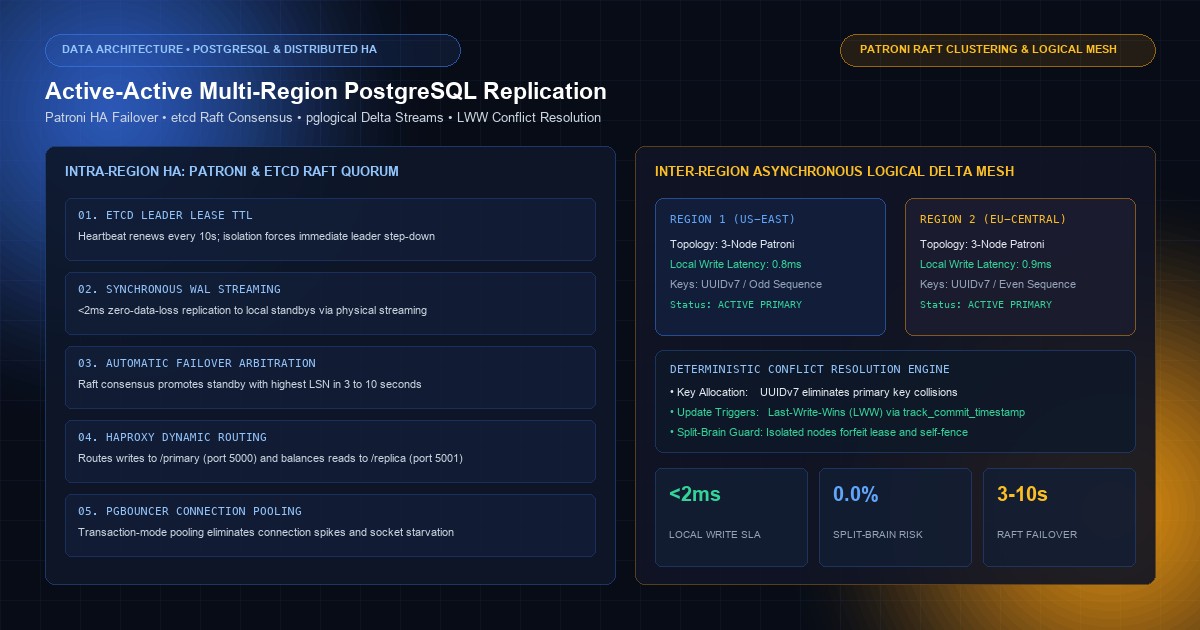
In modern distributed cloud architectures, global enterprises frequently demand active-active database deployments. CTOs and infrastructure architects envision a system where application services running in North America, Europe, and Asia-Pacific can write simultaneously to local PostgreSQL databases with sub-10ms response times, instantaneous cross-continental synchronization, and zero transactional anomalies.
Yet, this ambition collides directly with fundamental distributed systems physics: the CAP Theorem and the finite speed of light in fiber-optic glass (approximately 5ms per 1,000 kilometers of transit).
When engineering teams attempt to force synchronous replication across wide-area networks (WAN), write latency skyrockets from 2ms to over 250ms, distributed deadlocks cascade through connection pools, and minor network partitions halt global checkout pipelines. Conversely, when teams implement unconstrained asynchronous bi-directional replication, they encounter silent data divergence: conflicting updates overwrite customer records, sequence IDs collide, and referential integrity fractures.
Achieving production-grade multi-region reliability requires a pragmatic, hybrid architecture. By decoupling intra-region synchronous failover—using Patroni backed by etcd Raft consensus—from inter-region asynchronous delta streaming via logical replication, enterprises can deliver sub-millisecond local reads, reliable regional writes, and automated conflict-resolved global consistency.
At KNetwork's Cloud Migration & DevOps practice, we architect mission-critical database platforms that survive entire cloud region blackouts without corrupting ledger state. In this engineering guide, we unpack the mathematical realities of multi-master SQL, configure a high-availability Patroni cluster with Raft leader election, implement bi-directional logical replication with sequence offset partitioning, and provide an automated failure runbook.
1. The Physics of Distributed SQL: Why Synchronous Multi-Master Fails Across WANs#
To understand why true active-active synchronous replication across geographic continents is mathematically infeasible for relational databases, consider the round-trip time (RTT) of a standard two-phase commit (2PC):
┌────────────────────────────────────────────────────────────────────────┐
│ TWO-PHASE COMMIT (2PC) WAN LATENCY WATERFALL                          │
└────────────────────────────────────────────────────────────────────────┘

 [US-East (Virginia)]                [EU-West (Frankfurt)]
       │                                      │
       ├─── (1) BEGIN TRANSACTION ────────────┤ (Local write: 0.2ms)
       │                                      │
       ├─── (2) PREPARE (Phase 1) ───────────►│ (Network Transit: ~85ms)
       │                                      │
       │◄── (3) VOTE PREPARED ────────────────┤ (Network Transit: ~85ms)
       │                                      │
       ├─── (4) COMMIT (Phase 2) ────────────►│ (Network Transit: ~85ms)
       │                                      │
       │◄── (5) ACKNOWLEDGEMENT ──────────────┤ (Network Transit: ~85ms)
       │                                      │
       └─── Total Commit Latency: ~340ms ─────┘
1.1 The Latency Multiplier#
In a single availability zone, a write transaction committing to local NVMe storage takes 0.5ms to 2.0ms. When that transaction is bound by a synchronous distributed consensus loop across continents (e.g., Virginia to Frankfurt to Singapore), every individual write requires at least two network round-trips:- Prepare Phase: The coordinator node broadcasts the transaction log and waits for all replicas to acquire row-level locks and flush the write-ahead log (WAL) to disk.
- Commit Phase: The coordinator collects affirmative votes, broadcasts the commit instruction, and awaits confirmation.
Across transatlantic fiber, speed-of-light propagation plus optical router switching imposes a baseline network RTT of 80ms to 110ms. A two-phase commit therefore inflates transaction duration from 1ms to 340ms+.
1.2 Concurrency Collapse and Lock Contention#
During this 340ms window, the affected database rows remain exclusively locked. If the application processes high-velocity updates—such as updating an account balance, modifying an inventory counter, or decrementing a seat reservation—subsequent concurrent transactions queue behind the locks.Connection pools (such as PgBouncer) saturate in seconds. Client worker threads block, memory utilization spikes, and the database cascades into total throughput collapse.
2. Replication Typologies: Physical Streaming vs. Logical Replication#
PostgreSQL provides two native mechanisms for data replication, each serving distinct architectural boundaries:
REPLICATION MECHANISM COMPARISON:

┌─────────────────────┬──────────────────────────┬──────────────────────────┐
│ Dimension           │ Physical Streaming (WAL) │ Logical Replication      │
├─────────────────────┼──────────────────────────┼──────────────────────────┤
│ Granularity         │ Byte-400 font-semibold">for-byte block level│ Row-level change events  │
│ Target Schema       │ Must be 100% identical   │ Flexible (partial/subset)│
│ Write Direction     │ Strictly One-Way (Read)  │ Bi-directional / Mesh    │
│ Cross-Version       │ Same major Postgres only │ Cross-version compatible │
│ Overhead            │ Minimal CPU, disk I/O    │ Higher CPU (WAL decoding)│
│ Use Case            │ Intra-region High Avail. │ Inter-region Data Sync   │
└─────────────────────┴──────────────────────────┴──────────────────────────┘
Physical Streaming Replication#
Operates at the physical storage block layer. The primary node transmits raw byte streams of its Write-Ahead Log (WAL) to standby nodes. Standbys replay this log directly into their local storage engines. Standby nodes are strictly read-only and cannot accept write queries or maintain divergent indexes.Logical Replication#
Operates by decoding WAL records into logical row operations (INSERT, UPDATE, DELETE, TRUNCATE). A background publication process decodes transactions using output plugins (like pgoutput), and a remote subscription process applies these events as standard SQL operations on the target node. Because the target node remains writable, logical replication enables selective multi-master and active-active topologies.3. The Production Architecture: Intra-Region Patroni + Inter-Region Logical Mesh#
To resolve the trade-off between latency and consistency, enterprise platforms implement a hybrid topology:
┌────────────────────────────────────────────────────────────────────────┐
│ HYBRID MULTI-REGION ARCHITECTURE                                      │
└────────────────────────────────────────────────────────────────────────┘

 [REGION 1: US-EAST (Active Primary)]      [REGION 2: EU-CENTRAL (Active Read/Local)]
 ┌────────────────────────────────────┐    ┌────────────────────────────────────┐
 │  etcd Cluster (3-Node Raft Quorum) │    │  etcd Cluster (3-Node Raft Quorum) │
 └─────────────────┬──────────────────┘    └─────────────────┬──────────────────┘
                   │                                         │
        ┌──────────┴──────────┐                   ┌──────────┴──────────┐
        ▼                     ▼                   ▼                     ▼
 ┌──────────────┐      ┌──────────────┐    ┌──────────────┐      ┌──────────────┐
 │ Patroni Core │      │ Patroni Sync │    │ Patroni Core │      │ Patroni Sync │
 │ (Leader RW)  │      │ (Standby RO) │    │ (Leader RW)  │      │ (Standby RO) │
 └──────┬───────┘      └──────────────┘    └──────┬───────┘      └──────────────┘
        │   Physical Streaming (<2ms)             │   Physical Streaming (<2ms)
        │                                         │
        └─────────────────────────────────────────┘
             Asynchronous Logical Delta Stream
             (pglogical / WAL Decoders ~85ms)
- Within each region: A high-availability cluster managed by Patroni and etcd provides automated zero-data-loss failover using synchronous physical replication. If the regional leader crashes, etcd's Raft consensus elects a healthy standby within 3 to 10 seconds without human intervention or split-brain.
- Across regions: An asynchronous logical replication pipeline streams row-level changes between regional leaders. Local users read and write to their closest region, eliminating transatlantic latency loops.
4. Patroni & etcd: Eliminating Split-Brain in Automatic Failovers#
In high-availability clustering, the most dangerous failure mode is Split-Brain: a condition where a network partition causes two database instances to simultaneously believe they are the authoritative primary, accepting conflicting writes that cannot be reconciled.
Patroni prevents split-brain by relying on a Distributed Consensus Store (DCS), typically etcd or Consul.
4.1 The Leader Lease Mechanism#
- The active PostgreSQL primary must continuously renew an ephemeral key (the leader lease) in etcd via a TTL heartbeat (typically every 10 seconds).
- If the primary host loses network connectivity to etcd for longer than the TTL window, the lease expires.
- The Patroni daemon on the primary immediately detects lease forfeiture and executes a hard
SIGQUITorSIGKILLon the local PostgreSQL process to prevent orphaned writes. - Concurrently, the healthy standbys observe the expired lease and trigger a Raft election. The standby with the most advanced WAL position (highest LSN) is safely promoted to the new primary.
4.2 Production Patroni Configuration (patroni.yml)#
scope: knetwork-postgres-cluster
namespace: /service/database
name: pg-useast-01

etcd3:
  hosts:
    - 10.0.1.10:2379
    - 10.0.1.11:2379
    - 10.0.1.12:2379

restapi:
  listen: 0.0.0.0:8008
  connect_address: 10.0.1.20:8008

bootstrap:
  dcs:
    ttl: 30
    loop_wait: 10
    retry_timeout: 10
    maximum_lag_on_failover: 1048576 400 font-semibold">class=400 font-semibold">class="text-emerald-300">"text-slate-500 italic"># 1 MB max lag
    synchronous_mode: 400">true
    synchronous_mode_strict: 400">false
    postgresql:
      use_pg_rewind: 400">true
      use_slots: 400">true
      parameters:
        shared_buffers: 16GB
        wal_level: logical
        max_wal_senders: 16
        max_replication_slots: 16
        track_commit_timestamp: 400 font-semibold">class="text-emerald-300">"on"
        hot_standby: 400 font-semibold">class="text-emerald-300">"on"
        archive_mode: 400 font-semibold">class="text-emerald-300">"on"
        archive_command: 400 font-semibold">class="text-emerald-300">"pgbackrest --stanza=production archive-push %p"

postgresql:
  listen: 0.0.0.0:5432
  connect_address: 10.0.1.20:5432
  data_dir: /400 font-semibold">var/lib/postgresql/16/data
  bin_dir: /usr/lib/postgresql/16/bin
  pgpass: /400 font-semibold">var/lib/postgresql/.pgpass
  authentication:
    replication:
      username: replicator
      password: 400 font-semibold">class="text-emerald-300">"VaultSecuredReplicationPassword2026!"
    superuser:
      username: postgres
      password: 400 font-semibold">class="text-emerald-300">"VaultSecuredSuperuserPassword2026!"

tags:
  nofailover: 400">false
  noloadbalance: 400">false
  clonefrom: 400">false
  nosync: 400">false
Note the critical directive: track_commit_timestamp: "on". This flag forces PostgreSQL to record the microsecond timestamp and transaction ID for every committed row in the commit log, providing the mathematical foundation for cross-region conflict resolution.
5. Conflict Detection & Resolution in Asynchronous Multi-Region Meshes#
When multiple regional primaries accept writes independently, conflicting mutations on the same record are inevitable. To build a reliable active-active mesh, systems must implement deterministic conflict resolution strategies.
5.1 The Three Classic Conflict Scenarios#
┌────────────────────────────────────────────────────────────────────────┐
│ CONFLICT TAXONOMY IN MULTI-MASTER SQL                                  │
└────────────────────────────────────────────────────────────────────────┘

 1. 400 font-semibold">UPDATE / 400 font-semibold">UPDATE CONFLICT:
    Region A sets user status = 400 font-semibold">class="text-emerald-300">'SUSPENDED' at T1.
    Region B sets user status = 400 font-semibold">class="text-emerald-300">'ACTIVE'    at T1 + 20ms.

 2. 400 font-semibold">INSERT / 400 font-semibold">INSERT (KEY COLLISION) CONFLICT:
    Region A inserts order_id = 1001 400 font-semibold">for Customer X.
    Region B inserts order_id = 1001 400 font-semibold">for Customer Y.

 3. 400 font-semibold">INSERT / 400 font-semibold">DELETE CONFLICT:
    Region A deletes parent customer record 500.
    Region B inserts 400 font-semibold">new invoice record linking to customer 500.
5.2 Strategy 1: Deterministic Primary Key Partitioning#
To eliminate Key Collisions completely across regions without distributed coordination, avoid sequential auto-incrementing integers (SERIAL / BIGSERIAL). Instead, use one of two patterns:Pattern A: Snowflake / UUIDv7 Identifiers
Use time-ordered UUIDv7 identifiers that encode microsecond timestamps, node worker IDs, and monotonic random entropy:
400 font-semibold">CREATE EXTENSION IF NOT EXISTS 400 font-semibold">class="text-emerald-300">"pgcrypto";

-- Generate collision-free UUIDv7
400 font-semibold">CREATE OR REPLACE FUNCTION generate_uuid_v7()
RETURNS uuid AS $
DECLARE
  v_time timestamp with time zone := clock_timestamp();
  v_epoch_ms bigint;
  v_bytes bytea;
BEGIN
  v_epoch_ms := (extract(epoch 400 font-semibold">FROM v_time) * 1000)::bigint;
  v_bytes := int8send(v_epoch_ms);
  v_bytes := substring(v_bytes 400 font-semibold">FROM 3 FOR 6) || gen_random_bytes(10);

  -- Inject version 7 and RFC 4122 variant bits
  v_bytes := set_byte(v_bytes, 6, (get_byte(v_bytes, 6) & 15) | 112);
  v_bytes := set_byte(v_bytes, 8, (get_byte(v_bytes, 8) & 63) | 128);

  RETURN encode(v_bytes, 400 font-semibold">class="text-emerald-300">'hex')::uuid;
END;
$ LANGUAGE plpgsql VOLATILE;
Pattern B: Offset Sequence Allocation
If 64-bit integers are strictly required for legacy compatibility, configure sequence steps and offsets per region:- Region 1 (US-East): Starts at
1, steps by10(1, 11, 21, 31...) - Region 2 (EU-Central): Starts at
2, steps by10(2, 12, 22, 32...) - Region 3 (AP-South): Starts at
3, steps by10(3, 13, 23, 33...)
-- Region 1 Configuration:
400 font-semibold">ALTER SEQUENCE orders_id_seq INCREMENT BY 10 RESTART WITH 1;

-- Region 2 Configuration:
400 font-semibold">ALTER SEQUENCE orders_id_seq INCREMENT BY 10 RESTART WITH 2;
5.3 Strategy 2: Last-Write-Wins (LWW) with Commit Timestamps#
ForUPDATE/UPDATE conflicts, the system must evaluate which regional mutation takes precedence. Using track_commit_timestamp, conflict triggers inspect the microsecond timestamp of the incoming replication row against the existing local row:
400 font-semibold">CREATE OR REPLACE FUNCTION resolve_lww_conflict()
RETURNS TRIGGER AS $
DECLARE
  local_commit_time timestamp with time zone;
  incoming_commit_time timestamp with time zone;
BEGIN
  -- Retrieve commit timestamp of existing local row
  400 font-semibold">SELECT pg_xact_commit_timestamp(xmin) INTO local_commit_time
  400 font-semibold">FROM orders 400 font-semibold">WHERE id = NEW.id;

  -- Incoming replication delta timestamp
  incoming_commit_time := NEW.updated_at;

  -- If local row is newer, discard the incoming replication write
  IF local_commit_time IS NOT NULL AND local_commit_time > incoming_commit_time THEN
    RETURN NULL; -- Suppresses the 400 font-semibold">UPDATE
  END IF;

  RETURN NEW; -- Allows the 400 font-semibold">UPDATE to overwrite
END;
$ LANGUAGE plpgsql;
6. Distributed Connection Routing: PgBouncer, HAProxy, and Read/Write Splitting#
To ensure applications interact seamlessly with dynamic Patroni topologies, client applications must not connect directly to raw PostgreSQL ports. Instead, connection pools and health-checking reverse proxies abstract the physical node topology.
CLIENT ROUTING TOPOLOGY:

  [Application Service Pod]
             │
             ▼
  [Local PgBouncer Daemon (localhost:6432)]
             │
             ├─── Write Queries ──► HAProxy Port 5000 ──► Patroni Primary (:5432)
             │                      (Checks Patroni REST API /primary)
             │
             └─── Read Queries  ──► HAProxy Port 5001 ──► Patroni Standbys (:5432)
                                    (Checks Patroni REST API /replica)
6.1 HAProxy Health-Check Integration#
Patroni exposes a lightweight REST API on port8008. HAProxy queries this endpoint to dynamically route traffic:GET /primary: ReturnsHTTP 200 OKif the node is the elected leader. ReturnsHTTP 503 Service Unavailableif it is a standby.GET /replica: ReturnsHTTP 200 OKif the node is a healthy standby.
HAProxy Configuration (haproxy.cfg)
global
    maxconn 10000
    log /dev/log local0

defaults
    mode tcp
    timeout client 30m
    timeout server 30m
    timeout connect 5s

400 font-semibold">class=400 font-semibold">class="text-emerald-300">"text-slate-500 italic"># Write Pool (Primary Leader Only)
frontend postgres_write_front
    bind *:5000
    default_backend postgres_write_back

backend postgres_write_back
    option httpchk GET /primary
    http-check expect status 200
    400 font-semibold">default-server inter 3s fall 3 rise 2 on-marked-down shutdown-sessions
    server pg-node-01 10.0.1.20:5432 maxconn 200 check port 8008
    server pg-node-02 10.0.1.21:5432 maxconn 200 check port 8008
    server pg-node-03 10.0.1.22:5432 maxconn 200 check port 8008

400 font-semibold">class=400 font-semibold">class="text-emerald-300">"text-slate-500 italic"># Read Pool (Load-Balanced Across Replicas)
frontend postgres_read_front
    bind *:5001
    default_backend postgres_read_back

backend postgres_read_back
    balance roundrobin
    option httpchk GET /replica
    http-check expect status 200
    400 font-semibold">default-server inter 3s fall 3 rise 2
    server pg-node-01 10.0.1.20:5432 maxconn 500 check port 8008
    server pg-node-02 10.0.1.21:5432 maxconn 500 check port 8008
    server pg-node-03 10.0.1.22:5432 maxconn 500 check port 8008
7. Disaster Recovery Runbook: Regional Network Partition & Resynchronization#
When cross-region connectivity severs (a true WAN partition), the infrastructure must execute deterministic containment procedures.
Scenario: Transatlantic Fiber Cut#
Connectivity betweenus-east and eu-central drops completely for 45 minutes.Step 1: Regional Independence Verification#
- In
us-east: The local Patroni cluster continues executing writes. etcd retains quorum (3 local nodes). Traffic operates uninterrupted. - In
eu-central: The local Patroni cluster operates identically. Local European users perform read and write operations against the EU primary. - Critical Action: Because cross-region replication is paused, logical replication slots in both regions begin accumulating WAL files on disk.
Step 2: Storage Safeguard Monitoring#
Verify that replication slots do not exhaust primary disk space:
400 font-semibold">SELECT
    slot_name,
    plugin,
    active,
    pg_size_pretty(pg_wal_lsn_diff(pg_current_wal_lsn(), restart_lsn)) AS replication_backlog_size
400 font-semibold">FROM pg_replication_slots;
If replication_backlog_size approaches disk capacity thresholds (e.g., exceeds 500 GB), alerts trigger automated cloud volume expansion or temporary slot pausing.
Step 3: Partition Restoration & Conflict Replay#
Once WAN connectivity is restored:- Logical replication connections automatically re-establish.
- WAL decoders replay pending mutations in transactional sequence order.
- The
resolve_lww_conflict()triggers evaluate microsecond commit timestamps on intersecting records. - Divergent changes are normalized, and replication lag decays to
< 150ms.
8. Architectural Comparison: Single-Region HA vs. Multi-Region Logical vs. Distributed SQL#
ENTERPRISE DATABASE ARCHITECTURE TRADEOFF MATRIX:

┌──────────────────────────┬──────────────────┬──────────────────┬─────────────────┐
│ Architectural Vector     │ Single-Region HA │ Multi-Region Mesh│ Distributed SQL │
│                          │ (Patroni + Sync) │ (Patroni + Logic)│ (Cockroach/Yuga)│
├──────────────────────────┼──────────────────┼──────────────────┼─────────────────┤
│ Local Write Latency      │ 0.5ms - 2ms      │ 0.5ms - 2ms      │ 35ms - 120ms    │
│ Regional Read Latency    │ < 1ms            │ < 1ms            │ < 1ms           │
│ WAN Partition Behavior   │ N/A (Single Reg) │ Operates locally │ Quorum stalls   │
│ Conflict Handling        │ None (Strict)    │ LWW / CRDT Triggers│ Raft consensus│
│ SQL Compatibility        │ 100% Native PG   │ 100% Native PG   │ Partial/Dialect │
│ Complex Joins & PL/pgSQL │ Full Support     │ Full Support     │ High Latency    │
│ Operational Complexity   │ Moderate         │ High             │ Extreme         │
└──────────────────────────┴──────────────────┴──────────────────┴─────────────────┘
9. Production Verification & Engineering Standards#
When designing multi-region PostgreSQL architectures for regulated platforms, adhere to these operational mandates:
- Explicit Data Sovereignty Partitioning: For GDPR, HIPAA, and financial regulations, do not replicate sensitive personal identification information (PII) across international borders. Use logical replication row filters (
WHERE region = 'EU') to ensure European citizen records remain exclusively on European silicon. - Deterministic Sequence Auditing: Never deploy unpartitioned integer sequences to multi-master nodes. Enforce UUIDv7 across all database migration scripts in CI/CD linting gates.
- Automated Split-Brain Chaos Tests: Every quarter, execute automated network isolation tests using tools like Chaos Mesh or AWS Fault Injection Simulator. Verify that isolated primary nodes forfeit leadership within 15 seconds and standbys promote cleanly without data loss.
Frequently Asked Questions#
1. Can PostgreSQL achieve true active-active multi-master writes without trade-offs?#
No. True multi-master synchronous SQL across wide geographic regions violates the CAP Theorem and the speed of light. Any system that guarantees strict ACID serializability across continents must execute distributed consensus (like Raft or Paxos) on every write, which inflates write latency to hundreds of milliseconds. Multi-region PostgreSQL deployments must either accept higher latency (Distributed SQL) or adopt asynchronous replication with conflict resolution (Eventual Consistency).2. How does Patroni prevent two nodes from acting as primary simultaneously?#
Patroni relies on a Distributed Consensus Store (DCS) like etcd. The active primary must maintain an active leader lease by renewing an ephemeral key with a strict TTL. If network failure isolates the primary from etcd, its lease expires. The primary immediately steps down and shuts down its PostgreSQL engine, while healthy replicas with Raft quorum elect a new primary, eliminating split-brain.3. What happens to sequences and primary keys in multi-region setups?#
TraditionalSERIAL sequences generate colliding integer keys across regions. Production multi-region architectures avoid collisions by either adopting time-ordered UUIDv7 identifiers or assigning sequence offsets per region (e.g., Region 1 generates 1, 11, 21; Region 2 generates 2, 12, 22).4. How does logical replication handle schema migrations (DDL)?#
Standard PostgreSQL logical replication replicates Data Manipulation Language (INSERT, UPDATE, DELETE) but does not automatically replicate Data Definition Language (CREATE TABLE, ALTER TABLE). DDL migrations must be applied in lockstep across all regional databases using automated migration pipelines (e.g., Flyway, Liquibase, or Prisma) using the Expand/Contract database migration pattern.5. Why use PgBouncer in front of Patroni instead of letting apps connect directly?#
PostgreSQL uses a process-per-connection architecture where each client connection consumes 5MB to 10MB of RAM and incurs fork overhead. Furthermore, during a Patroni failover, client connection pools must be redirected from the old primary to the newly elected primary. PgBouncer manages hundreds of server connections efficiently and works with HAProxy to route read/write traffic cleanly without dropping client sessions.Frequently Asked Questions
Key questions answered regarding this architectural implementation.
Danisur Rahman
Lead AuthorPrincipal Cloud & Data Systems Architect • KNetwork Systems
Principal architect specializing in enterprise distributed systems, edge caching, and hardware integration pipelines. Leads engineering audits, high-concurrency database optimizations, and zero-trust VPC deployments across high-growth ventures.
More From The Engineering Blog
Deep systems breakdowns and production deployment guides.
First-Party Attribution Engines: Reconciling Offline CRM Sales with Web CAPI
Bypass pixel loss and iOS privacy barriers: Architect server-side first-party attribution, stitch deterministic identity graphs, and sync offline CRM deals to Meta CAPI.
Zero-Copy Parquet Lakehouses: Ingesting IoT Telemetry with Apache Iceberg
Eliminate Hive directory bottlenecks and small-file chaos: ACID snapshot trees, automated asynchronous compaction, hidden partitioning, and zero-copy multi-engine analytics.
Enjoyed this technical breakdown?
Subscribe to receive new architectural guides, system teardowns, and engineering benchmarks directly in your inbox.