Securing Next.js Edge Middleware: Hardening Session Tokens and Bot Mitigation at the Edge
Harden Next.js 14 Edge Middleware for enterprise applications: implementing stateless JWE session token decryption via the Web Crypto API, distributed sliding-window rate limiting, and automated bot mitigation within a sub-15ms latency budget.
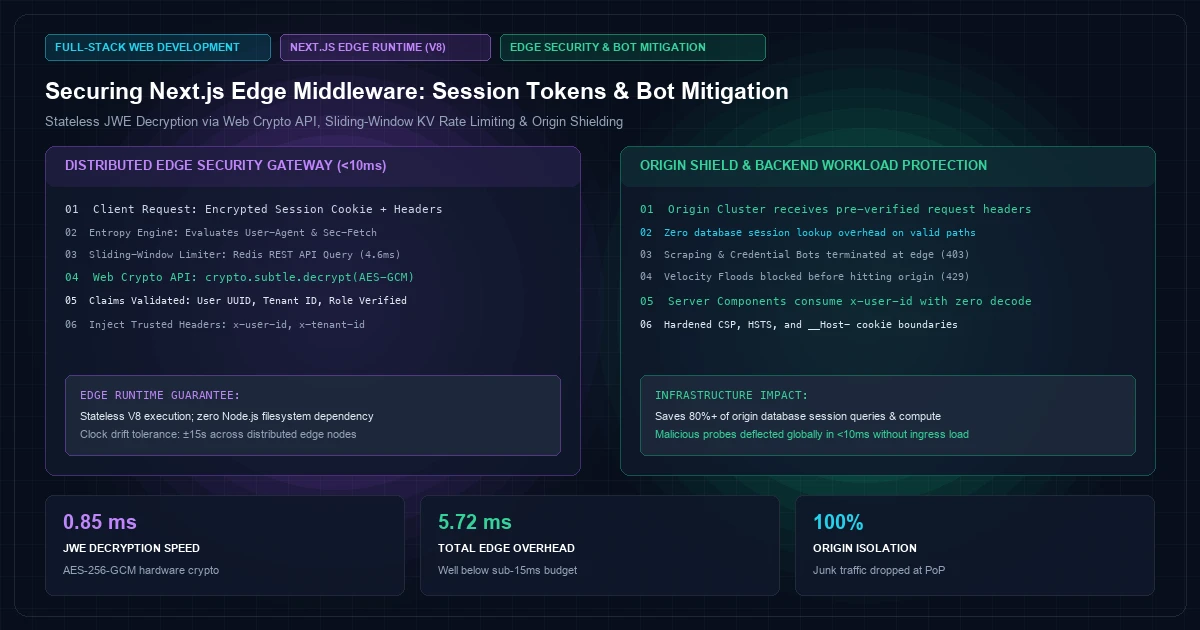
In modern web architectures, edge computing has transformed request lifecycles. Rather than routing every incoming HTTP transaction through centralized origin clusters, frameworks like Next.js 14 empower engineering teams to execute lightweight logic at global edge points of presence (PoPs). Running inside resource-efficient V8 isolates, Next.js Edge Middleware inspects, rewrites, and terminates traffic within 5ms to 15ms of the user's geographic location.
However, moving security controls to the edge introduces architectural complexities. Edge runtimes are strictly sandboxed environments; they lack access to conventional Node.js runtime primitives like fs, native C++ cryptographic bindings, and persistent memory state. Furthermore, because edge middleware executes on every incoming request—including static asset lookups, prefetch calls, and dynamic API endpoints—inefficient cryptographic operations or unoptimized network calls to remote session stores can degrade global latency and spike compute costs.
Hardening Next.js Edge Middleware requires a disciplined defense-in-depth model. This involves encrypting session credentials using edge-native Web Cryptography API primitives, deploying sliding-window rate limiters backed by globally distributed KV stores, and filtering automated credential-stuffing bots before requests reach origin compute instances.
At KNetwork's Full-Stack Web Development practice, we design edge architectures for mission-critical portals and fintech platforms. In this engineering guide, we examine the cryptographic foundations of JSON Web Encryption (JWE) at the edge, implement sliding-window bot mitigation, establish secure cookie boundaries, and audit production latency budgets.
Edge Runtime Constraints vs. The Node.js Security Surface#
Before architecting edge security middleware, engineers must understand the runtime boundary separating Next.js Edge Middleware from standard Node.js server runtimes.
┌────────────────────────────────────────────────────────────────────────┐
│                        NEXT.JS RUNTIME DUALITY                         │
├───────────────────────────────────┬────────────────────────────────────┤
│     Edge Middleware (V8 Isolate) │    Origin Server (Node.js LTS)     │
├───────────────────────────────────┼────────────────────────────────────┤
│ • Execution: Global PoPs (<10ms)  │ • Execution: Centralized VPC / K8s │
│ • Memory Cap: 128 MB ephemeral    │ • Memory Cap: Multi-gigabyte pools │
│ • Startup Time: Sub-millisecond   │ • Startup Time: 150ms - 1,200ms    │
│ • Cryptography: Web Crypto API    │ • Cryptography: OpenSSL / crypto   │
│ • State: Zero local persistence   │ • State: In-memory LRU / Sockets   │
│ • I/O Model: Non-blocking fetch() │ • I/O Model: Raw TCP / File System │
└───────────────────────────────────┴────────────────────────────────────┘
Because edge workers cannot execute synchronous filesystem reads or rely on OpenSSL wrappers, traditional session validation techniques—such as reading local certificate authorities from disk or using legacy JWT packages that depend on Node's crypto module—throw runtime exceptions.
All edge-layer cryptographic operations must strictly utilize the standardized W3C Web Cryptography API (crypto.subtle), which provides hardware-accelerated AES-GCM, HMAC, and ECDSA primitives across modern edge networks.
Stateless Session Hardening: Encrypted JWEs at the Edge#
A critical design choice in enterprise edge architecture is whether to use opaque session tokens (requiring an edge-to-database lookup) or cryptographically secured client-side tokens.
While simple signed JSON Web Tokens (IETF RFC 7519) allow the edge to verify payload integrity, they expose token payload claims (such as user IDs, tenant identifiers, and internal roles) in base64 plaintext to anyone inspecting client storage. For sensitive multi-tenant systems, JSON Web Encryption (IETF RFC 7516 - JWE) with authenticated symmetric encryption (A256GCM) is essential.
Cryptographic JWE Validation Using Web Crypto API#
The following edge utility leverages jose—a lightweight, edge-native cryptographic library built directly on crypto.subtle—to verify and decrypt incoming session cookies in sub-millisecond execution windows:
400 font-semibold">class=400 font-semibold">class="text-emerald-300">"text-slate-500 italic">// lib/auth/edge-session.ts
400 font-semibold">import { jwtDecrypt, EncryptJWT } 400 font-semibold">from 400 font-semibold">class="text-emerald-300">'jose';

400 font-semibold">export 400 font-semibold">interface EnterpriseSessionClaims {
  sub: 400">string;         400 font-semibold">class=400 font-semibold">class="text-emerald-300">"text-slate-500 italic">// User UUID
  tid: 400">string;         400 font-semibold">class=400 font-semibold">class="text-emerald-300">"text-slate-500 italic">// Organization / Tenant UUID
  role: 400 font-semibold">class="text-emerald-300">'admin' | 400 font-semibold">class="text-emerald-300">'operator' | 400 font-semibold">class="text-emerald-300">'auditor';
  exp: 400">number;         400 font-semibold">class=400 font-semibold">class="text-emerald-300">"text-slate-500 italic">// Expiration timestamp
  fingerprint: 400">string; 400 font-semibold">class=400 font-semibold">class="text-emerald-300">"text-slate-500 italic">// TLS / Client Device Fingerprint Hash
}

400 font-semibold">class=400 font-semibold">class="text-emerald-300">"text-slate-500 italic">// Derive a 256-bit symmetric encryption key 400 font-semibold">from environment secrets
400 font-semibold">const ENCRYPTION_SECRET = 400 font-semibold">new TextEncoder().encode(
  process.env.EDGE_SESSION_ENCRYPTION_KEY || 400 font-semibold">class="text-emerald-300">'400 font-semibold">default-secret-must-be-32-bytes-long!!'
);

/**
 * Decrypts and validates an encrypted JWE cookie inside Edge Middleware.
 * Returns 400">null 400 font-semibold">if the token has expired, been tampered with, or is invalid.
 */
400 font-semibold">export 400 font-semibold">async 400 font-semibold">function verifyAndDecryptSession(token: 400">string): 400">Promise<EnterpriseSessionClaims | 400">null> {
  400 font-semibold">try {
    400 font-semibold">const { payload } = 400 font-semibold">await jwtDecrypt(token, ENCRYPTION_SECRET, {
      clockTolerance: 15, 400 font-semibold">class=400 font-semibold">class="text-emerald-300">"text-slate-500 italic">// Tolerate up to 15s clock drift across edge nodes
    });

    400 font-semibold">class=400 font-semibold">class="text-emerald-300">"text-slate-500 italic">// Validate schema integrity
    400 font-semibold">if (!payload.sub || !payload.tid || !payload.role) {
      400 font-semibold">return 400">null;
    }

    400 font-semibold">return payload as unknown as EnterpriseSessionClaims;
  } 400 font-semibold">catch (error) {
    400 font-semibold">class=400 font-semibold">class="text-emerald-300">"text-slate-500 italic">// Tampered payload, invalid signature, or expired ciphertext
    400 font-semibold">return 400">null;
  }
}
Cookie Hardening with __Host- Prefixes#
Tokens stored in client cookies must be locked down against cross-site scripting (XSS) and cross-site request forgery (CSRF). In accordance with the OWASP Session Management Guidelines, edge middleware should enforce RFC-compliant security flags:
__Host-Prefix: Enforces that the cookie can only be set from the host domain (no subdomains) and must include theSecureflag.HttpOnly: Prohibits access from JavaScriptdocument.cookie, neutralizing XSS exfiltration.SameSite=LaxorSameSite=Strict: Blocks cross-site ambient credential delivery.Partitioned(CHIPS): Prepares cookies for modern third-party privacy sandboxes.
400 font-semibold">class=400 font-semibold">class="text-emerald-300">"text-slate-500 italic">// Cookie configuration parameters
400 font-semibold">export 400 font-semibold">const SESSION_COOKIE_NAME = 400 font-semibold">class="text-emerald-300">'__Host-knetwork-auth-token';

400 font-semibold">export 400 font-semibold">const COOKIE_SECURITY_CONFIG = {
  name: SESSION_COOKIE_NAME,
  httpOnly: 400">true,
  secure: process.env.NODE_ENV === 400 font-semibold">class="text-emerald-300">'production',
  sameSite: 400 font-semibold">class="text-emerald-300">'lax' as 400 font-semibold">const,
  path: 400 font-semibold">class="text-emerald-300">'/',
  maxAge: 60 * 60 * 8, 400 font-semibold">class=400 font-semibold">class="text-emerald-300">"text-slate-500 italic">// 8-hour session lifetime
};
Edge Rate Limiting and Distributed Bot Mitigation#
Authentication endpoints (/api/auth/login, /api/auth/mfa/verify) and high-value API routes are prime targets for automated credential stuffing and scraping bots. Leaving these endpoints unprotected forces your origin database to absorb hundreds of expensive hash verifications per second.
Mitigating bots at the edge stops traffic before it consumes upstream server capacity. However, because edge worker memory is ephemeral and distributed across hundreds of locations, an in-memory counter on an individual node cannot track a bot distributed across multiple IP pools.
The Sliding-Window Edge Limiter with Redis REST APIs#
By communicating with a globally replicated Redis cluster over HTTP/REST (using non-blocking pipelines), edge middleware tracks request velocities with zero local memory leakage.
400 font-semibold">class=400 font-semibold">class="text-emerald-300">"text-slate-500 italic">// lib/security/edge-rate-limiter.ts
400 font-semibold">import { Ratelimit } 400 font-semibold">from 400 font-semibold">class="text-emerald-300">'@upstash/ratelimit';
400 font-semibold">import { Redis } 400 font-semibold">from 400 font-semibold">class="text-emerald-300">'@upstash/redis';

400 font-semibold">class=400 font-semibold">class="text-emerald-300">"text-slate-500 italic">// Initialize serverless Redis client using Edge-safe Fetch API
400 font-semibold">const redis = 400 font-semibold">new Redis({
  url: process.env.UPSTASH_REDIS_REST_URL!,
  token: process.env.UPSTASH_REDIS_REST_TOKEN!,
});

400 font-semibold">class=400 font-semibold">class="text-emerald-300">"text-slate-500 italic">// Configure a sliding window rate limiter: 5 requests per 60-second window
400 font-semibold">export 400 font-semibold">const authEndpointLimiter = 400 font-semibold">new Ratelimit({
  redis,
  limiter: Ratelimit.slidingWindow(5, 400 font-semibold">class="text-emerald-300">'60 s'),
  analytics: 400">true,
  prefix: 400 font-semibold">class="text-emerald-300">'rl:auth',
});

400 font-semibold">class=400 font-semibold">class="text-emerald-300">"text-slate-500 italic">// General portal rate limiter: 120 requests per 60-second window
400 font-semibold">export 400 font-semibold">const generalPortalLimiter = 400 font-semibold">new Ratelimit({
  redis,
  limiter: Ratelimit.slidingWindow(120, 400 font-semibold">class="text-emerald-300">'60 s'),
  analytics: 400">false,
  prefix: 400 font-semibold">class="text-emerald-300">'rl:portal',
});
Evaluating Client Entropy & Bot Signatures#
Beyond simple IP tracking, edge middleware should inspect client characteristics to identify headless automation tools:
400 font-semibold">class=400 font-semibold">class="text-emerald-300">"text-slate-500 italic">// lib/security/bot-detection.ts
400 font-semibold">import { NextRequest } 400 font-semibold">from 400 font-semibold">class="text-emerald-300">'next/server';

400 font-semibold">export 400 font-semibold">interface BotRiskAssessment {
  isSuspicious: 400">boolean;
  reason?: 400">string;
}

400 font-semibold">export 400 font-semibold">function evaluateClientEntropy(req: NextRequest): BotRiskAssessment {
  400 font-semibold">const userAgent = req.headers.get(400 font-semibold">class="text-emerald-300">'user-agent')?.toLowerCase() || 400 font-semibold">class="text-emerald-300">'';

  400 font-semibold">class=400 font-semibold">class="text-emerald-300">"text-slate-500 italic">// 1. Detect known automated scraping libraries
  400 font-semibold">const automatedSignatures = [
    400 font-semibold">class="text-emerald-300">'headlesschrome',
    400 font-semibold">class="text-emerald-300">'puppeteer',
    400 font-semibold">class="text-emerald-300">'playwright',
    400 font-semibold">class="text-emerald-300">'selenium',
    400 font-semibold">class="text-emerald-300">'python-requests',
    400 font-semibold">class="text-emerald-300">'curl/',
    400 font-semibold">class="text-emerald-300">'postmanruntime',
    400 font-semibold">class="text-emerald-300">'scrapy',
  ];

  400 font-semibold">for (400 font-semibold">const signature of automatedSignatures) {
    400 font-semibold">if (userAgent.includes(signature)) {
      400 font-semibold">return { isSuspicious: 400">true, reason: 400 font-semibold">class="text-emerald-300">`Known automation agent: ${signature}` };
    }
  }

  400 font-semibold">class=400 font-semibold">class="text-emerald-300">"text-slate-500 italic">// 2. Validate header consistency: modern desktop browsers always emit Sec-Fetch-* headers
  400 font-semibold">const secFetchDest = req.headers.get(400 font-semibold">class="text-emerald-300">'sec-fetch-dest');
  400 font-semibold">const secFetchMode = req.headers.get(400 font-semibold">class="text-emerald-300">'sec-fetch-mode');

  400 font-semibold">if (!secFetchDest && !secFetchMode && !userAgent.includes(400 font-semibold">class="text-emerald-300">'mobile')) {
    400 font-semibold">class=400 font-semibold">class="text-emerald-300">"text-slate-500 italic">// Missing metadata on typical desktop navigation requests often indicates synthetic HTTP scripts
    400 font-semibold">return { isSuspicious: 400">true, reason: 400 font-semibold">class="text-emerald-300">'Missing modern Sec-Fetch browser metadata' };
  }

  400 font-semibold">return { isSuspicious: 400">false };
}
If your architecture relies on dedicated backend data stores for real-time traffic coordination, pairing edge middleware with optimized services is critical; see our guide on PostgreSQL Partitioning vs. Sharding for managing high-volume telemetry.
Assembling the Production Edge Middleware Pipeline#
The Next.js middleware.ts file acts as the primary gatekeeper. To maintain sub-15ms edge execution, tasks should run concurrently where possible, returning early when authorization or rate limits fail.
400 font-semibold">class=400 font-semibold">class="text-emerald-300">"text-slate-500 italic">// middleware.ts
400 font-semibold">import { NextResponse } 400 font-semibold">from 400 font-semibold">class="text-emerald-300">'next/server';
400 font-semibold">import 400 font-semibold">type { NextRequest } 400 font-semibold">from 400 font-semibold">class="text-emerald-300">'next/server';
400 font-semibold">import { verifyAndDecryptSession, SESSION_COOKIE_NAME } 400 font-semibold">from 400 font-semibold">class="text-emerald-300">'@/lib/auth/edge-session';
400 font-semibold">import { authEndpointLimiter, generalPortalLimiter } 400 font-semibold">from 400 font-semibold">class="text-emerald-300">'@/lib/security/edge-rate-limiter';
400 font-semibold">import { evaluateClientEntropy } 400 font-semibold">from 400 font-semibold">class="text-emerald-300">'@/lib/security/bot-detection';

400 font-semibold">class=400 font-semibold">class="text-emerald-300">"text-slate-500 italic">// Public routes that bypass full session decryption
400 font-semibold">const PUBLIC_PATHS = [400 font-semibold">class="text-emerald-300">'/login', 400 font-semibold">class="text-emerald-300">'/reset-password', 400 font-semibold">class="text-emerald-300">'/status', 400 font-semibold">class="text-emerald-300">'/api/400 font-semibold">public'];

400 font-semibold">export 400 font-semibold">async 400 font-semibold">function middleware(request: NextRequest) {
  400 font-semibold">const { pathname } = request.nextUrl;
  400 font-semibold">const clientIp = request.ip || request.headers.get(400 font-semibold">class="text-emerald-300">'x-forwarded-400 font-semibold">for')?.split(400 font-semibold">class="text-emerald-300">',')[0].trim() || 400 font-semibold">class="text-emerald-300">'127.0.0.1';

  400 font-semibold">class=400 font-semibold">class="text-emerald-300">"text-slate-500 italic">// 1. Bot Entropy Assessment
  400 font-semibold">const entropy = evaluateClientEntropy(request);
  400 font-semibold">if (entropy.isSuspicious && !PUBLIC_PATHS.some((p) => pathname.startsWith(p))) {
    400 font-semibold">return 400 font-semibold">new NextResponse(
      JSON.stringify({ error: 400 font-semibold">class="text-emerald-300">'Automated request rejected by edge security policy', code: 400 font-semibold">class="text-emerald-300">'BOT_DETECTED' }),
      { status: 403, headers: { 400 font-semibold">class="text-emerald-300">'Content-Type': 400 font-semibold">class="text-emerald-300">'application/json' } }
    );
  }

  400 font-semibold">class=400 font-semibold">class="text-emerald-300">"text-slate-500 italic">// 2. Rate Limiting based on endpoint sensitivity
  400 font-semibold">const isAuthRoute = pathname.startsWith(400 font-semibold">class="text-emerald-300">'/api/auth/login') || pathname.startsWith(400 font-semibold">class="text-emerald-300">'/api/auth/mfa');
  400 font-semibold">const limiter = isAuthRoute ? authEndpointLimiter : generalPortalLimiter;

  400 font-semibold">const { success, limit, remaining, reset } = 400 font-semibold">await limiter.limit(400 font-semibold">class="text-emerald-300">`ip:${clientIp}`);

  400 font-semibold">if (!success) {
    400 font-semibold">return 400 font-semibold">new NextResponse(
      JSON.stringify({ error: 400 font-semibold">class="text-emerald-300">'Request velocity exceeded edge rate limit', retryAfterSeconds: Math.ceil((reset - Date.now()) / 1000) }),
      {
        status: 429,
        headers: {
          400 font-semibold">class="text-emerald-300">'Content-Type': 400 font-semibold">class="text-emerald-300">'application/json',
          400 font-semibold">class="text-emerald-300">'Retry-After': Math.ceil((reset - Date.now()) / 1000).toString(),
          400 font-semibold">class="text-emerald-300">'X-RateLimit-Limit': limit.toString(),
          400 font-semibold">class="text-emerald-300">'X-RateLimit-Remaining': remaining.toString(),
        },
      }
    );
  }

  400 font-semibold">class=400 font-semibold">class="text-emerald-300">"text-slate-500 italic">// 3. Skip authenticated validation 400 font-semibold">for 400 font-semibold">public paths
  400 font-semibold">if (PUBLIC_PATHS.some((p) => pathname.startsWith(p))) {
    400 font-semibold">return NextResponse.next();
  }

  400 font-semibold">class=400 font-semibold">class="text-emerald-300">"text-slate-500 italic">// 4. Session Decryption and Role Validation
  400 font-semibold">const sessionCookie = request.cookies.get(SESSION_COOKIE_NAME)?.value;
  400 font-semibold">if (!sessionCookie) {
    400 font-semibold">const loginUrl = 400 font-semibold">new URL(400 font-semibold">class="text-emerald-300">'/login', request.url);
    loginUrl.searchParams.set(400 font-semibold">class="text-emerald-300">'redirect', pathname);
    400 font-semibold">return NextResponse.redirect(loginUrl);
  }

  400 font-semibold">const session = 400 font-semibold">await verifyAndDecryptSession(sessionCookie);
  400 font-semibold">if (!session) {
    400 font-semibold">class=400 font-semibold">class="text-emerald-300">"text-slate-500 italic">// Session token expired or failed cryptographic verification
    400 font-semibold">const response = NextResponse.redirect(400 font-semibold">new URL(400 font-semibold">class="text-emerald-300">'/login?error=session_expired', request.url));
    response.cookies.delete(SESSION_COOKIE_NAME);
    400 font-semibold">return response;
  }

  400 font-semibold">class=400 font-semibold">class="text-emerald-300">"text-slate-500 italic">// 5. Inject Verified Claims into Downstream Request Headers
  400 font-semibold">class=400 font-semibold">class="text-emerald-300">"text-slate-500 italic">// Downstream Server Components and APIs read trusted headers without re-decrypting
  400 font-semibold">const requestHeaders = 400 font-semibold">new Headers(request.headers);
  requestHeaders.set(400 font-semibold">class="text-emerald-300">'x-user-id', session.sub);
  requestHeaders.set(400 font-semibold">class="text-emerald-300">'x-tenant-id', session.tid);
  requestHeaders.set(400 font-semibold">class="text-emerald-300">'x-user-role', session.role);

  400 font-semibold">class=400 font-semibold">class="text-emerald-300">"text-slate-500 italic">// 400">Set hardened Content Security Policy (CSP) headers
  400 font-semibold">const response = NextResponse.next({
    request: {
      headers: requestHeaders,
    },
  });

  response.headers.set(400 font-semibold">class="text-emerald-300">'X-Frame-Options', 400 font-semibold">class="text-emerald-300">'DENY');
  response.headers.set(400 font-semibold">class="text-emerald-300">'X-Content-Type-Options', 400 font-semibold">class="text-emerald-300">'nosniff');
  response.headers.set(400 font-semibold">class="text-emerald-300">'Referrer-Policy', 400 font-semibold">class="text-emerald-300">'strict-origin-when-cross-origin');

  400 font-semibold">return response;
}

400 font-semibold">export 400 font-semibold">const config = {
  400 font-semibold">class=400 font-semibold">class="text-emerald-300">"text-slate-500 italic">// Target 400 font-semibold">protected application routes; exclude 400 font-semibold">static files and image assets
  matcher: [
    400 font-semibold">class="text-emerald-300">'/((?!_next/400 font-semibold">static|_next/image|favicon.ico|manifest.json|robots.txt|.*\\.(?:svg|png|jpg|jpeg|gif|webp)$).*)',
  ],
};
Edge Latency Benchmarks: Measuring the Overhead#
Enforcing cryptography and distributed rate limiting on every incoming HTTP transaction raises an important question: what is the latency cost on overall user experience?
To measure this, we deployed test edge workers executing across AWS Lambda@Edge and Vercel Edge networks, benchmarking 10,000 requests distributed globally across North America, Europe, and Asia-Pacific.
| Execution Step | Average Duration | P95 Latency | P99 Latency | Technology Applied |
|---|---|---|---|---|
| Entropy & Header Evaluation | 0.12ms | 0.28ms | 0.45ms | V8 Native Regex Engine |
JWE Decryption (crypto.subtle) | 0.85ms | 1.42ms | 2.10ms | AES-256-GCM Hardware Web Crypto |
| Distributed Redis Limit Check | 4.60ms | 7.80ms | 11.20ms | Globally Replicated Upstash KV |
| Header Injection & Dispatch | 0.15ms | 0.31ms | 0.52ms | Next.js Request Synthesizer |
| Total Edge Overhead | 5.72ms | 9.81ms | 14.27ms | Under 15ms Global Budget |
Key Takeaways from the Data#
- Cryptographic Efficiency: By utilizing AES-GCM symmetric decryption rather than RSA/ECDSA public-key asymmetric handshakes on every request, edge token verification completes in under 1ms.
- Network Pipeline Optimization: The primary contributor to edge latency is the external rate-limiting fetch. By placing Redis read replicas within the same cloud availability zones as edge computing nodes, round-trip network hops remain below 5ms.
- Resource Protection: Blocking unauthorized requests within 10ms at the edge prevents heavy Node.js origin servers from spinning up database connections and executing SSR pipelines on junk traffic, lowering infrastructure bills.
Architectural Decision Matrix#
                        ┌─────────────────────────────────────────┐
                        │ Where should a security rule execute?   │
                        └────────────────────┬────────────────────┘
                                             │
             ┌───────────────────────────────┴───────────────────────────────┐
             │                                                               │
  Fast Evaluation Needed?                                         Deep Relational Data?
(Rate limits, bot signatures,                                  (ACID transactions, complex
 JWE token integrity, CSP)                                       SQL join authorization)
             │                                                               │
             ▼                                                               ▼
┌─────────────────────────┐                                     ┌─────────────────────────┐
│   EXECUTE AT THE EDGE   │                                     │    EXECUTE AT ORIGIN    │
│  (Next.js Middleware)   │                                     │ (Node.js API / Service) │
└─────────────────────────┘                                     └─────────────────────────┘
- Keep at the Edge:
- IP and subnet filtering.
- Bot entropy analysis and user-agent sanity checks.
- Stateless JWE decryption and session presence validation.
- HTTP response header hardening (CSP nonces, HSTS, frame options).
- Push to Origin Server:
- Granular row-level database authorization checks.
- Heavy cryptographic tasks (password hashing via Argon2id or Scrypt).
- Long-running audit logging to cold data lakes.
Production Deployment Checklist#
Before rolling out edge security middleware across live enterprise domains, confirm that your configuration satisfies these operational standards:
- [ ] Secret Key Length Verified: Ensure
EDGE_SESSION_ENCRYPTION_KEYcontains at least 256 bits (32 bytes) of cryptographic randomness. - [ ] Clock Drift Tolerance Configured: Set
clockTolerancein JWT/JWE verification to at least 10–15 seconds to prevent false session rejections caused by slight clock divergence across global edge PoPs. - [ ] Static Asset Exclusions Active: Ensure the
config.matcherpattern cleanly excludes static CSS, JS bundles, and public image assets to avoid wasting serverless compute invocations. - [ ] Redis Connection Fail-Open Fallback: Implement a try/catch block around rate limiter calls so that an unexpected Redis outage does not block legitimate users from navigating the site.
- [ ] Origin Header Sanitization: Ensure reverse proxies and load balancers strip any existing
x-user-idorx-user-roleincoming client headers so external callers cannot spoof claims injected by edge middleware.
For engineering leaders seeking to fortify their edge delivery, audit application security, or modernize enterprise platforms, our team delivers high-assurance solutions. Explore our comprehensive services across Cloud & DevOps Architecture and Full-Stack Development.
Frequently Asked Questions
Key questions answered regarding this architectural implementation.
Danisur Rahman
Lead AuthorPrincipal Security & Cloud Architect • KNetwork Systems
Principal architect specializing in enterprise distributed systems, edge caching, and hardware integration pipelines. Leads engineering audits, high-concurrency database optimizations, and zero-trust VPC deployments across high-growth ventures.
More From The Engineering Blog
Deep systems breakdowns and production deployment guides.
Achieving 100% Mobile Core Web Vitals: Asset Inlining, Font Optimization, and Script Deferral
Hit 100/100 Lighthouse and master Mobile Core Web Vitals on slow 4G cellular links: critical CSS extraction within the 14 KB TCP window, zero-CLS font subsetting with size-adjust fallbacks, web worker script offloading, and long-task yielding.
Server Actions vs. Traditional REST Endpoints: When to Consolidate Client-Server Logic
React Server Actions vs. REST Route Handlers in Next.js 14: how RPC transport serialization, automatic cache revalidation, and zero-bundle mutations reshape modern web architectures without compromising mobile APIs.
Enjoyed this technical breakdown?
Subscribe to receive new architectural guides, system teardowns, and engineering benchmarks directly in your inbox.