Closed-Loop Pipeline Attribution: Mapping Organic Search Clicks Directly to Closed CRM Deals
How enterprise engineering and growth teams bridge the chasm between web analytics and CRM revenue: deploying first-party HttpOnly edge cookies immune to Safari ITP, asynchronous ClickHouse event streaming, and W-shaped multi-touch attribution webhooks mapping organic clicks directly to signed contracts.
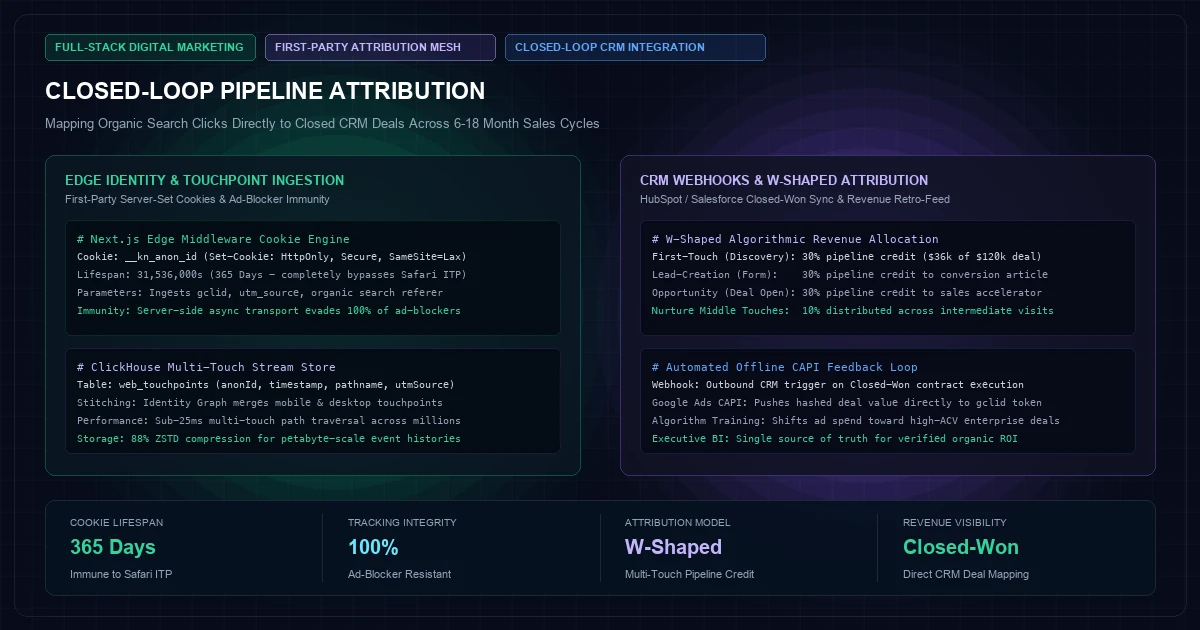
Marketing and engineering executives routinely encounter a frustrating chasm between digital analytics and financial reality. The marketing team presents monthly dashboards reporting 250,000 organic search sessions and 3,500 form submissions. Simultaneously, the Chief Financial Officer (CFO) and VP of Sales report that qualified sales pipeline remains flat, conversion rates from lead to signed deal are deteriorating, and customer acquisition costs (CAC) continue to climb.
This discrepancy stems from a systemic architectural failure: Disconnected Attribution Silos.
Web analytics platforms (such as Google Analytics 4, Plausible, or Mixpanel) terminate tracking at the browser edge when an anonymous visitor submits a lead form. Meanwhile, sales CRM platforms (such as HubSpot, Salesforce, or internal PostgreSQL databases) begin tracking only when a lead enters the sales rep's queue—typically stripped of session parameters, first-touch referral histories, and technical query intent.
Without Closed-Loop Pipeline Attribution, organizations make fatal marketing allocation decisions:
- Vanity Traffic Over-Investment: Content marketing budgets pour into high-volume informational search queries ("what is cloud architecture") that generate millions of non-commercial clicks but zero enterprise pipeline.
- High-Intent Topic Starvation: Deep technical architectural articles that yield only 200 monthly visits—yet generate three $150,000 enterprise contracts—are starved of editorial resources because web analytics mislabel them as "low-performing."
- Ad Blocker & Privacy Blindspots: Client-side tracking scripts miss 25% to 40% of visitor touchpoints due to Safari ITP (Intelligent Tracking Prevention), Firefox Enhanced Tracking Protection, and ad blockers, permanently severing the referral chain before CRM ingestion.
The systems engineering solution is an Immutable First-Party Closed-Loop Attribution Pipeline: capturing persistent cryptographic visitor fingerprints at the edge, stitching session identifiers to CRM pipeline deals across 6-to-18-month sales cycles, and feeding closed revenue back to advertising and analytics algorithms via server-side conversion webhooks.
This technical blueprint breaks down the end-to-end architecture: from deterministic cookie persistence and server-side identity resolution to bi-directional CRM database webhooks and multi-touch algorithmic attribution models.
End-to-End Closed-Loop Attribution Architecture#
To track an organic search click across months of sales calls, procurement audits, and legal contracting, the attribution engine decouples data capture from third-party vendor tags:
+---------------------------------------------------------------------------------------------------+
|                        CLOSED-LOOP ATTRIBUTION PIPELINE ARCHITECTURE                              |
+---------------------------------------------------------------------------------------------------+
|                                                                                                   |
|   BROWSER CLIENT (EDGE)                               EDGE PROXY & MIDDLEWARE (NEXT.JS)           |
|                                                                                                   |
|   +------------------------------------+             +------------------------------------+       |
|   | Visitor Clicks Organic Search Link |             | Next.js Edge Middleware Proxy      |       |
|   | URL: /blog/high-concurrency-ledger | ----------> | - Extracts gclid, fbclid, utm_*,   |       |
|   | HTTP Headers: Referer, Sec-CH-UA   |             |   organic search engine referer    |       |
|   +------------------------------------+             | - Writes 400">Set-Cookie: __kn_anon_id  |       |
|                                                      |   (HttpOnly, Secure, SameSite=Lax, |       |
|                                                      |   Max-Age=31536000 [1 Year])       |       |
|                                                      +-----------------+------------------+       |
|                                                                        |                          |
|                                         +------------------------------+                          |
|                                         |                                                         |
|                                         v (Asynchronous Server Event Stream)                      |
|   +-------------------------------------------------------------------------------------------+   |
|   |                       SERVER-SIDE EVENT INGESTION & IDENTITY RESOLUTION                   |   |
|   |                                                                                           |   |
|   |  +-------------------------+   +--------------------------+   +------------------------+  |   |
|   |  | Edge Event Streamer     |   | ClickHouse Session Store |   | Identity Stitching Hub |  |   |
|   |  | Kafka / Dragonfly Queue |-->| Append-Only Event Log    |-->| Graph DB / PostgreSQL  |  |   |
|   |  | Raw Timestamp & Hash    |   | Unsampled Touchpoints    |   | Anon ID <-> User ID    |  |   |
|   |  +-------------------------+   +--------------------------+   +-----------+------------+  |   |
|   +---------------------------------------------------------------------------|---------------+   |
|                                                                               |                   |
|                                         +-------------------------------------+                   |
|                                         |                                                         |
|                                         v (Lead Form Submitted: Anon ID bound to CRM Contact)     |
|   +-------------------------------------------------------------------------------------------+   |
|   |                       ENTERPRISE CRM & PIPELINE LIFECYCLE (6-18 MONTHS)                   |   |
|   |                                                                                           |   |
|   |  +-------------------------+   +--------------------------+   +------------------------+  |   |
|   |  | HubSpot / Salesforce    |   | Sales Discovery Call     |   | Closed-Won Enterprise  |  |   |
|   |  | New Deal Created ($120k)|-->| Technical Evaluation     |-->| Contract Signed ($120k)|  |   |
|   |  | Contact: anon_id_88a    |   | Stage 3: Security Review |   | Outbound CRM Webhook   |  |   |
|   |  +-------------------------+   +--------------------------+   +-----------+------------+  |   |
|   +---------------------------------------------------------------------------|---------------+   |
|                                                                               |                   |
|                                         +-------------------------------------+                   |
|                                         |                                                         |
|                                         v (POST /api/webhooks/crm-closed-deal)                    |
|   +-------------------------------------------------------------------------------------------+   |
|   |                       ALGORITHMIC ATTRIBUTION & REVENUE RETRO-FEED                        |   |
|   |                                                                                           |   |
|   |  +-------------------------+   +--------------------------+   +------------------------+  |   |
|   |  | Multi-Touch Engine      |   | Google CAPI / Meta Offline|   | Executive Pipeline BI  |  |   |
|   |  | Shapley Value / W-Shaped|-->| Enhanced Conversion Sync |-->| ClickHouse / Metabase  |  |   |
|   |  | Credit: $48k to SEO     |   | Algorithm Smart Bidding  |   | Real Organic Pipeline  |  |   |
|   |  +-------------------------+   +--------------------------+   +------------------------+  |   |
|   +-------------------------------------------------------------------------------------------+   |
+---------------------------------------------------------------------------------------------------+
Step 1: Resilient Edge Identity Capture & Cookie Hardening#
Client-side JavaScript cookies set via document.cookie are aggressively penalized by modern browser privacy frameworks. Apple's Safari Intelligent Tracking Prevention (ITP) caps client-set cookies to a lifespan of 1 to 7 days. If a prospective enterprise client reads a blog post in March and signs a contract in September, client-side attribution cookies have vanished months prior.
The solution is First-Party Server-Set HttpOnly Cookies issued by the Next.js edge middleware:
400 font-semibold">class=400 font-semibold">class="text-emerald-300">"text-slate-500 italic">// middleware.ts
400 font-semibold">import { NextRequest, NextResponse } 400 font-semibold">from 400 font-semibold">class="text-emerald-300">"next/server";
400 font-semibold">import { v4 as uuidv4 } 400 font-semibold">from 400 font-semibold">class="text-emerald-300">"uuid";

400 font-semibold">export 400 font-semibold">async 400 font-semibold">function middleware(request: NextRequest) {
  400 font-semibold">const response = NextResponse.next();
  400 font-semibold">const cookies = request.cookies;

  400 font-semibold">class=400 font-semibold">class="text-emerald-300">"text-slate-500 italic">// Retrieve or generate persistent first-party anonymous identifier
  400 font-semibold">let anonId = cookies.get(400 font-semibold">class="text-emerald-300">"__kn_anon_id")?.value;
  400 font-semibold">const isNewVisitor = !anonId;

  400 font-semibold">if (isNewVisitor) {
    anonId = 400 font-semibold">class="text-emerald-300">`kn_${uuidv4()}`;
    400 font-semibold">class=400 font-semibold">class="text-emerald-300">"text-slate-500 italic">// RFC 6265 compliant first-party cookie: Immune to Safari ITP 7-day cap
    response.cookies.set({
      name: 400 font-semibold">class="text-emerald-300">"__kn_anon_id",
      value: anonId,
      httpOnly: 400">true,
      secure: 400">true,
      sameSite: 400 font-semibold">class="text-emerald-300">"lax",
      maxAge: 31536000, 400 font-semibold">class=400 font-semibold">class="text-emerald-300">"text-slate-500 italic">// 365 Days
      path: 400 font-semibold">class="text-emerald-300">"/",
    });
  }

  400 font-semibold">class=400 font-semibold">class="text-emerald-300">"text-slate-500 italic">// Extract inbound attribution parameters
  400 font-semibold">const url = request.nextUrl;
  400 font-semibold">const referer = request.headers.get(400 font-semibold">class="text-emerald-300">"referer") || 400 font-semibold">class="text-emerald-300">"";
  400 font-semibold">const touchpoint = {
    anonId,
    timestamp: 400 font-semibold">new Date().toISOString(),
    pathname: url.pathname,
    utmSource: url.searchParams.get(400 font-semibold">class="text-emerald-300">"utm_source") || parseOrganicEngine(referer),
    utmMedium: url.searchParams.get(400 font-semibold">class="text-emerald-300">"utm_medium") || (referer ? 400 font-semibold">class="text-emerald-300">"referral" : 400 font-semibold">class="text-emerald-300">"direct"),
    utmCampaign: url.searchParams.get(400 font-semibold">class="text-emerald-300">"utm_campaign") || 400 font-semibold">class="text-emerald-300">"",
    gclid: url.searchParams.get(400 font-semibold">class="text-emerald-300">"gclid") || 400 font-semibold">class="text-emerald-300">"",
    userAgent: request.headers.get(400 font-semibold">class="text-emerald-300">"user-agent") || 400 font-semibold">class="text-emerald-300">"",
  };

  400 font-semibold">class=400 font-semibold">class="text-emerald-300">"text-slate-500 italic">// Asynchronous fire-and-forget push to internal event gateway
  400 font-semibold">if (touchpoint.utmSource || isNewVisitor) {
    fetch(400 font-semibold">class="text-emerald-300">`${process.env.INTERNAL_INGEST_URL}/api/telemetry/touchpoint`, {
      method: 400 font-semibold">class="text-emerald-300">"POST",
      headers: { 400 font-semibold">class="text-emerald-300">"Content-Type": 400 font-semibold">class="text-emerald-300">"application/json" },
      body: JSON.stringify(touchpoint),
    }).400 font-semibold">catch((err) => console.error(400 font-semibold">class="text-emerald-300">"Touchpoint 400 font-semibold">async write error:", err));
  }

  400 font-semibold">return response;
}

400 font-semibold">function parseOrganicEngine(referer: 400">string): 400">string {
  400 font-semibold">if (referer.includes(400 font-semibold">class="text-emerald-300">"google.")) 400 font-semibold">return 400 font-semibold">class="text-emerald-300">"google_organic";
  400 font-semibold">if (referer.includes(400 font-semibold">class="text-emerald-300">"bing.")) 400 font-semibold">return 400 font-semibold">class="text-emerald-300">"bing_organic";
  400 font-semibold">if (referer.includes(400 font-semibold">class="text-emerald-300">"duckduckgo.")) 400 font-semibold">return 400 font-semibold">class="text-emerald-300">"duckduckgo_organic";
  400 font-semibold">if (referer.includes(400 font-semibold">class="text-emerald-300">"linkedin.")) 400 font-semibold">return 400 font-semibold">class="text-emerald-300">"linkedin_organic";
  400 font-semibold">return 400 font-semibold">class="text-emerald-300">"";
}
Step 2: In-Session Lead Hydration & CRM Injection#
When an enterprise lead fills out a contact form or requests an architectural consultation, the frontend extracts the session anonId (via a lightweight server handshake or hidden form field) and embeds it directly into the CRM payload:
400 font-semibold">class=400 font-semibold">class="text-emerald-300">"text-slate-500 italic">// components/consultation/ConsultationForm.tsx
400 font-semibold">export 400 font-semibold">async 400 font-semibold">function submitConsultationRequest(formData: FormData) {
  400 font-semibold">class="text-emerald-300">"use server";

  400 font-semibold">const rawData = {
    workEmail: formData.get(400 font-semibold">class="text-emerald-300">"workEmail") as 400">string,
    fullName: formData.get(400 font-semibold">class="text-emerald-300">"fullName") as 400">string,
    companySize: formData.get(400 font-semibold">class="text-emerald-300">"companySize") as 400">string,
    projectScope: formData.get(400 font-semibold">class="text-emerald-300">"projectScope") as 400">string,
    400 font-semibold">class=400 font-semibold">class="text-emerald-300">"text-slate-500 italic">// Extract server-side secure cookie context
    anonId: cookies().get(400 font-semibold">class="text-emerald-300">"__kn_anon_id")?.value,
  };

  400 font-semibold">class=400 font-semibold">class="text-emerald-300">"text-slate-500 italic">// Push directly to CRM with persistent attribution key
  400 font-semibold">const hubspotResponse = 400 font-semibold">await fetch(400 font-semibold">class="text-emerald-300">"https:400 font-semibold">class="text-slate-500 italic400 font-semibold">class="text-emerald-300">">//api.hubapi.com/crm/v3/objects/contacts", {
    method: 400 font-semibold">class="text-emerald-300">"POST",
    headers: {
      400 font-semibold">class="text-emerald-300">"Authorization": 400 font-semibold">class="text-emerald-300">`Bearer ${process.env.HUBSPOT_API_KEY}`,
      400 font-semibold">class="text-emerald-300">"Content-Type": 400 font-semibold">class="text-emerald-300">"application/json",
    },
    body: JSON.stringify({
      properties: {
        email: rawData.workEmail,
        firstname: rawData.fullName.split(400 font-semibold">class="text-emerald-300">" ")[0],
        lastname: rawData.fullName.split(400 font-semibold">class="text-emerald-300">" ").slice(1).join(400 font-semibold">class="text-emerald-300">" "),
        company_size: rawData.companySize,
        first_party_anon_id: rawData.anonId, 400 font-semibold">class=400 font-semibold">class="text-emerald-300">"text-slate-500 italic">// CRITICAL: Persistent linkage key!
        initial_conversion_url: cookies().get(400 font-semibold">class="text-emerald-300">"__kn_initial_url")?.value,
      },
    }),
  });

  400 font-semibold">return { success: 400">true };
}
Step 3: Multi-Touch Attribution Modeling: Shapley Value vs. W-Shaped#
Enterprise B2B transactions rarely result from a single interaction. A typical 9-month buying committee journey involves multiple stakeholders across distinct touchpoints:
+---------------------------------------------------------------------------------------------------+
|                        ENTERPRISE 9-MONTH TOUCHPOINT TIMELINE                                     |
+---------------------------------------------------------------------------------------------------+
|                                                                                                   |
|  Month 1: Lead Engineer reads 400 font-semibold">class="text-emerald-300">"Handling Delta Syncs in Flutter" (Organic Google Search)           |
|           [Touchpoint 1: First Touch Discovery]                                                  |
|                                         |                                                         |
|  Month 3: VP of Eng downloads 400 font-semibold">class="text-emerald-300">"Private RAG Architecture Whitepaper" (Direct Return Visit)          |
|           [Touchpoint 2: Lead Creation / Conversion]                                              |
|                                         |                                                         |
|  Month 6: CTO reads 400 font-semibold">class="text-emerald-300">"PostgreSQL vs. Dedicated Vector Stores" (Retargeting Campaign)               |
|           [Touchpoint 3: Opportunity Acceleration]                                                |
|                                         |                                                         |
|  Month 9: Procurement reviews 400 font-semibold">class="text-emerald-300">"SOC 2 Type II Compliance Spec" and signs $140,000 contract         |
|           [Touchpoint 4: Closed-Won Deal]                                                         |
+---------------------------------------------------------------------------------------------------+
Comparison of Attribution Algorithms
| Attribution Model | Attribution Mechanics | Bias & Distortion Risk | Best Used For |
|---|---|---|---|
| First-Touch | 100% credit assigned to initial organic visit | Ignores months of mid-funnel nurture | Measuring top-of-funnel discovery campaigns |
| Last-Touch | 100% credit assigned to the final pre-contract page | Over-indexes on branded search & legal docs | Disastrous for B2B; starves technical content |
| W-Shaped | 30% First Touch, 30% Lead Gen, 30% Opportunity Creation, 10% Middle | Balanced, deterministic heuristic | Standard mid-market enterprise SaaS |
| Data-Driven (Shapley Value) | Cooperative game theory: Marginal contribution of each channel | Computationally complex; requires large deal volumes | Enterprise companies closing >500 deals/yr |
The W-Shaped Revenue Allocation Formula
For a deal closing at valueV_{deal}, the revenue allocated to touchpoint i under a W-shaped model is computed as:Under this model, the organic blog post that introduced the lead engineer receives $42,000 in recognized pipeline credit, justifying ongoing investment in deep engineering content.
Step 4: Closed-Won Webhook & ClickHouse Attribution Sync#
When a sales executive transitions a CRM opportunity to Closed-Won, the CRM emits an automated outbound webhook to the internal attribution ingestion service:
400 font-semibold">class=400 font-semibold">class="text-emerald-300">"text-slate-500 italic">// app/api/webhooks/crm-closed-deal/route.ts
400 font-semibold">import { NextRequest, NextResponse } 400 font-semibold">from 400 font-semibold">class="text-emerald-300">"next/server";
400 font-semibold">import { clickhouseClient } 400 font-semibold">from 400 font-semibold">class="text-emerald-300">"@/lib/analytics/clickhouse";

400 font-semibold">export 400 font-semibold">async 400 font-semibold">function POST(req: NextRequest) {
  400 font-semibold">const payload = 400 font-semibold">await req.json();

  400 font-semibold">class=400 font-semibold">class="text-emerald-300">"text-slate-500 italic">// Validate webhook cryptographic signature
  400 font-semibold">const signature = req.headers.get(400 font-semibold">class="text-emerald-300">"x-hubspot-signature-v3");
  400 font-semibold">if (!isValidSignature(signature, payload)) {
    400 font-semibold">return NextResponse.json({ error: 400 font-semibold">class="text-emerald-300">"Unauthorized" }, { status: 401 });
  }

  400 font-semibold">const { dealId, dealValue, anonId, closedAt } = payload;

  400 font-semibold">class=400 font-semibold">class="text-emerald-300">"text-slate-500 italic">// Retrieve full historical touchpoint chain 400 font-semibold">for 400 font-semibold">this anonymous visitor
  400 font-semibold">const query = 400 font-semibold">class="text-emerald-300">`
    400 font-semibold">SELECT
      timestamp,
      pathname,
      utmSource,
      utmMedium,
      utmCampaign
    400 font-semibold">FROM web_touchpoints
    400 font-semibold">WHERE anonId = {anonId:String}
    400 font-semibold">ORDER BY timestamp ASC
  `;

  400 font-semibold">const touchpoints = 400 font-semibold">await clickhouseClient.query({
    query,
    query_params: { anonId },
    format: 400 font-semibold">class="text-emerald-300">"JSONEachRow",
  });

  400 font-semibold">const history = 400 font-semibold">await touchpoints.json();

  400 font-semibold">class=400 font-semibold">class="text-emerald-300">"text-slate-500 italic">// Calculate W-Shaped Attribution & Insert into Final Attribution Ledger
  400 font-semibold">const allocatedCredits = calculateWShapedAttribution(history, dealValue);
  400 font-semibold">await insertAttributionLedger(dealId, allocatedCredits);

  400 font-semibold">return NextResponse.json({ success: 400">true, processedTouchpoints: history.length });
}
Technical FAQ#
1. How does closed-loop attribution handle visitors browsing in incognito mode or across multiple devices?
In multi-device enterprise journeys, an engineer explores solutions on mobile, forwards articles via Slack, and later converts on desktop. Device fragmentation is reconciled via Identity Graph Resolution: prior to lead submission, touchpoints exist on separate anonymous cookies. When the user authenticates or submits their work email on either device, the backend identity graph merges the distinctanonId nodes into a unified global_entity_id, retrospectively binding the mobile discovery search to the desktop contract.2. Why is client-side Google Tag Manager (GTM) insufficient for B2B closed-loop attribution?
Client-side GTM containers depend on third-party scripts executing within browser memory. These scripts are blocked by ad-blocking DNS profiles (Pi-hole, Brave, uBlock Origin) in up to 35% of technical developer and IT buyer audiences. Furthermore, client-side GTM cannot access CRM database events, offline contract signatures, or multi-year sales pipeline updates that occur outside the browser runtime.3. How do you prevent attribution spam or duplicate webhook events from skewing pipeline revenue?
The attribution ingestion engine implements idempotent event processing. Every incoming CRM webhook is tagged with an idempotent event hash:If the event hash exists in ClickHouse or Redis within a 30-day sliding window, the incoming payload is acknowledged with HTTP 200 but bypassed in financial ledger calculations.
4. Can closed-loop attribution data be fed back to Google Ads and LinkedIn Ads for algorithmic bidding?
Yes. Modern advertising platforms support offline conversion APIs: Google Ads Enhanced Conversions / Google Ads API and Meta Conversions API (CAPI). The attribution engine formats closed-won deals into hashed PII payloads (ePHI / PII hashed via SHA-256) paired with original click identifiers (gclid, fbclid). This trains advertising bidding algorithms to optimize for actual enterprise contract revenue rather than cheap, unqualified newsletter signups.5. What database engine is optimal for storing billions of raw attribution touchpoints?
ClickHouse or DuckDB columnar storage engines outperform traditional relational databases (MySQL/PostgreSQL) by orders of magnitude for attribution modeling. ClickHouse executes aggregate window queries across hundreds of millions of click events in under 25 milliseconds, while providing 85%+ ZSTD data compression on disk.Conclusion & Operational Impact#
Closed-loop pipeline attribution eliminates the guesswork from B2B marketing. By replacing client-side vanity metrics with a resilient, server-side identity mesh, engineering and marketing leadership:
- Prove Definite Organic ROI: Trace high-value enterprise contracts directly to specific technical architectural articles.
- Defeat Browser Tracking Restrictions: First-party
HttpOnlyedge cookies guarantee multi-year attribution persistence immune to Safari ITP and ad-blockers. - Align Go-to-Market Strategy: Terminate spend on high-volume zero-value keywords and double down on the deep technical content that moves enterprise buyers.
Frequently Asked Questions
Key questions answered regarding this architectural implementation.
Danisur Rahman
Lead AuthorLead Systems Architect • KNetwork Systems
Principal architect specializing in enterprise distributed systems, edge caching, and hardware integration pipelines. Leads engineering audits, high-concurrency database optimizations, and zero-trust VPC deployments across high-growth ventures.
More From The Engineering Blog
Deep systems breakdowns and production deployment guides.
Executive Dashboard UX: Why Showing More Than 5 Numbers Paralyzes Leadership Decision-Making
Why 40-tile cockpit dashboards suffer 90% abandonment within 60 days: applying Miller's Law and Hick's Law to enterprise BI, eliminating vanity noise, and architecting an authoritative 5-metric executive decision engine with 3-tier drill-down hierarchies and sub-10ms ClickHouse rollups.
Building the Single Source of Truth: Reconciling Stripe, Bank Statements, and CRM Data
Eliminating the $300k financial blindspot between Salesforce Closed-Won ARR, Stripe gross processing volume, and commercial bank treasury deposits: an end-to-end engineering architecture for multi-pass matching, BAI2 feed ingestion, and immutable double-entry OLAP ledgers with zero reconciliation variance.
Enjoyed this technical breakdown?
Subscribe to receive new architectural guides, system teardowns, and engineering benchmarks directly in your inbox.