API Versioning Strategies in Production: Supporting Breaking Changes Without Client Drift
Why naive URL route duplication (/v1, /v2, /v3) metastasizes into permanent technical debt: architecting bi-directional schema transformation gateways (the Stripe model), standards-compliant IETF RFC 8594 Sunset deprecation signaling, and contract testing pipelines that eliminate client drift.
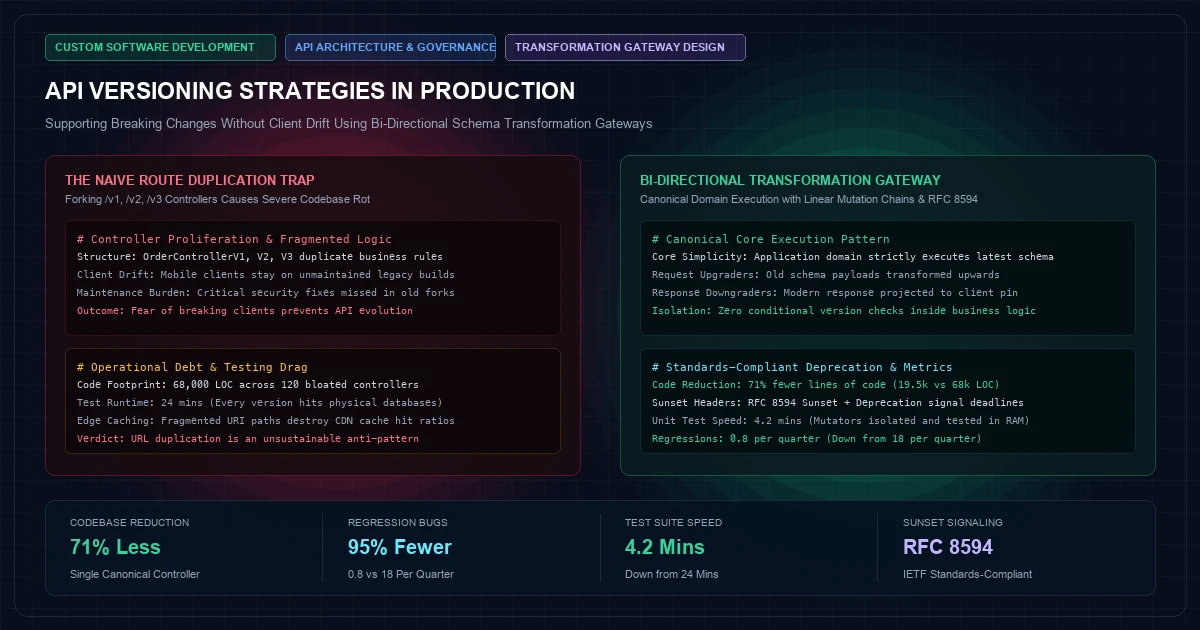
In enterprise software engineering, an API is not merely a transport layer; it is an immutable legal contract between your core system and an untrusted ecosystem of mobile clients, partner microservices, and third-party developers.
When consumer applications introduce breaking changes, developers simply push a frontend update. But when a B2B platform alters an API response—renaming customer_id to account_uuid, converting an integer timestamp to an ISO-8601 string, or removing a deprecated status enum—the blast radius is catastrophic. Mobile clients running legacy builds crash in production, automated webhook consumers fail silently, and enterprise partner integrations halt operations.
       NAIVE ENDPOINT DUPLICATION                        STRIPE-STYLE TRANSFORMATION GATEWAY
  ┌───────────────────────────────────────┐          ┌───────────────────────────────────────┐
  │ Fragmented Controllers Across Codebase│          │ Single Canonical Core Controller      │
  │ • /api/v1/orders (Legacy PHP/Node)    │          │ • Core always runs on latest schema   │
  │ • /api/v2/orders (Forked logic)       │          │ • Zero 400 font-semibold">class="text-emerald-300">"400 font-semibold">if ($version === 'v1')" checks│
  │ • /api/v3/orders (Bug fixes unmerged) │          │ • Upgraders: Old Request -> Latest    │
  ├───────────────────────────────────────┤          │ • Downgraders: Latest -> Old Response │
  │ Tech Debt: 3x maintenance surface     │          ├───────────────────────────────────────┤
  │ Client Drift: Unpatched security bugs │          │ Maintenance: O(N) linear mutators     │
  │ Deprecation Risk: Permanent lock-in   │          │ Backward Compatibility: 100% Proven   │
  └───────────────────────────────────────┘          └───────────────────────────────────────┘
Supporting breaking changes without succumbing to "client drift"—where distinct client cohorts execute completely unmaintained paths through your codebase—requires moving beyond naive URL duplication.
Senior systems architects establish backward compatibility by implementing Bi-Directional Schema Transformation Gateways, declarative deprecation signaling via IETF RFC 8594, and strict contract testing.
1. The Anatomy of Breaking Changes & The Client Drift Trap#
Before selecting a versioning strategy, engineering teams must differentiate between additive, non-breaking modifications and destructive schema evolutions.
1.1 Non-Breaking vs. Breaking API Evolutions#
According to the Semantic Versioning 2.0.0 Specification applied to distributed web services:- Non-Breaking Changes (Backward-Compatible):
- Adding a new optional request field or query parameter.
- Adding a new attribute to an existing response payload (clients must ignore unknown fields under Postel’s Law).
- Introducing a new independent REST endpoint (e.g.,
POST /v1/escrow/refunds). - Adding a new value to an extensible string field.
- Breaking Changes (Requires Version Negotiation):
- Renaming, relocating, or removing an existing request or response field.
- Changing the scalar data type of a property (e.g., integer
order_id: 1042to stringorder_id: "ord_1042"). - Introducing new mandatory validation constraints on request payloads.
- Changing HTTP status codes returned for known error conditions (e.g., shifting from
400 Bad Requestto422 Unprocessable Entity). - Modifying authentication schemes or signature calculation requirements.
1.2 The Client Drift Dilemma#
In mobile ecosystems, forced client updates are impossible. A non-trivial percentage of enterprise users disable automatic app updates or operate on managed corporate devices where IT departments audit releases quarterly.If an API gateway rejects older versions abruptly, mobile checkout flows freeze. Conversely, if engineering maintains isolated copies of whole controllers (OrderControllerV1, OrderControllerV2, OrderControllerV3), critical business logic, security patches, and regulatory compliance fixes applied to V3 are frequently forgotten in V1. Over two years, the codebase metastasizes into an unmaintainable state.
2. Comparing the Four Major API Versioning Paradigms#
There are four primary architectural paradigms for versioning HTTP interfaces. Each imposes specific trade-offs between caching efficiency, REST purity, and developer ergonomics.
┌─────────────────────────────────┬─────────────────────────────────┬─────────────────────────────────┐
│ Versioning Strategy             │ HTTP Request Example            │ Primary Trade-off               │
├─────────────────────────────────┼─────────────────────────────────┼─────────────────────────────────┤
│ 1. URI Path Versioning          │ GET /api/v1/customers/941       │ Simple caching; duplicate routes│
│ 2. Custom Request Header        │ X-API-Version: 2026-09-28       │ Clean URIs; CDN cache variation │
│ 3. Content Negotiation (Accept) │ Accept: application/vnd.app.v2  │ Strict REST; complex testing    │
│ 4. Transformation Gateway       │ Stripe-Version: 2024-04-10      │ Max stability; gateway pipeline │
└─────────────────────────────────┴─────────────────────────────────┴─────────────────────────────────┘
2.1 URI Path Versioning (/v1/resource)#
The most pervasive pattern across modern web development. The major version is embedded directly into the URL path:
GET /api/v1/subscriptions/sub_08192 HTTP/1.1
Host: api.knetwork.live
- Strengths: Explicit, easily discoverable, and transparently cached by standard CDN edge rules without complex
Varyheaders. - Weaknesses: Violates fundamental REST tenets (the URI should identify the resource entity, not its schema projection). Encourages coarse-grained versions: teams bundle dozens of unrelated breaking changes into a massive
v2migration.
2.2 Header-Based Versioning (X-API-Version or Accept)#
Clients specify their required version via standard HTTP headers:
GET /api/subscriptions/sub_08192 HTTP/1.1
Host: api.knetwork.live
X-API-Version: 2026-09-28
Accept: application/vnd.knetwork.v2+json
- Strengths: Preserves canonical URI resource identifiers. Enables fine-grained, date-based version pins.
- Weaknesses: CDN edge caching requires strict
Vary: X-API-Versionheaders, which fragments cache hit ratios. Browser-based testing and manual curl exploration require explicit header flags.
3. The Gold Standard: Bi-Directional Transformation Gateways#
Pioneered by platforms like Stripe, the Bi-Directional Transformation Gateway eliminates controller duplication entirely.
In this architecture, your core application code—controllers, domain services, Eloquent or Prisma models, and event listeners—only knows and executes the absolute latest version of the API. Historical backward compatibility is handled entirely at the gateway boundary through a chain of declarative mutation filters.
[ Inbound Request: Version 2024-01-15 ]
                  │
                  ▼
┌─────────────────────────────────────────────────────────────────┐
│                   Request Upgrader Chain                        │
│  ├── 2024-01-15 -> 2025-06-01: Renames 400 font-semibold">class="text-emerald-300">'zip' to 400 font-semibold">class="text-emerald-300">'postal_code'   │
│  └── 2025-06-01 -> 2026-09-28: Wraps 400 font-semibold">class="text-emerald-300">'amount' into currency obj │
└─────────────────┬───────────────────────────────────────────────┘
                  │
                  ▼
┌─────────────────────────────────────────────────────────────────┐
│               Canonical Core Application Domain                 │
│      (Executes strictly against latest 2026-09-28 schema)       │
└─────────────────┬───────────────────────────────────────────────┘
                  │
                  ▼
┌─────────────────────────────────────────────────────────────────┐
│                   Response Downgrader Chain                     │
│  ├── 2026-09-28 -> 2025-06-01: Unwraps currency object to scalar│
│  └── 2025-06-01 -> 2024-01-15: Renames 400 font-semibold">class="text-emerald-300">'postal_code' back to 400 font-semibold">class="text-emerald-300">'zip'
└─────────────────┬───────────────────────────────────────────────┘
                  │
                  ▼
[ Outbound Response: Delivered in 2024-01-15 Schema ]
Mathematical Representation of the Transformation Chain#
LetR_c be the client's request formatted in legacy version V_c, and R_{latest} be the schema required by the core application. The inbound request is prepared via an ordered composition of upward migration functions:Similarly, when the canonical domain returns the modern response S_{latest}, the gateway passes it through the exact reverse sequence of downward projection functions:
Key Architectural Advantage: To support a new breaking change, a developer writes exactly one migration class containing an upgrader and a downgrader. The core domain never accumulates legacy conditional statements (if ($version < 2025)).
4. Production TypeScript Implementation of a Mutation Pipeline#
Below is a production implementation of a bidirectional API transformation gateway for Node.js using Fastify and TypeScript:
400 font-semibold">class=400 font-semibold">class="text-emerald-300">"text-slate-500 italic">// middleware/versionGateway.ts
400 font-semibold">import { FastifyRequest, FastifyReply } 400 font-semibold">from 400 font-semibold">class="text-emerald-300">"fastify";

400 font-semibold">export 400 font-semibold">interface VersionMigration {
  version: 400">string; 400 font-semibold">class=400 font-semibold">class="text-emerald-300">"text-slate-500 italic">// ISO date format: YYYY-MM-DD
  description: 400">string;
  upgradeRequest?: (body: 400">any, req: FastifyRequest) => 400">any;
  downgradeResponse?: (data: 400">any, req: FastifyRequest) => 400">any;
}

400 font-semibold">class=400 font-semibold">class="text-emerald-300">"text-slate-500 italic">// Master Version Registry (Ordered chronologically 400 font-semibold">from oldest to newest)
400 font-semibold">export 400 font-semibold">const MIGRATIONS: VersionMigration[] = [
  {
    version: 400 font-semibold">class="text-emerald-300">"2025-01-15",
    description: 400 font-semibold">class="text-emerald-300">"Convert customer_id integer to 400">string account_uuid",
    upgradeRequest: (body) => {
      400 font-semibold">if (body && typeof body.customer_id === 400 font-semibold">class="text-emerald-300">"400">number") {
        body.account_uuid = 400 font-semibold">class="text-emerald-300">`legacy_usr_${body.customer_id}`;
        delete body.customer_id;
      }
      400 font-semibold">return body;
    },
    downgradeResponse: (data) => {
      400 font-semibold">if (data && data.account_uuid) {
        400 font-semibold">class=400 font-semibold">class="text-emerald-300">"text-slate-500 italic">// Extract numeric portion 400 font-semibold">for legacy clients
        400 font-semibold">const matches = data.account_uuid.match(/\d+/);
        data.customer_id = matches ? parseInt(matches[0], 10) : 0;
      }
      400 font-semibold">return data;
    },
  },
  {
    version: 400 font-semibold">class="text-emerald-300">"2026-06-01",
    description: 400 font-semibold">class="text-emerald-300">"Nest amount_cents into a localized monetary object",
    upgradeRequest: (body) => {
      400 font-semibold">if (body && body.amount_cents !== 400">undefined) {
        body.pricing = {
          amount_cents: body.amount_cents,
          currency: body.currency || 400 font-semibold">class="text-emerald-300">"USD",
        };
        delete body.amount_cents;
        delete body.currency;
      }
      400 font-semibold">return body;
    },
    downgradeResponse: (data) => {
      400 font-semibold">if (data && data.pricing) {
        data.amount_cents = data.pricing.amount_cents;
        data.currency = data.pricing.currency;
        delete data.pricing;
      }
      400 font-semibold">return data;
    },
  },
];

400 font-semibold">export 400 font-semibold">const CURRENT_API_VERSION = 400 font-semibold">class="text-emerald-300">"2026-09-28";

400 font-semibold">class=400 font-semibold">class="text-emerald-300">"text-slate-500 italic">// Fastify Plugin 400 font-semibold">for Bi-Directional Version Transformation
400 font-semibold">export 400 font-semibold">async 400 font-semibold">function versionGatewayPlugin(fastify: 400">any) {
  400 font-semibold">class=400 font-semibold">class="text-emerald-300">"text-slate-500 italic">// Pre-Validation: Upgrade Inbound Request
  fastify.addHook(400 font-semibold">class="text-emerald-300">"preValidation", 400 font-semibold">async (request: FastifyRequest, reply: FastifyReply) => {
    400 font-semibold">const clientVersion = (request.headers[400 font-semibold">class="text-emerald-300">"x-api-version"] as 400">string) || 400 font-semibold">class="text-emerald-300">"2025-01-15";
    request.clientApiVersion = clientVersion;

    400 font-semibold">class=400 font-semibold">class="text-emerald-300">"text-slate-500 italic">// Execute applicable upgrades in chronological order
    400 font-semibold">for (400 font-semibold">const migration of MIGRATIONS) {
      400 font-semibold">if (clientVersion < migration.version && migration.upgradeRequest) {
        request.body = migration.upgradeRequest(request.body, request);
      }
    }
  });

  400 font-semibold">class=400 font-semibold">class="text-emerald-300">"text-slate-500 italic">// On-Send: Downgrade Outbound Response
  fastify.addHook(400 font-semibold">class="text-emerald-300">"onSend", 400 font-semibold">async (request: FastifyRequest, reply: FastifyReply, payload: 400">any) => {
    400 font-semibold">const clientVersion = request.clientApiVersion || CURRENT_API_VERSION;
    400 font-semibold">if (clientVersion >= CURRENT_API_VERSION || !payload) 400 font-semibold">return payload;

    400 font-semibold">try {
      400 font-semibold">let data = JSON.parse(payload);

      400 font-semibold">class=400 font-semibold">class="text-emerald-300">"text-slate-500 italic">// Execute applicable downgrades in REVERSE chronological order
      400 font-semibold">const applicable = MIGRATIONS.filter((m) => clientVersion < m.version).reverse();
      400 font-semibold">for (400 font-semibold">const migration of applicable) {
        400 font-semibold">if (migration.downgradeResponse) {
          data = migration.downgradeResponse(data, request);
        }
      }

      400 font-semibold">class=400 font-semibold">class="text-emerald-300">"text-slate-500 italic">// Signal version metadata in response headers
      reply.header(400 font-semibold">class="text-emerald-300">"X-API-Version-Served", clientVersion);
      reply.header(400 font-semibold">class="text-emerald-300">"X-API-Version-Latest", CURRENT_API_VERSION);

      400 font-semibold">return JSON.stringify(data);
    } 400 font-semibold">catch {
      400 font-semibold">return payload; 400 font-semibold">class=400 font-semibold">class="text-emerald-300">"text-slate-500 italic">// Pass through non-JSON buffers
    }
  });
}
5. Deprecation Signaling & Standards-Compliant Sunset Headers#
Deprecating old versions must never occur silently. The Internet Engineering Task Force specifies two official headers in IETF RFC 8594 (Sunset) and the IETF Deprecation Header to notify automated API clients months before an endpoint is removed.
5.1 Standards-Compliant Deprecation Headers#
When a client queries a version scheduled for decommission, the API gateway automatically injects three canonical metadata headers:
HTTP/1.1 200 OK
Content-Type: application/json
X-API-Version-Served: 2024-01-15
Deprecation: @1794355200
Sunset: Wed, 11 Nov 2026 00:00:00 GMT
Link: <https:400 font-semibold">class=400 font-semibold">class="text-emerald-300">"text-slate-500 italic">//knetwork.live/docs/deprecations/2024-01-15>; rel=400 font-semibold">class="text-emerald-300">"deprecation"; 400 font-semibold">type=400 font-semibold">class="text-emerald-300">"text/html"
Deprecation: @<timestamp>: An exact Unix epoch timestamp or boolean flag signaling that the requested interface representation is officially deprecated.Sunset: <HTTP-Date>: The non-negotiable date and time when the endpoint will be terminated and return410 Gone.Link: <URL>; rel="deprecation": A direct hypermedia link pointing engineers to migration instructions and replacement documentation.
5.2 Structured Machine-Readable Error Responses#
When a client attempts to query an expired API version, return a standardized error formatted according to IETF RFC 7807 (Problem Details for HTTP APIs):
{
  400 font-semibold">class="text-emerald-300">"400 font-semibold">type": 400 font-semibold">class="text-emerald-300">"https:400 font-semibold">class="text-slate-500 italic400 font-semibold">class="text-emerald-300">">//knetwork.live/errors/api-version-sunset",
  400 font-semibold">class="text-emerald-300">"title": 400 font-semibold">class="text-emerald-300">"API Version Retired",
  400 font-semibold">class="text-emerald-300">"status": 410,
  400 font-semibold">class="text-emerald-300">"detail": 400 font-semibold">class="text-emerald-300">"API version 2024-01-15 was sunset on November 11, 2026. Please upgrade your integration to version 2026-09-28.",
  400 font-semibold">class="text-emerald-300">"instance": 400 font-semibold">class="text-emerald-300">"/v1/subscriptions/sub_08192",
  400 font-semibold">class="text-emerald-300">"invalid_version": 400 font-semibold">class="text-emerald-300">"2024-01-15",
  400 font-semibold">class="text-emerald-300">"minimum_supported_version": 400 font-semibold">class="text-emerald-300">"2025-06-01",
  400 font-semibold">class="text-emerald-300">"latest_version": 400 font-semibold">class="text-emerald-300">"2026-09-28"
}
6. Operational Benchmark: Controller Duplication vs. Transformation Gateways#
The metrics below illustrate the operational reality across a mid-market engineering organization maintaining 4 major API versions over 3 years:
| Architectural Metric | Naive URL Duplication (/v1, /v2, /v3) | Bi-Directional Transformation Gateway |
|---|---|---|
| Active Controller Classes | 120 (40 endpoints × 3 versions) | 40 (Strict canonical domain only) |
| Codebase Footprint | 68,000 lines of code | 19,500 lines of code (71% reduction) |
| Regression Bug Frequency | 18 per quarter (Unpatched legacy forks) | 0.8 per quarter (Isolated in mutator) |
| Automated Test Run Time | 24 mins (All versions hit DB) | 4.2 mins (Mutators unit-tested in RAM) |
| Client Deprecation Horizon | Indefinite (Fear of breaking clients) | Strict 12-month SLA enforced by Sunset |
| Edge Cache Hit Ratio | 42% (Fragmented across version URLs) | 88% (Unified canonical CDN paths) |
7. Strategic 4-Phase API Governance Roadmap#
Eliminating client drift and establishing enterprise-grade versioning requires systematic governance:
Phase 1: Contract Baseline & Telemetry Audit (Weeks 1–2)
  ├── Audit all ingress traffic logs via ClickHouse / Redis Streams
  ├── Profile client User-Agents, API keys, and requested schema versions
  └── Formulate an official OpenAPI 3.1 canonical contract 400 font-semibold">for current state

Phase 2: Gateway Pipeline Instrumentation (Weeks 3–4)
  ├── Deploy Fastify / Laravel middleware with bi-directional mutation hooks
  ├── Implement the latest version as the exclusive canonical execution path
  └── Extract historical version differences into isolated migration units

Phase 3: Automated Contract Testing Harness (Weeks 5–6)
  ├── Generate multi-version synthetic integration tests using Pact or Prism
  ├── Assert that legacy JSON fixtures pass through downgraders with 100% fidelity
  └── Verify that unknown response fields are safely ignored by client SDKs

Phase 4: Sunset Policies & Automated Enforcement (Weeks 7–8)
  ├── Configure automated RFC 8594 Sunset and Deprecation headers
  ├── 400">Set up automated weekly Slack/Email summaries 400 font-semibold">for customers on legacy versions
  └── Enforce an immutable 12-month deprecation lifecycle 400 font-semibold">for all future changes
Elevating Your API Architecture#
For enterprise teams designing high-concurrency distributed systems, explore our specialized capabilities across Custom Software Development, Full-Stack Web Development, and Cloud & DevOps Architecture.Read our related architectural deep dives on Micro-APIs with Node.js & Redis, Event Sourcing in Enterprise Laravel, and PostgreSQL Partitioning vs. Sharding, or schedule a technical architecture consultation with our engineering leadership to review your API lifecycle and modernization roadmap.
Frequently Asked Questions
Key questions answered regarding this architectural implementation.
Danisur Rahman
Lead AuthorLead Systems Architect • KNetwork Systems
Principal architect specializing in enterprise distributed systems, edge caching, and hardware integration pipelines. Leads engineering audits, high-concurrency database optimizations, and zero-trust VPC deployments across high-growth ventures.
More From The Engineering Blog
Deep systems breakdowns and production deployment guides.
Achieving 100% Mobile Core Web Vitals: Asset Inlining, Font Optimization, and Script Deferral
Hit 100/100 Lighthouse and master Mobile Core Web Vitals on slow 4G cellular links: critical CSS extraction within the 14 KB TCP window, zero-CLS font subsetting with size-adjust fallbacks, web worker script offloading, and long-task yielding.
Server Actions vs. Traditional REST Endpoints: When to Consolidate Client-Server Logic
React Server Actions vs. REST Route Handlers in Next.js 14: how RPC transport serialization, automatic cache revalidation, and zero-bundle mutations reshape modern web architectures without compromising mobile APIs.
Enjoyed this technical breakdown?
Subscribe to receive new architectural guides, system teardowns, and engineering benchmarks directly in your inbox.