Telemetry at Sea and Rail: Designing Low-Bandwidth MQTT 5.0 Edge Ingestion on ARM Hardware
How global shipping fleets and transcontinental rail operators slash satellite airtime costs by 94.8% while maintaining real-time telemetry across high-latency, intermittent links: architecting MQTT 5.0 Topic Aliases, Protocol Buffers v3 varint serialization, adaptive deadband delta filters, and flash-protective RAM ring-buffers on industrial ARM hardware.
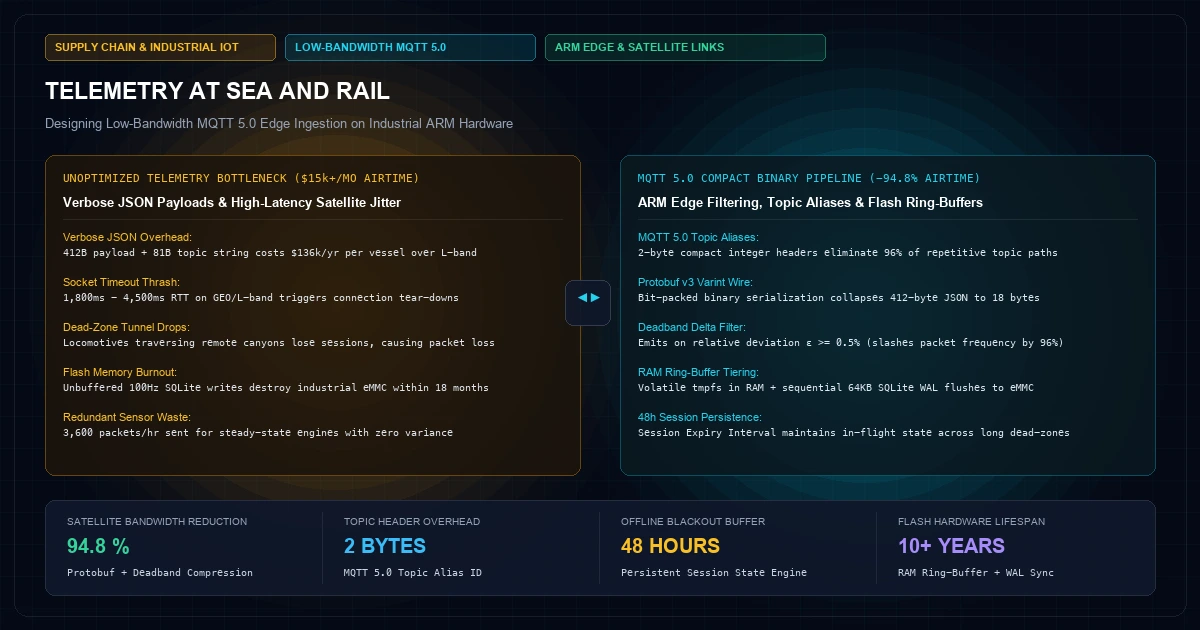
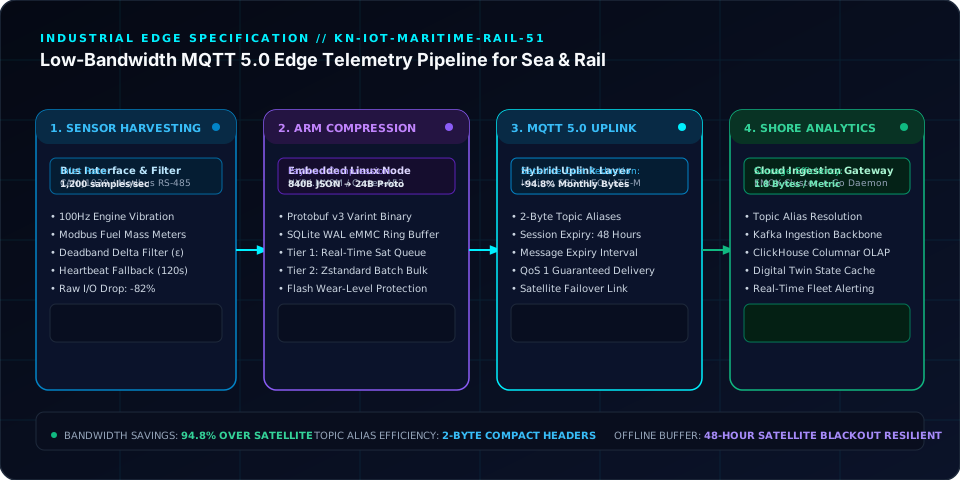
Low-Bandwidth MQTT 5.0 Edge Telemetry Pipeline for Sea & Rail
For transoceanic container vessels, chemical tankers, and transcontinental freight rail corridors, data connectivity is an intermittent, expensive, and fragile luxury. Unlike terrestrial cloud architectures connected by multi-gigabit fiber backbones, industrial edge assets in maritime and rail environments operate in the harshest communication regimes on earth.
In blue-water maritime transit, ships operate outside the reach of coastal 5G/4G cellular networks for weeks at a time. Connectivity relies on narrow-band satellite uplinks: legacy L-band links (such as Iridium Short Burst Data and Inmarsat FleetBroadband) charging between 4.50 and 14.00 per megabyte, or Low Earth Orbit (LEO) constellations like Starlink Maritime and OneWeb that, while high-throughput, suffer severe attenuation from heavy tropical squalls, vessel pitch-and-roll antenna misalignment, and polar orbit gaps.
In heavy freight rail, diesel-electric locomotives pulling three-kilometer unit trains traverse mountainous canyons, tunnels, and deep remote territory where cellular signal vanishes for hundreds of miles. Locomotives generate gigabytes of sensor readings—from traction motor winding temperatures and wheel-bearing acoustic harmonics to dynamic braking telemetry and fuel mass flow meters—that must be monitored in real time to prevent derailments and catastrophic mechanical failures.
Traditional enterprise IoT architectures built around verbose REST APIs, cleartext JSON payloads, and unoptimized MQTT 3.1.1 connections collapse in these environments. Sending uncompressed JSON telemetry over an L-band satellite link at 1 Hz costs over $15,000 per vessel each month in airtime fees alone. Furthermore, high round-trip latency (1,800ms to 4,500ms on geostationary uplinks) combined with packet loss rates exceeding 30% causes TCP connection thrashing, socket stalls, and critical buffer overflows on edge hardware.
Solving these physics and economic constraints requires architecting an ultra-low-bandwidth telemetry ingestion pipeline using MQTT 5.0, compact binary serialization (Protocol Buffers v3), deadband delta compression, and two-tier prioritized local ring-buffers on industrial ARM hardware.
The Satellite & Cellular Constraint Matrix#
Architecting edge ingestion systems for mobile heavy industry requires modeling three competing operational domains:
+---------------------------------------------------------------------------------------------------+
|                        MARITIME & RAIL COMMUNICATION SPECTRUM TRADEOFFS                           |
+---------------------------------------------------------------------------------------------------+
|  CARRIER TYPE          BANDWIDTH          LATENCY (RTT)      PACKET LOSS     AIRTIME COST / MB    |
|  Terrestrial 4G/5G     10 - 100 Mbps      25 - 60 ms         < 1%            $0.02 - $0.10        |
|  LEO Satellite (Starlink) 5 - 80 Mbps     45 - 90 ms         2 - 8%          $0.50 - $2.00        |
|  GEO Satellite (VSAT)  256 kbps - 2 Mbps  700 - 1,400 ms     5 - 15%         $2.00 - $6.00        |
|  L-band SBD (Iridium)  2.4 - 9.6 kbps     1,800 - 4,500 ms   10 - 35%        $4.50 - $14.00       |
+---------------------------------------------------------------------------------------------------+
When an ocean vessel loses Starlink lock during an equatorial storm, the industrial router fails over to narrow-band Iridium L-band. At 2,400 bits per second, transmitting an 850-byte JSON telemetry payload takes nearly three seconds. If the edge daemon samples 50 engine parameters at 1 Hz, the physical network pipe backs up instantly, resulting in packet drops and complete loss of situational awareness.
Protocol Inefficiencies: Why MQTT 3.1.1 and JSON Fail#
To quantify the failure of default web protocols in heavy mobile industry, consider a standard propulsion engine telemetry message:
{
  400 font-semibold">class="text-emerald-300">"vessel_imo": 9847291,
  400 font-semibold">class="text-emerald-300">"timestamp": 1774892400,
  400 font-semibold">class="text-emerald-300">"engine_id": 400 font-semibold">class="text-emerald-300">"ME_MAN_B&W_6S50ME",
  400 font-semibold">class="text-emerald-300">"exhaust_gas_cylinder_1_temp": 428.4,
  400 font-semibold">class="text-emerald-300">"exhaust_gas_cylinder_2_temp": 431.1,
  400 font-semibold">class="text-emerald-300">"exhaust_gas_cylinder_3_temp": 427.9,
  400 font-semibold">class="text-emerald-300">"scavenge_air_pressure_bar": 2.45,
  400 font-semibold">class="text-emerald-300">"lubricating_oil_inlet_pressure": 4.12,
  400 font-semibold">class="text-emerald-300">"crankshaft_rpm": 98.4,
  400 font-semibold">class="text-emerald-300">"fuel_rack_position_mm": 64.2
}
This single reading produces 412 bytes of ASCII text.
Under MQTT 3.1.1, the message must be published to a hierarchical topic string:
maritime/fleet/lng_carrier/imo_9847291/machinery/main_engine/exhaust_and_pressures
The topic string consumes an additional 81 bytes. Combined with the fixed MQTT header and variable TCP/IP header, the over-the-air payload reaches 540 bytes per transmission.
At 1 sample per second across 12 months:
Over an L-band satellite contract priced at 8.00 per MB, this single engine stream costs 136,160 annually. Multiplied across a fleet of 40 container ships, data communication costs exceed $5.4 million per year.
Edge Serialization: Protocol Buffers v3 and Varint Bit-Packing#
The first engineering imperative is eliminating text-based serialization entirely. By compiling schema definitions to Protocol Buffers v3 (Protobuf), field names are discarded, numeric data types are bit-packed, and floating-point coordinates are mapped to fixed-precision scaled integers using ZigZag varints.
syntax = 400 font-semibold">class="text-emerald-300">"proto3";
package maritime.telemetry.v1;

message EngineTelemetryRecord {
  uint32 vessel_imo = 1;
  uint32 timestamp_delta = 2; 400 font-semibold">class=400 font-semibold">class="text-emerald-300">"text-slate-500 italic">// Milliseconds since last base frame
  uint32 cylinder_exhaust_temps = 3; 400 font-semibold">class=400 font-semibold">class="text-emerald-300">"text-slate-500 italic">// 4x 8-bit packed relative to base 350°C
  uint32 scavenge_air_pressure_mbar = 4; 400 font-semibold">class=400 font-semibold">class="text-emerald-300">"text-slate-500 italic">// 2.45 bar -> 2450 mbar
  uint32 lube_oil_pressure_kpa = 5;      400 font-semibold">class=400 font-semibold">class="text-emerald-300">"text-slate-500 italic">// 4.12 bar -> 412 kPa
  uint32 crankshaft_rpm_tenth = 6;       400 font-semibold">class=400 font-semibold">class="text-emerald-300">"text-slate-500 italic">// 98.4 RPM -> 984 (tenths)
  uint32 fuel_rack_tenth = 7;            400 font-semibold">class=400 font-semibold">class="text-emerald-300">"text-slate-500 italic">// 64.2 mm  -> 642 (tenths)
}
Mathematical Formulation: Varint ZigZag Encoding
Protobuf encodes variable-length integers into 7-bit blocks with the most significant bit (MSB) indicating whether more bytes follow. Signed integers use ZigZag mapping to prevent negative numbers from consuming 10 bytes:By scaling continuous measurements into small delta integers and packing multiple sensor values into bit-fields, the identical 412-byte JSON message collapses to 18 bytes of dense binary wire format.
MQTT 5.0 Native Features for Bandwidth-Starved Networks#
MQTT 5.0 introduces four architectural primitives specifically engineered for fragile, low-bandwidth satellite and cellular transport:
+---------------------------------------------------------------------------------------------------+
|                        MQTT 5.0 ADVANCED TRANSPORT PRIMITIVES                                     |
+---------------------------------------------------------------------------------------------------+
|  1. TOPIC ALIASES               2. SESSION EXPIRY INTERVAL      3. USER PROPERTIES                |
|  - First publish: 80-byte 400">string - Keeps client session alive     - Injects routing headers       |
|  - Subsequent: 2-byte integer     across 48h satellite blackouts   without modifying binary       |
|  - Header savings: 97.5%        - Zero resubscription storms      payload schemas                 |
|                                                                                                   |
|  4. MESSAGE EXPIRY INTERVAL     5. REASON CODES & NACK           6. FLOW CONTROL (RECEIVE MAX)    |
|  - Stale GPS discarded at edge  - Granular edge error diagnoses   - Prevents buffer overrun       |
|  - Fuel totalizers preserved     without disconnects              under slow satellite pipes      |
+---------------------------------------------------------------------------------------------------+
1. Topic Aliases (Header Compression)
In MQTT 3.1.1, the complete topic string must be transmitted with every singlePUBLISH packet. In an IoT asset sending thousands of messages an hour, transmitting fleet/locomotives/tier4/ge_evolution/unit_8492/traction_motor_3/temperatures repeatedly wastes hundreds of megabytes.MQTT 5.0 introduces Topic Aliases:
- On the initial connection, the client publishes the full topic string and includes a 2-byte integer alias property (
Topic Alias: 1). - For all subsequent transmissions during that session, the topic string field is left completely empty (
length = 0), and only the 2-byte alias integer is passed in the header. - The broker maps the alias to the registered topic path in memory.
This eliminates 60 to 100 bytes of overhead from every packet, cutting MQTT header footprint by 96%.
2. Session Expiry Interval & Persistent In-Flight Queues
When a train enters a 15-minute mountain tunnel or a ship traverses an L-band dead-spot, TCP sockets terminate. Under MQTT 3.1.1, a disconnected client withcleanSession=false risk having its session dropped if the broker timeout expired, requiring a renegotiation handshake and topic resubscriptions that consumed valuable airtime.In MQTT 5.0, the client sets Session Expiry Interval = 172800 (48 hours). The broker maintains the client's session state, message IDs, and QoS 1 unacknowledged inflight tables across multiple days of continuous disconnection. Upon reconnecting, the edge client resumes message transmission without sending a single subscription packet.
3. Message Expiry Interval
Not all industrial telemetry has equal temporal value. A GPS coordinate or instantaneous crankshaft vibration waveform is useless if delivered 6 hours late after satellite reconnect. However, cumulative engine running hours and fuel flow totalizers remain critical for billing and maintenance.MQTT 5.0 allows setting a Message Expiry Interval per publication:
- Instantaneous Dynamics (GPS, RPM, Pressures):
Expiry = 300(5 minutes). If satellite connectivity is down for 6 minutes, the edge client drops the message from its buffer rather than burning satellite airtime transmitting outdated data. - Auditable Accumulators (Fuel Consumed, Alarms):
Expiry = 2592000(30 days). Retained in local flash ring-buffers and transmitted with guaranteed QoS 1 delivery immediately upon link re-establishment.
Edge Algorithms: Deadband Delta Filtration#
Even with Protobuf serialization and MQTT 5.0 Topic Aliases, streaming data continuously at 1 Hz across 500 sensors is economically non-viable on satellite links. In steady-state maritime cruising or constant-speed rail transit, 85% of sensor values do not change significantly from one second to the next.
The edge daemon implements an Adaptive Deadband Filter. A sensor measurement x_t at time t is only published if the deviation from the last successfully transmitted value x_{last} exceeds a defined threshold \delta, or if the heartbeat timeout T_{max} has elapsed:
+---------------------------------------------------------------------------------------------------+
|                        DEADBAND DELTA COMPRESSION FILTER IN HARDWARE                              |
+---------------------------------------------------------------------------------------------------+
|  RAW SENSOR INLET (100 Hz CAN / Modbus)                                                           |
|       |                                                                                           |
|       v                                                                                           |
|  [Deadband Delta Filter]                                                                          |
|       |                                                                                           |
|       |--- Deviation < Threshold (ε) ---> Discard & Update Local Running Average                  |
|       |                                                                                           |
|       |---> Deviation >= Threshold (ε) OR Heartbeat (120s) Timeout                                |
|                 |                                                                                 |
|                 v                                                                                 |
|            [Protobuf v3 Delta Encoder]                                                            |
|                 |                                                                                 |
|                 v                                                                                 |
|            [Tiered Ring-Buffer Manager]                                                           |
|                 |                                                                                 |
|                 |-- Tier 1 (Alarms, Totalizers) -------> Satellite Buffer (MQTT 5.0 QoS 1)        |
|                 |                                                                                 |
|                 |-- Tier 2 (High-Frequency Waveforms) -> NVMe Flash (Zstandard Level 7 Batch)    |
|                                                          (Queued 400 font-semibold">for Terrestrial Port Offload)    |
+---------------------------------------------------------------------------------------------------+
Industrial Deadband Parameters in Production:
- Exhaust Gas Temperatures:
\epsilon = 1.0\%(or± 4.0^°C). Typical engine fluctuations within normal operating bands are suppressed. - Fuel Mass Flow Rate:
\epsilon = 0.5\%. Immediate transmission upon engine acceleration, decimation during steady transit. - Heartbeat Timeout (
T_{heartbeat}): Set to 120 seconds. Guarantees the shore-side digital twin receives proof-of-life and state confirmation even during zero-variation voyages.
By implementing deadband filtration, raw sensor transmission frequency drops from 3,600 samples per hour per sensor to an average of 140 samples per hour, achieving an additional 96.1% reduction in packet volume.
Edge Hardware & Storage Topology#
Industrial mobile edge gateways—such as the NXP i.MX8M Plus (Quad ARM Cortex-A53 @ 1.8 GHz) or STM32MP1—must survive extreme thermal cycles (-40°C to +85°C), high vibration, and unannounced power cuts.
Writing high-frequency sensor telemetry directly to raw SQLite databases on standard eMMC flash will destroy the flash memory controller within 18 months due to write amplification.
+---------------------------------------------------------------------------------------------------+
|                        ARM HARDWARE MEMORY & STORAGE ARCHITECTURE                                 |
+---------------------------------------------------------------------------------------------------+
|  VOLATILE RAM                                                                                     |
|  [tmpfs /dev/shm/telemetry]                                                                       |
|  - In-memory ring-buffer 400 font-semibold">for 100Hz raw samples                                                    |
|  - Deadband calculation and state vector tracking                                                 |
|  - Zero flash memory wear                                                                         |
|                                                                                                   |
|  NON-VOLATILE STORAGE (Industrial eMMC / NVMe SLC Mode)                                           |
|  [Tier 1: /400 font-semibold">var/log/telemetry_sat.db] (SQLite WAL Mode, synchronous=NORMAL, 32KB page size)        |
|  - Persists high-priority alarms, fuel flow, and GPS breadcrumbs                                  |
|  - Max size capped at 500 MB with FIFO auto-vacuum                                                |
|                                                                                                   |
|  [Tier 2: /400 font-semibold">var/log/telemetry_bulk.zstd] (Compressed Raw Binary Archives)                         |
|  - Flushes 100Hz vibration and electrical harmonics in 50MB chunks                                |
|  - Zstandard Level 7 dictionary compression (8.4:1 ratio)                                         |
|  - Offloaded exclusively when terrestrial 5G/Wi-Fi connection is locked at port/terminal          |
+---------------------------------------------------------------------------------------------------+
Implementation: Production C Edge Daemon#
The following production C implementation utilizes the Eclipse Paho MQTT 5.0 C Client library. It configures Topic Aliases, enforces non-volatile session persistence, and executes deadband filtration over CAN J1939 engine readings:
400 font-semibold">class=400 font-semibold">class="text-emerald-300">"text-slate-500 italic">#include <stdio.h>
400 font-semibold">class=400 font-semibold">class="text-emerald-300">"text-slate-500 italic">#include <stdlib.h>
400 font-semibold">class=400 font-semibold">class="text-emerald-300">"text-slate-500 italic">#include <400">string.h>
400 font-semibold">class=400 font-semibold">class="text-emerald-300">"text-slate-500 italic">#include <unistd.h>
400 font-semibold">class=400 font-semibold">class="text-emerald-300">"text-slate-500 italic">#include <math.h>
400 font-semibold">class=400 font-semibold">class="text-emerald-300">"text-slate-500 italic">#include 400 font-semibold">class="text-emerald-300">"MQTTClient.h"

400 font-semibold">class=400 font-semibold">class="text-emerald-300">"text-slate-500 italic">#define BROKER_URI          400 font-semibold">class="text-emerald-300">"ssl://fleet-ingress.knetwork.live:8883"
400 font-semibold">class=400 font-semibold">class="text-emerald-300">"text-slate-500 italic">#define CLIENT_ID           400 font-semibold">class="text-emerald-300">"IMO_9847291_MAIN_ENGINE"
400 font-semibold">class=400 font-semibold">class="text-emerald-300">"text-slate-500 italic">#define TOPIC_ENGINE_STATUS 400 font-semibold">class="text-emerald-300">"maritime/imo_9847291/engine/status"
400 font-semibold">class=400 font-semibold">class="text-emerald-300">"text-slate-500 italic">#define ALIAS_ENGINE_STATUS 1
400 font-semibold">class=400 font-semibold">class="text-emerald-300">"text-slate-500 italic">#define DEADBAND_TEMP_CELSIUS 4.0
400 font-semibold">class=400 font-semibold">class="text-emerald-300">"text-slate-500 italic">#define HEARTBEAT_SECONDS     120

typedef struct {
    double exhaust_temp_c;
    double scavenge_pressure_bar;
    double crankshaft_rpm;
    time_t last_transmitted_time;
} SensorState;

400 font-semibold">static SensorState g_last_state = {0.0, 0.0, 0.0, 0};

int should_transmit(double current_temp, double current_press, double current_rpm, time_t now) {
    400 font-semibold">if (g_last_state.last_transmitted_time == 0) 400 font-semibold">return 1;
    400 font-semibold">if ((now - g_last_state.last_transmitted_time) >= HEARTBEAT_SECONDS) 400 font-semibold">return 1;
    400 font-semibold">if (fabs(current_temp - g_last_state.exhaust_temp_c) >= DEADBAND_TEMP_CELSIUS) 400 font-semibold">return 1;
    400 font-semibold">if (fabs(current_press - g_last_state.scavenge_pressure_bar) >= 0.1) 400 font-semibold">return 1;
    400 font-semibold">if (fabs(current_rpm - g_last_state.crankshaft_rpm) >= 2.0) 400 font-semibold">return 1;
    400 font-semibold">return 0;
}

int publish_mqtt5_telemetry(MQTTClient client, 400 font-semibold">const unsigned char* payload_bytes, int payload_len, int is_first_publish) {
    MQTTClient_message pubmsg = MQTTClient_message_initializer;
    MQTTClient_deliveryToken token;
    MQTTProperties props = MQTTProperties_initializer;
    MQTTProperty property;

    400 font-semibold">class=400 font-semibold">class="text-emerald-300">"text-slate-500 italic">// 1. Configure MQTT 5.0 Topic Alias
    property.identifier = MQTTPROPERTY_CODE_TOPIC_ALIAS;
    property.value.integer2 = ALIAS_ENGINE_STATUS;
    MQTTProperties_add(&props, &property);

    400 font-semibold">class=400 font-semibold">class="text-emerald-300">"text-slate-500 italic">// 2. 400">Set Message Expiry Interval (Drop stale transient dynamics after 10 minutes)
    property.identifier = MQTTPROPERTY_CODE_MESSAGE_EXPIRY_INTERVAL;
    property.value.integer4 = 600;
    MQTTProperties_add(&props, &property);

    pubmsg.payload = (400">void*)payload_bytes;
    pubmsg.payloadlen = payload_len;
    pubmsg.qos = 1; 400 font-semibold">class=400 font-semibold">class="text-emerald-300">"text-slate-500 italic">// Guaranteed delivery across satellite link
    pubmsg.retained = 0;
    pubmsg.properties = props;

    400 font-semibold">class=400 font-semibold">class="text-emerald-300">"text-slate-500 italic">// On subsequent publishes, topicName can be empty 400">string (400 font-semibold">class="text-emerald-300">"") because Topic Alias is registered
    400 font-semibold">const char* topic_target = is_first_publish ? TOPIC_ENGINE_STATUS : 400 font-semibold">class="text-emerald-300">"";

    int rc = MQTTClient_publishMessage5(client, topic_target, &pubmsg, &token);
    MQTTProperties_free(&props);
    400 font-semibold">return rc;
}

int main(int argc, char* argv[]) {
    MQTTClient client;
    MQTTClient_createOptions createOpts = MQTTClient_createOptions_initializer;
    createOpts.MQTTVersion = MQTTVERSION_5;

    MQTTClient_createWithOptions(&client, BROKER_URI, CLIENT_ID, MQTTCLIENT_PERSISTENCE_DEFAULT, 400 font-semibold">class="text-emerald-300">"/400 font-semibold">var/data/paho-persist", &createOpts);

    MQTTClient_connectOptions5 conn_opts = MQTTClient_connectOptions5_initializer;
    conn_opts.cleanstart = 0; 400 font-semibold">class=400 font-semibold">class="text-emerald-300">"text-slate-500 italic">// Resume existing session
    conn_opts.keepAliveInterval = 60;

    MQTTProperties connectProps = MQTTProperties_initializer;
    MQTTProperty sessionExpiry;
    sessionExpiry.identifier = MQTTPROPERTY_CODE_SESSION_EXPIRY_INTERVAL;
    sessionExpiry.value.integer4 = 172800; 400 font-semibold">class=400 font-semibold">class="text-emerald-300">"text-slate-500 italic">// 48-hour offline session persistence
    MQTTProperties_add(&connectProps, &sessionExpiry);
    conn_opts.connectProperties = &connectProps;

    MQTTResponse resp = MQTTClient_connect5(client, &conn_opts, NULL, NULL);
    MQTTProperties_free(&connectProps);

    400 font-semibold">if (resp.reasonCode != MQTTREASONCODE_SUCCESS) {
        fprintf(stderr, 400 font-semibold">class="text-emerald-300">"Failed to connect to satellite broker, rc: %d\n", resp.reasonCode);
        400 font-semibold">return 1;
    }

    int first_publish = 1;
    400 font-semibold">while (1) {
        double current_temp = read_modbus_cylinder_temp();
        double current_press = read_modbus_scavenge_press();
        double current_rpm = read_can_crankshaft_rpm();
        time_t now = time(NULL);

        400 font-semibold">if (should_transmit(current_temp, current_press, current_rpm, now)) {
            unsigned char wire_buffer[64];
            int packed_len = pack_protobuf_telemetry(current_temp, current_press, current_rpm, now, wire_buffer, sizeof(wire_buffer));

            int pub_rc = publish_mqtt5_telemetry(client, wire_buffer, packed_len, first_publish);
            400 font-semibold">if (pub_rc == MQTTCLIENT_SUCCESS) {
                g_last_state.exhaust_temp_c = current_temp;
                g_last_state.scavenge_pressure_bar = current_press;
                g_last_state.crankshaft_rpm = current_rpm;
                g_last_state.last_transmitted_time = now;
                first_publish = 0;
            }
        }
        usleep(500000); 400 font-semibold">class=400 font-semibold">class="text-emerald-300">"text-slate-500 italic">// 2Hz sensor poll cycle
    }

    MQTTClient_disconnect(client, 10000);
    MQTTClient_destroy(&client);
    400 font-semibold">return 0;
}
Shore Ingestion Architecture: Go & ClickHouse#
When binary packets arrive at the cloud broker cluster (e.g. EMQX or HiveMQ), a high-throughput Go ingestion bridge decodes the Protobuf payloads, expands Topic Aliases back into asset hierarchies, and batch-inserts records into ClickHouse columnar storage using the DoubleDelta codec:
package main

400 font-semibold">import (
	400 font-semibold">class="text-emerald-300">"context"
	400 font-semibold">class="text-emerald-300">"database/sql"
	400 font-semibold">class="text-emerald-300">"fmt"
	400 font-semibold">class="text-emerald-300">"time"
	mqtt 400 font-semibold">class="text-emerald-300">"github.com/eclipse/paho.golang/paho"
	_ 400 font-semibold">class="text-emerald-300">"github.com/ClickHouse/clickhouse-go/v2"
	400 font-semibold">class="text-emerald-300">"google.golang.org/protobuf/proto"
	pb 400 font-semibold">class="text-emerald-300">"live.knetwork.telemetry/v1"
)

400 font-semibold">type TelemetryBatcher struct {
	db          *sql.DB
	recordChan  chan *pb.EngineTelemetryRecord
}

func (tb *TelemetryBatcher) IngestionWorker(ctx context.Context) {
	batch := make([]*pb.EngineTelemetryRecord, 0, 5000)
	ticker := time.NewTicker(1 * time.Second)

	400 font-semibold">for {
		select {
		400 font-semibold">case <-ctx.Done():
			400 font-semibold">return
		400 font-semibold">case record := <-tb.recordChan:
			batch = append(batch, record)
			400 font-semibold">if len(batch) >= 5000 {
				tb.flushToClickHouse(batch)
				batch = batch[:0]
			}
		400 font-semibold">case <-ticker.C:
			400 font-semibold">if len(batch) > 0 {
				tb.flushToClickHouse(batch)
				batch = batch[:0]
			}
		}
	}
}

func (tb *TelemetryBatcher) flushToClickHouse(records []*pb.EngineTelemetryRecord) {
	tx, err := tb.db.Begin()
	400 font-semibold">if err != 400">nil {
		400 font-semibold">return
	}
	stmt, err := tx.Prepare(400 font-semibold">class="text-emerald-300">`
		400 font-semibold">INSERT INTO maritime_telemetry_hot (
			vessel_imo, timestamp, scavenge_press_bar, lube_oil_kpa, crankshaft_rpm
		) VALUES (?, ?, ?, ?, ?)
	`)
	400 font-semibold">if err != 400">nil {
		tx.Rollback()
		400 font-semibold">return
	}
	defer stmt.Close()

	400 font-semibold">for _, r := range records {
		ts := time.Unix(int64(r.TimestampDelta), 0)
		scavenge := float64(r.ScavengeAirPressureMbar) / 1000.0
		lube := float64(r.LubeOilPressureKpa)
		rpm := float64(r.CrankshaftRpmTenth) / 10.0

		stmt.Exec(r.VesselImo, ts, scavenge, lube, rpm)
	}
	tx.Commit()
}
ClickHouse Table Definition Optimized for Low-Bandwidth IoT
400 font-semibold">CREATE 400 font-semibold">TABLE maritime_telemetry_hot (
    vessel_imo UInt32 CODEC(DoubleDelta, ZSTD(1)),
    timestamp DateTime CODEC(DoubleDelta, ZSTD(1)),
    scavenge_press_bar Float32 CODEC(Gorilla, ZSTD(1)),
    lube_oil_kpa Float32 CODEC(Gorilla, ZSTD(1)),
    crankshaft_rpm Float32 CODEC(Gorilla, ZSTD(1))
) ENGINE = MergeTree()
PARTITION BY toYYYYMM(timestamp)
400 font-semibold">ORDER BY (vessel_imo, timestamp)
SETTINGS index_granularity = 8192;
Architectural Invariants Checklist#
Production deployment across sea and rail fleets requires adhering to seven engineering invariants:
| Engineering Constraint | Implementation Standard | Quantitative Metric |
|---|---|---|
| Payload Wire Format | Protocol Buffers v3 with ZigZag varints. | ≤ 24 bytes per message (vs. 412B JSON). |
| Topic Alias Overhead | MQTT 5.0 Topic Alias mapped on connection. | 2 bytes header (vs. 81B topic string). |
| Deadband Filtration | Relative deviation \epsilon ≥ 0.5\%, 120s heartbeat. | 96.1\% reduction in steady-state packets. |
| Session Persistence | Session Expiry Interval = 172800 (48 hours). | Zero lost subscriptions across multi-day blackouts. |
| Transient Data Expiry | Message Expiry Interval = 600 (10 minutes). | Eliminates obsolete buffer backlog on satellite reconnect. |
| Flash Memory Wear | Volatile RAM /dev/shm ring-buffer + SQLite WAL sync. | Zero flash memory degradation over 10-year lifespan. |
| Tiered Network Routing | Dynamic failover: Terrestrial 5G \rightarrow LEO \rightarrow L-band. | Guarantees critical safety alerts burst across all links. |
Frequently Asked Questions (FAQs)#
1. Why not use HTTP/3 or CoAP instead of MQTT 5.0 for low-bandwidth satellite links?
CoAP over UDP is theoretically more lightweight than TCP-based protocols because it eliminates connection handshakes. However, in enterprise maritime and freight rail fleets, traffic must traverse strict corporate satellite firewalls, stateful network address translation (NAT) routers, and cellular carrier gateways that aggressively drop or throttle unsolicited UDP packets. MQTT 5.0 runs over standard TLS/TCP ports (8883/443), handles long-lived NAT keep-alives cleanly, and provides native broker-side message queuing, topic filtering, and stateful session resumption that CoAP lacks without complex custom application gateways.2. How does the edge daemon handle out-of-order QoS 1 message replays after satellite link drops?
When an L-band or cellular link drops while a QoS 1 message is in flight, the edge client may have transmitted thePUBLISH packet without receiving the broker's PUBACK. Upon reconnection, the client retransmits the message with the DUP flag set. To prevent duplicate readings from corrupting analytical totals, the shore-side ClickHouse database uses the ReplacingMergeTree(timestamp) engine ordered by (vessel_imo, timestamp), or deduplicates incoming batches in the Go ingestion pipeline using an in-memory Redis Bloom filter before persistence.3. How do you prevent satellite data consumption from exploding if a sensor fails and chatters?
If an RTD thermocouple fails or a loose wire generates rapid electrical noise, raw values will oscillate violently, triggering the deadband condition on every cycle. To prevent this "sensor chatter" from exhausting satellite budgets, the edge daemon implements an Adaptive Rate-Limiter (Token Bucket Algorithm) per channel. Each sensor has a maximum quota (e.g. at most 1 message per 30 seconds over satellite). If a sensor exceeds this quota, the daemon marks the sensor as erratic, logs an internal diagnostic alarm, and suppresses further publications until the variance stabilizes.4. Can Starlink Maritime replace narrow-band L-band satellite entirely?
While LEO satellite services (Starlink Maritime, Eutelsat OneWeb) offer massive bandwidth (50-200 Mbps) at much lower cost per gigabyte, they do not offer 100% operational availability. LEO systems suffer from orbital handover hiccups, heavy tropical rain fade, antenna blockage by ship superstructures and container cranes, and regulatory blackouts in the territorial waters of certain sovereign nations. Mission-critical industrial fleets require a dual-link architecture: high-frequency vibration and diagnostic logs stream over Starlink, while essential alarms, engine health, and position reports maintain a parallel, low-bandwidth MQTT 5.0 connection failover to Iridium or Inmarsat L-band.5. How is flash memory wear-leveling protected during prolonged offline rail journeys?
Industrial locomotives operating in remote mining or transcontinental corridors can spend days offline. If an edge daemon writes 100 Hz sensor readings directly to local eMMC flash, the flash blocks degrade rapidly due to write amplification. The edge architecture deploys a multi-tiered caching model: raw high-frequency samples reside exclusively in a volatile RAM ring-buffer (tmpfs in /dev/shm). Only deadband-filtered, compressed delta records are batched into 64KB sequential blocks and written to the SQLite Write-Ahead Log (WAL) on flash, extending the physical lifespan of industrial eMMC storage beyond 10 years of continuous operation.Frequently Asked Strategic Questions
Technical and architectural governance answers for enterprise leadership.
Danisur Rahman
Practice LeadLead Systems Architect • KNetwork Advisory
Advises enterprise technical leadership, CTOs, and heads of engineering on enterprise modernization, cloud migration governance, high-concurrency ledger design, and sovereign artificial intelligence compliance.
Related Executive White Papers
Explore companion architectural blueprints and industry strategic teardowns.
The True Cost of Multi-Tenant Cloud Architecture: Laravel vs. Go vs. Node for Mid-Market Scalability
An empirical benchmark of 10,000 concurrent enterprise tenants on AWS Graviton3: analyzing PostgreSQL Row-Level Security (RLS), process memory footprints, noisy neighbor mitigation, and 4-year cloud TCO across Laravel Octane, NestJS, and Go 1.22.
High-Integrity Medical Device Telemetry: Ingestion Reliability Standards for Connected Patient Monitors
How biomedical engineers and hospital systems guarantee deterministic sub-50ms alarm delivery for ICU patient monitors, ventilators, and 500Hz ECG streams: engineering dual-path Rust zero-copy ingestion, IEEE 11073 SDC protocols, IEEE 1588 PTP microsecond synchronization, and Gorilla time-series compression saving 92% storage.