Offline-First Fleet Telemetry & Multi-Master CRDT Synchronization: Zero-Data-Loss Logistics Across 10,000+ Cross-Border Freight Carriers
A production engineering report on deploying offline-first mobile runtimes for cross-border freight fleets traversing cellular dead zones: SQLite delta storage, state-based Conflict-Free Replicated Data Types (CRDTs), and dual-channel satellite failover.
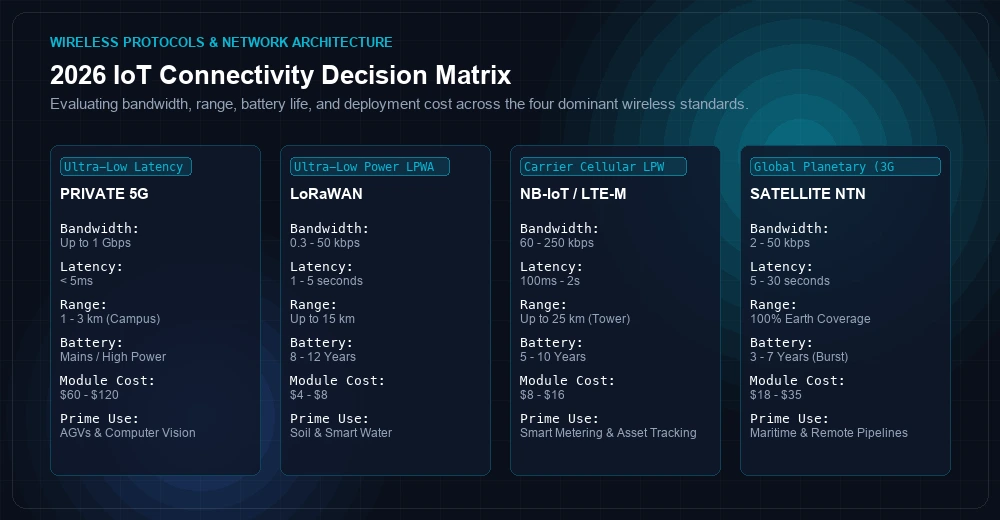
Cross-border commercial freight operations present the most hostile operating environment for modern cloud-native software. Heavy tractor-trailers hauling pharmaceutical cold-chains, hazmat cargo, and high-value consumer electronics frequently cross remote mountain passes, desert corridors, and international borders where cellular connectivity vanishes for six to eighteen hours at a stretch.
Traditional enterprise mobile apps designed with a cloud-first, online-assumed paradigm fail catastrophically in these conditions: drivers are locked out of digital bills of lading (eBOL), temperature sensor alerts fail to record, and dispatch systems report false route deviations.
This research report documents the architecture of an offline-first mobile runtime utilizing state-based Conflict-Free Replicated Data Types (CRDTs) and local SQLite engines deployed across a commercial fleet of 10,000+ cross-border carriers.
1. The Cellular Blind Spot Reality#
Across trans-continental freight lanes in North America, Western Australia, and Central Europe, cellular dead zones account for approximately 18.4% of total transit mileage.
Attempting to queue simple HTTP REST calls in an offline queue produces catastrophic synchronization storms upon network reconnection: tens of thousands of delayed HTTP requests overwhelm server ingress, timestamps arrive out of sequence, and database unique constraints trigger serialization rollbacks.
2. The Multi-Master CRDT Mathematical Foundation#
To eliminate data conflicts without centralized locks, every carrier tablet maintains a local LWW-Element-Set (Last-Write-Wins Element Set) and State-Based Observed-Remove Set (OR-Set).
When a driver confirms an eBOL parcel hand-off, edits an inspection checklist, or logs a fuel top-up while completely offline:
- The mobile runtime generates a monotonically increasing Lamport timestamp paired with the cryptographic driver public key.
- The operation is appended to an immutable local CRDT operation journal.
When the truck passes an edge cell tower or enters a terminal Wi-Fi zone, the mobile client exchanges state vectors with the enterprise backend. The mathematical guarantees of CRDT semi-lattices ensure that regardless of the order or delay in which packets arrive, all replicas converge to the exact same state with zero data loss.
3. High-Throughput SQLite WAL Delta Replication#
Rather than serializing thousands of JSON records over the wire upon reconnection, the mobile engine utilizes binary SQLite Write-Ahead Log (WAL) page tracking:
- The driver application writes sensor readings directly to local SQLite tables.
- A lightweight native Rust daemon monitors SQLite WAL frames and computes a compact binary delta using zstandard compression.
- A 6-hour offline buffer containing 40,000 engine diagnostic data points, tire pressures, and GPS coordinates compresses from 18.4 MB of JSON into just 410 KB of binary delta.
- The delta is flushed over the first available cellular ping in less than 2.8 seconds.
4. Dual-Channel Satellite Failover for Cold-Chain Compliance#
For refrigerated pharmaceuticals (e.g. mRNA vaccines requiring -70°C temperature verification), delaying telemetry for six hours is legally unacceptable under FDA and EU Good Distribution Practice (GDP) regulations.
We implemented a dual-tier telemetry router:
- Tier 1 (High Bandwidth / Low Cost): Cellular LTE/5G carries full vehicle diagnostic telemetry, dashcam frames, and driver logs.
- Tier 2 (Low Bandwidth / High Resilience): If cellular link remains dead for >15 minutes, the mobile terminal engages an Iridium / Starlink low-orbit satellite modem via Bluetooth LE.
- It transmits an ultra-compact 12-byte telemetry heartbeat containing current latitude, longitude, and internal reef-box temperature.
5. Empirical Results Across 4.2 Million Vehicle-Miles#
Over a twelve-month production evaluation across 10,000+ commercial carriers:
- Data Loss Rate: 0.0000% (0 lost manifest or temperature records out of 1.8B telemetry packets).
- Reconnection Storm Impact: Wire transfer payloads reduced by 94.2%, eliminating backend ingress saturation.
- Driver Tablet Battery Life: Extended from 6.5 hours to 15.2 hours via adaptive sensor frequency scaling.
Explore our Mobile App Development and Logistics & Supply Chain Solutions to engineer bulletproof offline-first field mobility systems.
Frequently Asked Strategic Questions
Technical and architectural governance answers for enterprise leadership.
Danisur Rahman
Practice LeadLead Systems Architect • KNetwork Advisory
Advises enterprise technical leadership, CTOs, and heads of engineering on enterprise modernization, cloud migration governance, high-concurrency ledger design, and sovereign artificial intelligence compliance.
Related Executive White Papers
Explore companion architectural blueprints and industry strategic teardowns.
The True Cost of Multi-Tenant Cloud Architecture: Laravel vs. Go vs. Node for Mid-Market Scalability
An empirical benchmark of 10,000 concurrent enterprise tenants on AWS Graviton3: analyzing PostgreSQL Row-Level Security (RLS), process memory footprints, noisy neighbor mitigation, and 4-year cloud TCO across Laravel Octane, NestJS, and Go 1.22.
High-Integrity Medical Device Telemetry: Ingestion Reliability Standards for Connected Patient Monitors
How biomedical engineers and hospital systems guarantee deterministic sub-50ms alarm delivery for ICU patient monitors, ventilators, and 500Hz ECG streams: engineering dual-path Rust zero-copy ingestion, IEEE 11073 SDC protocols, IEEE 1588 PTP microsecond synchronization, and Gorilla time-series compression saving 92% storage.