Mainframe Decoupling via Change Data Capture: Modernizing Core Banking with Apache Kafka
A technical case study on how a regional commercial institution modernized its core transaction processing, cutting daily batch reconciliation latency from 7 hours to 14 milliseconds using Debezium CDC and Kafka event streams.
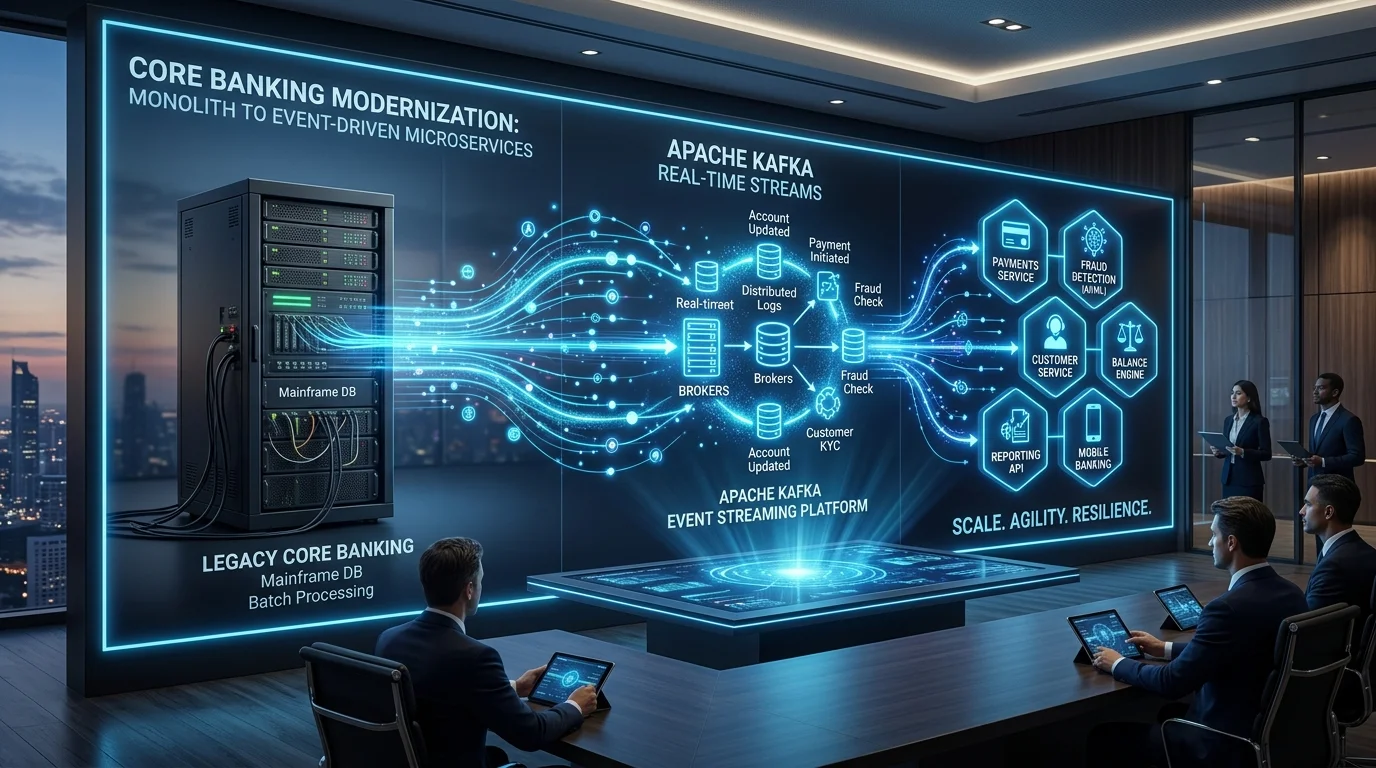
Regional financial institutions face intense competition from agile neobanks offering instant transaction alerts, sub-second split-payments, and real-time fraud scoring. Yet most traditional banks remain anchored to 30-year-old COBOL mainframe transaction engines that process customer balances in overnight batch windows.
A wholesale 'rip and replace' of a core banking engine carries catastrophic operational risk. The proven engineering strategy is asynchronous event interception.
1. The Challenge: Batch Latency and Customer Churn#
Our client, a commercial bank managing $4.2B in assets across 120 regional branches, suffered from severe architectural bottlenecks:
- Daily interest accrual and branch reconciliations ran as an 8-hour overnight batch job.
- Customer mobile banking portals frequently displayed stale account balances up to 14 hours old.
- Direct database query loads from the mobile API caused frequent lock escalation timeouts on the primary ledger.
2. The Solution: Debezium Change Data Capture & Kafka Mesh#
Rather than refactoring the core COBOL ledger, KNetwork implemented the Strangler Fig Pattern by deploying non-intrusive log-based Change Data Capture:
[ Core Transaction Database (DB2 / Oracle) ]
                    │
                    ▼ (Zero-Query Read 400 font-semibold">from Transaction WAL Log)
[ Debezium CDC Connector Engine ]
                    │
                    ▼ (Avro Serialized Event Stream)
[ Distributed Apache Kafka Cluster (3-Node Quorum) ]
   ├─ Topic: 400 font-semibold">class="text-emerald-300">`ledger.transactions.v1`
   ├─ Topic: 400 font-semibold">class="text-emerald-300">`accounts.balance-updates.v1`
   └─ Topic: 400 font-semibold">class="text-emerald-300">`security.fraud-signals.v1`
                    │
   ┌────────────────┼────────────────┐
   ▼                ▼                ▼
[ Mobile API Read-Model ] [ Fraud Analytics ML ] [ Audit Telemetry ]
   (Sub-15ms Redis Cache)   (Real-time Scorer)    (Immutable S3 WORM)
3. Business & Technical Impact#
┌──────────────────────────────────────┬────────────────┬────────────────┐
│ Metric                               │ Legacy Mainframe│ Kafka CDC Mesh │
├──────────────────────────────────────┼────────────────┼────────────────┤
│ Balance Reflection Latency           │ 4 to 8 Hours   │ 14 Milliseconds│
│ Mobile API Read Contention on DB2    │ 84% Peak Load  │ 0% (Redis Tier)│
│ Daily Settlement Processing Duration │ 7.2 Hours      │ Continuous Sync│
│ System Uptime During Peak Promotions │ 97.4%          │ 99.995%        │
└──────────────────────────────────────┴────────────────┴────────────────┘
By streaming immutable ledger events to a high-speed Redis read-model tier, mobile app response times dropped to sub-50ms globally while completely eliminating query timeouts on the central ledger.
Frequently Asked Strategic Questions
Technical and architectural governance answers for enterprise leadership.
KNetwork Platform Architecture Team
Practice LeadCore Systems Practice • KNetwork Advisory
Advises enterprise technical leadership, CTOs, and heads of engineering on enterprise modernization, cloud migration governance, high-concurrency ledger design, and sovereign artificial intelligence compliance.
Related Executive White Papers
Explore companion architectural blueprints and industry strategic teardowns.
The True Cost of Multi-Tenant Cloud Architecture: Laravel vs. Go vs. Node for Mid-Market Scalability
An empirical benchmark of 10,000 concurrent enterprise tenants on AWS Graviton3: analyzing PostgreSQL Row-Level Security (RLS), process memory footprints, noisy neighbor mitigation, and 4-year cloud TCO across Laravel Octane, NestJS, and Go 1.22.
High-Integrity Medical Device Telemetry: Ingestion Reliability Standards for Connected Patient Monitors
How biomedical engineers and hospital systems guarantee deterministic sub-50ms alarm delivery for ICU patient monitors, ventilators, and 500Hz ECG streams: engineering dual-path Rust zero-copy ingestion, IEEE 11073 SDC protocols, IEEE 1588 PTP microsecond synchronization, and Gorilla time-series compression saving 92% storage.