Eliminating Third-Party Logistics Portal Fees: Custom Fleet Management Software vs. Enterprise SaaS
How mid-market and enterprise carriers eliminate $600K+ in annual recurring SaaS subscription taxes by engineering custom, owned fleet telematics portals: analyzing 4-year TCO financial models, open hardware OBD-II/J1939 protocols, sub-second telemetry ingestion pipelines, and private data sovereignty.
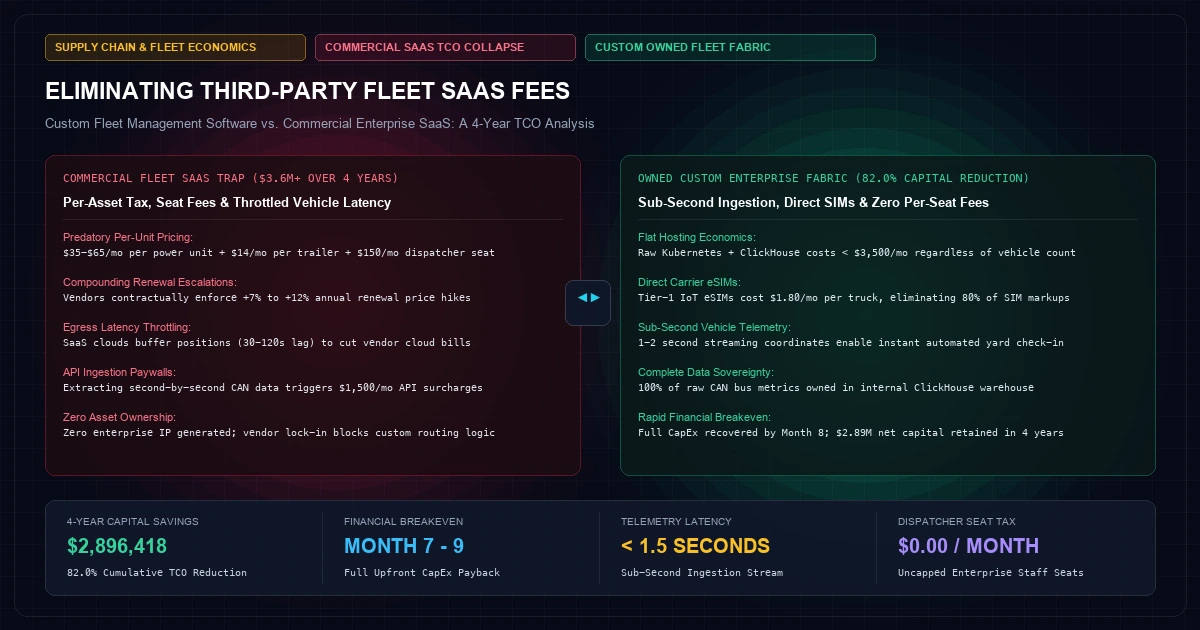
For mid-market and enterprise logistics operators running fleets of 250 to 5,000 power units, third-party telematics and Fleet Management Software (FMS) vendors represent one of the fastest-growing line-item expenses on the balance sheet.
What began a decade ago as simple hardware subscription models for GPS tracking and Electronic Logging Devices (ELD) has metastasized into predatory enterprise SaaS pricing tiers. Operators are subjected to aggressive per-asset vehicle charges (35 to 65 per truck per month), seat-based dispatcher licenses (120 to 250 per user per month), proprietary dashcam AI surcharge add-ons ($30 per cab), and arbitrary API rate-limit surcharges when integrating telematics streams into internal Transport Management Systems (TMS) and Enterprise Resource Planning (ERP) platforms.
For a carrier operating 600 tractors and 1,200 trailers with 40 operational dispatchers, annual commercial FMS licensing easily exceeds 620,000. Over a standard four-year contract horizon, the carrier transfers over 2.4 million in recurring capital to third-party software vendors—without gaining proprietary intellectual property, customized dispatch logic, or direct ownership of their vehicle telemetry data.
Even more damaging than software subscription costs are the operational constraints imposed by commercial SaaS vendors:
- Data Hostage & Latency Throttling: Commercial telematics clouds buffer and throttle live vehicle coordinates to reduce their own infrastructure egress costs, feeding dispatchers updates with 30-to-120 second latencies that prevent agile real-time dynamic rerouting.
- Artificial API Ingestion Limits: Extracting raw second-by-second fuel flow, CAN bus fault codes, and driver acceleration telemetry into internal analytical data lakes triggers punitive tiered API fees.
- Rigid Workflow Inflexibility: Generic multi-tenant SaaS tools cannot model the carrier's unique demurrage terms, specialized cross-docking wave schedules, or custom driver safety incentive algorithms.
This strategic whitepaper provides the executive Total Cost of Ownership (TCO) financial model, data sovereignty architecture, and systems blueprint for replacing commercial third-party fleet software with a custom, owned enterprise fleet management portal built on modern high-velocity open architectures.
The Anatomy of the Commercial Fleet SaaS Tax#
To calculate the true economic impact of third-party fleet software, executive leadership must examine the compounding multi-variable fee structure typical of enterprise SaaS vendors:
+---------------------------------------------------------------------------------------------------+
|                        COMMERCIAL FLEET SAAS 4-YEAR TCO EXPOSURE                                  |
+---------------------------------------------------------------------------------------------------+
|  LINE ITEM                        PRICING BENCHMARK             ANNUAL COST (600 TRUCKS / 40 STAFF)|
|  Vehicle Telematics Subscription  $42.00 / truck / month        $302,400                          |
|  Reefer / Trailer Tracking        $14.00 / trailer / month      $201,600 (1,200 units)            |
|  Dual-Facing AI Dashcam Add-on    $28.00 / cab / month          $201,600                          |
|  Dispatcher / Safety Seat Tax     $150.00 / seat / month        $72,000 (40 staff)                |
|  API Access / Webhook Integration $1,500.00 / month flat        $18,000                           |
|  Annual Contract Escalation       +7% contractual compound      Compound across Years 2-4         |
+---------------------------------------------------------------------------------------------------+
|  TOTAL 4-YEAR COMMERCIAL SAAS EXPENDITURE:                      $3,684,210                        |
+---------------------------------------------------------------------------------------------------+
Across four years, an operator pays nearly $3.7 million in operating expenses (OpEx) for generic, multi-tenant software. When contracts expire, vendors leverage high switching costs (the threat of physical hardware de-installation across 600 vehicles) to enforce 8% to 15% renewal price hikes.
TCO Comparison: Commercial SaaS vs. Owned Custom Platform#
Building a dedicated enterprise fleet portal requires upfront engineering capital (CapEx), but collapses long-term operational expenditures to raw cloud hosting and cellular data SIM costs.
+---------------------------------------------------------------------------------------------------+
|                        4-YEAR CUMULATIVE CAPITAL ALLOCATION MODEL                                 |
+---------------------------------------------------------------------------------------------------+
|  YEAR          COMMERCIAL FLEET SAAS            OWNED CUSTOM FLEET PLATFORM                       |
|  Year 1        $795,600 (Licensing + Hardware)  $420,000 (Initial Build) + $48,000 (Infra & SIM)  |
|  Year 2        $851,292 (+7% Escalation)        $52,000 (Infra & Maintenance)                    |
|  Year 3        $910,882 (+7% Escalation)        $56,000 (Infra & Feature Polish)                 |
|  Year 4        $974,644 (+7% Escalation)        $60,000 (Infra & Maintenance)                    |
+---------------------------------------------------------------------------------------------------+
|  TOTAL TCO     $3,532,418                       $636,000                                          |
|  NET SAVINGS   --                               $2,896,418 (82.0% CAPITAL REDUCTION!)             |
+---------------------------------------------------------------------------------------------------+
The Financial Breakeven Point
The breakeven point occurs between Month 7 and Month 9 of Year 1. Beyond month nine, the company saves between65,000 and 80,000 every single month in recurring licensing fees—capital that flows directly back into net operating margin or driver compensation pools.Data Sovereignty & Commercial Fleet Hardware Decoupling#
The primary fear cited by logistics executives considering custom software is hardware compatibility: "Do we have to re-wire all 600 trucks?"
The answer is no. Modern industrial telematics hardware operates on standardized international physical protocols. Leading rugged vehicle gateways (such as CalAmp, Geometris, Queclink, and Teltonika) are hardware-agnostic:
- They communicate directly over standard J1939 (Type 1 and Type 2 Diagnostic Connectors) and OBD-II CAN bus pins.
- They support configurable IP socket destinations over commercial cellular SIMs (AT&T, Verizon, T-Mobile, or global roaming eSIMs).
Instead of sending telemetry to the SaaS vendor's closed cloud, the telematics hardware is configured via SMS or Over-the-Air (OTA) commands to point its TCP/UDP telemetry stream directly to the carrier's own cloud ingress load balancer:
AT+COMMAND: SET_SERVER_IP=35.214.88.12, PORT=8082, PROTOCOL=TCP
By retaining physical control over the vehicle hardware and SIM cards, the carrier eliminates vendor lock-in permanently.
Systems Architecture: The Owned Enterprise Telematics Fabric#
The custom fleet software architecture decouples high-frequency telemetry ingestion from transactional order dispatching and executive analytics:
+---------------------------------------------------------------------------------------------------+
|                        CUSTOM ENTERPRISE FLEET PLATFORM BLUEPRINT                                 |
+---------------------------------------------------------------------------------------------------+
|  EDGE ASSETS (600 Trucks, 1,200 Trailers, 40 Dispatchers)                                         |
|  - Cellular IoT Gateways (J1939 CAN Engine Diagnostics, GPS, Fuel Mass Meters)                    |
|  - Driver Mobile Tablets (Android Enterprise Flutter Portal, Offline Pick/BOLs)                   |
|       |                                                                                           |
|       v (TLS 1.3 / TCP & WebSockets)                                                              |
|  INGRESS LAYER                                                                                    |
|  - Envoy / Nginx High-Throughput Stream Ingress Gateway                                           |
|  - Distributed Redis 7 In-Memory Hot State (Active Vehicle Coordinates & Geofence Cache)          |
|       |                                                                                           |
|       v                                                                                           |
|  EVENT STREAMING & BUSINESS LOGIC                                                                 |
|  - Apache Kafka / RabbitMQ Telematics Event Backbone                                              |
|  - Laravel 11 Core Service Engine (TMS Integration, Dispatch Workflows, Billing Reconciliation)   |
|       |                                                                                           |
|       +------------------------------------+-------------------------------------+                |
|       |                                    |                                     |                |
|       v                                    v                                     v                |
|  TRANSACTIONAL DB                   COLUMNAR ANALYTICS                     REAL-TIME UI           |
|  PostgreSQL 16 Enterprise           ClickHouse OLAP Engine                 Next.js 14 App Router  |
|  - ACID Driver Assignments          - 50,000+ Raw Sensor Metrics/sec       - Deck.gl WebGL 400">Map    |
|  - Customer Contracts & BOLs        - Sub-50ms Historical Trail Queries    - Sub-50ms SSR Dispatch|
|  - Maintenance Work Orders          - Automated Fuel Theft Analysis        - Zero Per-Seat Tax!   |
+---------------------------------------------------------------------------------------------------+
Core Operational Advantages of Custom Fleet Portals#
Beyond millions in direct licensing savings, an owned custom fleet platform delivers decisive competitive operational advantages that generic multi-tenant SaaS tools can never match:
1. Zero Latency Sub-Second Vehicle Tracking
Commercial SaaS vendors throttle vehicle location updates to 30 or 60 seconds to save cloud compute. A dedicated platform updates vehicle vectors at 1-to-2 second intervals, enabling sub-second geofence entry/exit detection and immediate dock bay assignment before the driver reaches the gatehouse.2. Proprietary Dynamic Dispatch Algorithms
Generic SaaS platforms route freight based on simple highway distance. An owned Laravel 11 engine incorporates the carrier's proprietary constraints:- Real-time driver remaining Hours of Service (HOS) pulled directly from the engine ECM.
- Specific tractor fuel burn curves under heavy payload tonnage.
- High-value customer preferred delivery windows.
- Demurrage cost penalties calculated dynamically per facility.
3. Instant Fuel Theft & Siphoning Detection
By running high-frequency fuel level readings through a real-time delta classifier in ClickHouse, the custom platform identifies rapid fuel tank drops (> 5 gallons in < 2 minutes) while the tractor velocity is zero, immediately sounding the cab horn and alerting security dispatch.Production Implementation: Laravel 11 Telematics Ingestion Handler#
The following high-performance Laravel service processes raw incoming CAN J1939 binary packets from the Kafka bridge, validates geofences using spatial Redis commands, and dispatches automated ETA recalculations:
<?php

namespace App\Services\Fleet;

use App\Models\Vehicle;
use App\Events\GeofenceBreachDetected;
use Illuminate\Support\Facades\Redis;
use Illuminate\Support\Facades\DB;

400 font-semibold">class TelematicsProcessingEngine
{
    400 font-semibold">public 400 font-semibold">function processIngestedPacket(array $packet): 400">void
    {
        $vehicleId = $packet[400 font-semibold">class="text-emerald-300">'vehicle_id'];
        $lat = (float) $packet[400 font-semibold">class="text-emerald-300">'lat'];
        $lng = (float) $packet[400 font-semibold">class="text-emerald-300">'lng'];
        $speed = (float) $packet[400 font-semibold">class="text-emerald-300">'speed_kph'];
        $fuelLevel = (float) $packet[400 font-semibold">class="text-emerald-300">'fuel_percent'];
        $timestamp = $packet[400 font-semibold">class="text-emerald-300">'timestamp'];

        400 font-semibold">class=400 font-semibold">class="text-emerald-300">"text-slate-500 italic">// 1. Update In-Memory Hot State in Redis GEO (< 1ms)
        Redis::geoadd(400 font-semibold">class="text-emerald-300">'fleet:live_positions', $lng, $lat, $vehicleId);

        Redis::hset(400 font-semibold">class="text-emerald-300">"fleet:vehicle:{$vehicleId}:vitals", [
            400 font-semibold">class="text-emerald-300">'speed' => $speed,
            400 font-semibold">class="text-emerald-300">'fuel' => $fuelLevel,
            400 font-semibold">class="text-emerald-300">'last_ping' => $timestamp,
            400 font-semibold">class="text-emerald-300">'ignition' => $packet[400 font-semibold">class="text-emerald-300">'ignition_status'] ? 400 font-semibold">class="text-emerald-300">'ON' : 400 font-semibold">class="text-emerald-300">'OFF'
        ]);

        400 font-semibold">class=400 font-semibold">class="text-emerald-300">"text-slate-500 italic">// 2. Evaluate Instantaneous Geofence Radius
        400 font-semibold">class=400 font-semibold">class="text-emerald-300">"text-slate-500 italic">// Checks customer terminal locations within 5km radius
        $nearbyTerminals = Redis::georadius(
            400 font-semibold">class="text-emerald-300">'terminals:geofences',
            $lng,
            $lat,
            5000,
            400 font-semibold">class="text-emerald-300">'m',
            [400 font-semibold">class="text-emerald-300">'WITHDIST', 400 font-semibold">class="text-emerald-300">'WITHCOORD']
        );

        400 font-semibold">if (!empty($nearbyTerminals)) {
            $400 font-semibold">this->evaluateTerminalArrival($vehicleId, $nearbyTerminals[0]);
        }

        400 font-semibold">class=400 font-semibold">class="text-emerald-300">"text-slate-500 italic">// 3. Batch Asynchronously to ClickHouse Columnar Warehouse
        400 font-semibold">class=400 font-semibold">class="text-emerald-300">"text-slate-500 italic">// (Handled via high-throughput background queue worker)
        dispatch(400 font-semibold">new PersistTelemetryToClickHouseJob($packet))->onQueue(400 font-semibold">class="text-emerald-300">'telemetry-ingest');
    }

    400 font-semibold">protected 400 font-semibold">function evaluateTerminalArrival(400">string $vehicleId, array $terminalData): 400">void
    {
        $terminalId = $terminalData[0];
        $distanceMeters = (float) $terminalData[1];

        400 font-semibold">if ($distanceMeters <= 250.0) { 400 font-semibold">class=400 font-semibold">class="text-emerald-300">"text-slate-500 italic">// Within gate perimeter
            $arrivalKey = 400 font-semibold">class="text-emerald-300">"arrival:{$vehicleId}:{$terminalId}";

            400 font-semibold">class=400 font-semibold">class="text-emerald-300">"text-slate-500 italic">// Atomic check to prevent duplicate gate arrival events
            400 font-semibold">if (Redis::set($arrivalKey, time(), 400 font-semibold">class="text-emerald-300">'NX', 400 font-semibold">class="text-emerald-300">'EX', 7200)) {
                event(400 font-semibold">new GeofenceBreachDetected($vehicleId, $terminalId, 400 font-semibold">class="text-emerald-300">'ARRIVED'));
            }
        }
    }
}
Executive Decision Framework: When to Build vs. Rent#
+---------------------------------------------------------------------------------------------------+
|                        FLEET MANAGEMENT BUILD VS. RENT DECISION MATRIX                            |
+---------------------------------------------------------------------------------------------------+
|  CRITERIA                    RENT COMMERCIAL SAAS             BUILD CUSTOM OWNED PLATFORM         |
|  Fleet Size                  < 50 Power Units                 > 150 Power Units                   |
|  4-Year Software Spend       < $180,000                       $1.5M - $5.0M+ (Massive ROI)        |
|  Workflow Requirements       Standard van freight             Custom cross-dock, reefer, HazMat   |
|  Data Ownership Policy       Third-party cloud storage        Air-gapped VPC / Full Sovereignty   |
|  API Integrations Needed     Basic CSV exports sufficient     Real-time ERP / SAP / TMS Sync      |
|  Competitive Differentiator  Standard industry operations     Proprietary dynamic dispatch logic  |
+---------------------------------------------------------------------------------------------------+
Frequently Asked Questions (FAQs)#
1. What happens to Electronic Logging Device (ELD) compliance when leaving commercial SaaS?
In the United States (under FMCSA mandates) and the European Union, ELD and digital tachograph compliance requires certified hardware and specific data recording rules. Building a custom fleet portal does not require re-certifying ELD hardware from scratch. Leading ELD engine providers (such as Coretex, Geotab, and Pacific Track) offer FMCSA-registered hardware SDKs and white-label compliance APIs. The custom fleet portal consumes certified driver duty-status logs directly via API, maintaining 100% DOT compliance while eliminating proprietary SaaS portal markups.2. How much does ongoing cloud infrastructure cost to run a custom fleet portal?
For a fleet of 1,000 active vehicles reporting every 5 seconds, the entire cloud infrastructure—comprising a high-availability Kubernetes cluster, ClickHouse columnar node, PostgreSQL primary/replica database, and Redis cache running on AWS or Google Cloud—costs between2,800 and 4,200 per month. Compared to commercial SaaS fees of 42,000 to 65,000 per month for the same fleet size, cloud infrastructure accounts for less than 8% of the commercial licensing cost.3. How do you handle cellular connectivity SIM cards across hundreds of trucks?
Carriers eliminate vendor cellular markups by contracting directly with Tier-1 IoT MVNOs (such as Twilio IoT, Hologram, or Aeris) or major telecom enterprise divisions (AT&T IoT, Vodafone Automotive). Multi-carrier eSIMs cost approximately1.20 to 2.50 per vehicle per month for 50 MB of data (more than sufficient for optimized Protobuf telemetry), granting the carrier direct network management and carrier-switching leverage.4. How long does it take to design, build, and deploy a custom enterprise fleet platform?
A production-grade custom fleet platform follows a phased 16-to-24 week delivery roadmap:- Weeks 1–6: Architecture design, IoT hardware protocol decoders, and Kafka-to-ClickHouse streaming ingestion fabric.
- Weeks 7–14: Real-time dispatcher map canvas, driver mobile app (Flutter), and automated geofence event engine.
- Weeks 15–20: ERP/TMS bi-directional integration, maintenance work order ticketing, and driver safety scoring.
- Weeks 21–24: Pilot fleet deployment across 50 vehicles, load-testing to 100k events/sec, and full fleet rollout.
5. Can a custom fleet portal integrate with third-party customer tracking portals (e.g. Project44, FourKites)?
Yes. In fact, custom fleet platforms integrate with visibility aggregators (such as Project44 and FourKites) far more cleanly than commercial SaaS tools. The custom backend exposes direct, secure REST and webhook endpoints that stream cryptographically signed location updates to customer tracking systems within milliseconds of physical arrival, improving customer carrier scorecards and eliminating the API surcharge fees imposed by SaaS vendors.Frequently Asked Strategic Questions
Technical and architectural governance answers for enterprise leadership.
Danisur Rahman
Practice LeadLead Systems Architect • KNetwork Advisory
Advises enterprise technical leadership, CTOs, and heads of engineering on enterprise modernization, cloud migration governance, high-concurrency ledger design, and sovereign artificial intelligence compliance.
Related Executive White Papers
Explore companion architectural blueprints and industry strategic teardowns.
The True Cost of Multi-Tenant Cloud Architecture: Laravel vs. Go vs. Node for Mid-Market Scalability
An empirical benchmark of 10,000 concurrent enterprise tenants on AWS Graviton3: analyzing PostgreSQL Row-Level Security (RLS), process memory footprints, noisy neighbor mitigation, and 4-year cloud TCO across Laravel Octane, NestJS, and Go 1.22.
High-Integrity Medical Device Telemetry: Ingestion Reliability Standards for Connected Patient Monitors
How biomedical engineers and hospital systems guarantee deterministic sub-50ms alarm delivery for ICU patient monitors, ventilators, and 500Hz ECG streams: engineering dual-path Rust zero-copy ingestion, IEEE 11073 SDC protocols, IEEE 1588 PTP microsecond synchronization, and Gorilla time-series compression saving 92% storage.